


Lean Thinking: The Complete Practitioner Guide to Eliminating Waste and Creating Value
Updated: Aug 13
By Allan Ung | Founder & Principal Consultant, Operational Excellence Consulting (OEC)
Updated on 11 April 2026

Allan Ung is the Founder and Principal Consultant of Operational Excellence Consulting, a Singapore-based firm established in 2009. With over 30 years of experience leading operational excellence and quality transformation across manufacturing, technology, and global operations—including senior roles at IBM, Microsoft, and Underwriters Laboratories—Allan brings deep shopfloor expertise to every learning room he enters. A Certified Management Consultant (CMC, Japan), Lean Six Sigma Black Belt, TPM Instructor, TWI Master Trainer, and former Singapore Quality Award National Assessor, he has facilitated Lean programmes and structured problem-solving for organisations including the Ministry of Social & Family Development, the Ministry of Culture, Youth & Sports, the Ministry of Education, Health Sciences Authority, Temasek Polytechnic, Tokyo Electron, Panasonic, Micron, Lam Research, Toyota Tsusho, NileDutch, Sika Group, Fugro Subsea Technologies, and NEC.
Introduction: Why Lean Thinking Matters More Than Ever
Whether in times of recession or rapid growth, organisations that survive and thrive share one discipline: the relentless focus on delivering value while eliminating everything that does not. Lean Thinking provides that discipline. It is not a cost-cutting exercise or a flavour-of-the-month initiative — it is a management philosophy that has fundamentally reshaped how world-class organisations operate, from Toyota's production floors to Singapore government ministries and global shipping companies.
Over 70% of Fortune 500 companies report using Lean principles to drive growth. In Singapore, where productivity and service excellence are strategic imperatives, Lean has taken root across manufacturing, logistics, healthcare, and the public sector. Yet despite its proven track record, Lean is still widely misunderstood. Many organisations mistake it for a set of tools — 5S events here, a kaizen workshop there — without ever embedding the thinking that makes it sustainable.
This practitioner guide cuts through that confusion. Drawing on more than two decades of hands-on consulting experience with clients including the Ministry of Social and Family Development (MSF), the Ministry of Community Development, Youth & Sports (MCYS), Health Science Authority, NileDutch, Lam Research, Panasonic, Tokyo Electron, Micron, Sika Group, and Toyota Tsusho, this article provides a comprehensive, experience-grounded reference for practitioners, managers, and leaders who are serious about making Lean work.
What Is Lean Thinking? A Precise Definition
Lean Thinking is a systematic management approach rooted in the Toyota Production System (TPS) that focuses on creating maximum value for customers by continuously identifying and eliminating waste from every process, workflow, and value stream across an organisation.
The term "Lean" was first coined by researchers James Womack, Daniel Jones, and Daniel Roos in their landmark 1990 study The Machine That Changed the World, which documented the dramatic performance gap between Toyota and Western automotive manufacturers. Womack and Jones later formalised the philosophy into five core principles in their 1996 book Lean Thinking.
A working definition for practitioners: Lean is a management philosophy that creates greater value for customers with fewer resources — less time, less human effort, less space, and less capital — by eliminating waste and continuously improving processes.
Critically, Lean is not confined to manufacturing. It applies with equal force to logistics, financial services, healthcare, government, IT, and office environments. When the Ministry of Social and Family Development engaged OEC to build Lean capability across its divisions, the context was entirely administrative — approvals, case management workflows, interdepartmental information flows — yet the wastes identified and the tools applied were recognisably Lean.
The Origins of Lean: The Toyota Production System
To understand Lean Thinking, it helps to understand its origins. Toyota was founded in 1933 and endured a major strike in the 1950s that forced the company to rethink how it operated. Out of that crucible, engineer Taiichi Ohno developed the Toyota Production System (TPS) — a radical departure from mass-production thinking that focused on producing only what was needed, when it was needed, in the exact quantity required.
TPS evolved through the 1960s as Toyota began applying its principles systematically to suppliers and sales functions. By the 1980s, the system had proven itself globally as Toyota expanded to international manufacturing sites. By the 2000s, Toyota had overtaken General Motors as the world's number one automaker — a milestone that validated TPS as the most powerful operational management system ever developed.
Toyota's management philosophy, as applied to modern Lean Thinking, rests on four pillars:
Reduce costs by eliminating waste
Deliver world-class quality and service
Create a flexible system that adapts to changing demands
Unlock employee potential through trust and collaboration
The Five Core Principles of Lean Thinking
Womack and Jones distilled Lean into five principles that remain the definitional framework for the discipline.
1. Define Value
Value must be defined from the customer's perspective, not the organisation's. It is the specific capability, outcome, or experience the customer is willing to pay for. In manufacturing, value is embedded in a product. In a government ministry, value might be a timely, accurate decision or a seamless service experience. Defining value clearly is the essential first step — without it, waste cannot be reliably distinguished from value.
2. Map the Value Stream
The value stream is the complete sequence of activities required to deliver a product or service from concept to customer. Value stream mapping makes the entire flow visible, identifying every step that adds value and every step that does not. It is typically the most revealing exercise in any Lean engagement: in most organisations, non-value-added activities account for 90% or more of the total process time.
3. Create Flow
Once waste has been identified, the goal is to make the remaining value-creating steps flow continuously — without interruption, waiting, backflow, or batching. Flow thinking challenges the deeply ingrained habit of organising work into functional silos and batch-and-queue systems. Creating flow often requires cross-functional process redesign and, frequently, a cultural shift in how work is handed off between teams.
4. Establish Pull
A pull system means that work or production is triggered only by actual demand — nothing is produced, processed, or moved until the next person or team in the value stream needs it. Pull eliminates overproduction, reduces inventory, and aligns operational activity to real customer need. In an office context, a pull system might mean that a report is prepared only when a decision-maker requests it, rather than being generated on a fixed weekly schedule regardless of need.
5. Pursue Perfection
Lean is not a project with an end date. As waste is eliminated, previously hidden wastes become visible. Lean organisations institutionalise continuous improvement (kaizen) as a way of operating, embedding the habit of seeking perfection at every level of the organisation. Aristotle expressed the underlying truth well: "We are what we repeatedly do. Excellence, then, is not an act, but a habit."
The House of Toyota: Lean's Structural Framework
The Toyota Production System is often depicted as a "house" — a metaphor that captures both the integrated nature of the system and the importance of a stable foundation.

The five elements of the House of Toyota are:
Stability — Ensure consistent workflows by addressing process bottlenecks and balancing workloads.
Standardisation — Develop clear and uniform procedures for recurring tasks, whether administrative, service, or production-related.
Just-In-Time — Deliver tasks, information, or products exactly when needed, reducing waste and ensuring responsiveness across all sectors.
Jidoka — Empower teams to identify and address issues immediately, preventing errors and ensuring quality at every step of the process.
Involvement — Foster a culture of collaboration and continuous improvement, encouraging active participation from all team members to drive efficiency and innovation.
The house metaphor matters because it reminds practitioners that installing a Kaizen programme on an unstable foundation — one without standard work, reliable processes, or visual management — will not hold. Sequence matters in Lean.
Value-Added vs. Non-Value-Added Activities
In Lean philosophy, every activity falls into one of two categories:
Value-Added (VA) activities change the form, fit, or function of a product or service in ways the customer is willing to pay for. In a container shipping context, correctly processing a booking is value-added. In a government ministry, reviewing and deciding on a citizen's application is value-added.
Non-Value-Added (NVA) activities consume resources — time, people, space, money — without creating value. Waiting for a signature, reprocessing a form because of an error, printing a report that is never read: these are all non-value-added.
The sobering reality, confirmed repeatedly in OEC's client engagements, is that in most office and service processes, 80–95% of total elapsed time is non-value-added. A case that takes ten working days to resolve might involve just two hours of actual value-creating work. The rest is waiting, checking, duplicating, and approving.
This is simultaneously the challenge and the opportunity. The path to dramatically better performance — faster cycle times, lower costs, higher quality — runs directly through the elimination of waste.
The Eight Types of Waste (Muda)
Lean identifies eight universal categories of waste, applicable across manufacturing, service, and office environments. The acronym DOWNTIME is a useful memory aid.

1. Defects
Errors, rework, scrap, and quality failures that require correction or cause the work to be repeated. In office environments, this includes incorrectly completed forms, data entry errors, miscommunications that require rework, and decisions that need to be revisited.
2. Overproduction
Producing more than is needed, sooner than it is needed, or in a larger batch than required. In an office context: generating reports that are not read, preparing presentations that are never used, or processing applications before they are needed.
3. Waiting
Idle time caused by delays, bottlenecks, missing information, or unavailable approvers. Waiting is often the most immediately visible waste in service environments — staff waiting for decisions, customers waiting for responses, processes stalled for approvals.
4. Non-Utilised Talent
The failure to engage, develop, and apply employees' skills, ideas, and creativity. When frontline staff are treated as task executors rather than problem-solvers, organisations forfeit their most powerful improvement resource.
5. Transportation
The unnecessary movement of materials, files, or information. Routing a document through three departments for sequential review when a single collaborative review would suffice; sending physical files between buildings that could be handled digitally.
6. Inventory
Excess materials, files, or work-in-progress beyond what is immediately required. In an office, this includes email inboxes with thousands of unprocessed messages, filing cabinets stuffed with documents that are never referenced, and queues of cases waiting to be processed.
7. Motion
Excessive or unnecessary movement by people — walking to a shared printer at the far end of a floor, searching for files in disorganised storage systems, moving between screens in a poorly designed software interface.
8. Extra Processing (Over-Processing)
Doing more work than the customer requires, or using resources more complex than necessary. Excessive reports, redundant approval layers, multiple sign-offs on routine decisions, and gold-plating deliverables that customers neither need nor value.
Muda, Mura, and Muri: The Three Enemies of Flow
Beyond the eight wastes, experienced Lean practitioners recognise three root sources of inefficiency:
Muda (Waste): Activities that consume resources without adding value — the eight wastes described above.
Mura (Unevenness): Variability or inconsistency in workload, quality, or process output. When demand is lumpy or processes are inconsistent, the system alternates between overload and idle time — both of which generate waste.
Muri (Overburden): Unreasonable demands placed on people or equipment. Overburden leads to breakdowns, errors, and burnout — all of which create downstream waste.
Effective Lean practitioners address all three. Focusing only on Muda while ignoring the uneven workloads (Mura) and overburdened processes (Muri) that generate it is a common and costly mistake.
Essential Lean Thinking Tools: A Practitioner Reference
The following tools are the primary instruments of Lean practice. They are most effective when applied in context — grounded in a clear understanding of value, the current-state value stream, and the specific wastes being targeted.
Hoshin Kanri (Strategy Deployment)
Hoshin Kanri is a strategy deployment methodology that cascades organisational goals from senior leadership to frontline teams through a disciplined process of alignment, negotiation, and review.

The distinctive mechanism of Hoshin Kanri is catchball — the iterative exchange of goals and plans between management levels, ensuring that targets are understood, feasible, and owned by those who must achieve them, rather than simply imposed from above.
At NileDutch Singapore, OEC facilitated a strategy deployment workshop using Hoshin Kanri to help the management team develop and align their operational strategy for the Asia-Africa trade corridor. Using A3 thinking as the communication format, the team translated three-to-five-year strategic goals into actionable annual objectives — cascading them through departments and establishing a monthly review cadence.

The benefits of Hoshin Kanri, as experienced by NileDutch, include: focus on a vital few breakthrough objectives rather than the trivial many; genuine alignment across functions through the catchball process; clear communication of goals to all managers and staff; and a structured review process that maintains accountability throughout the year.
Value Stream Mapping (VSM)
Value Stream Mapping is the primary diagnostic tool of Lean. It creates a visual representation of every step in a process — from the moment a customer request is received to the moment value is delivered — capturing both the flow of work and the flow of information.
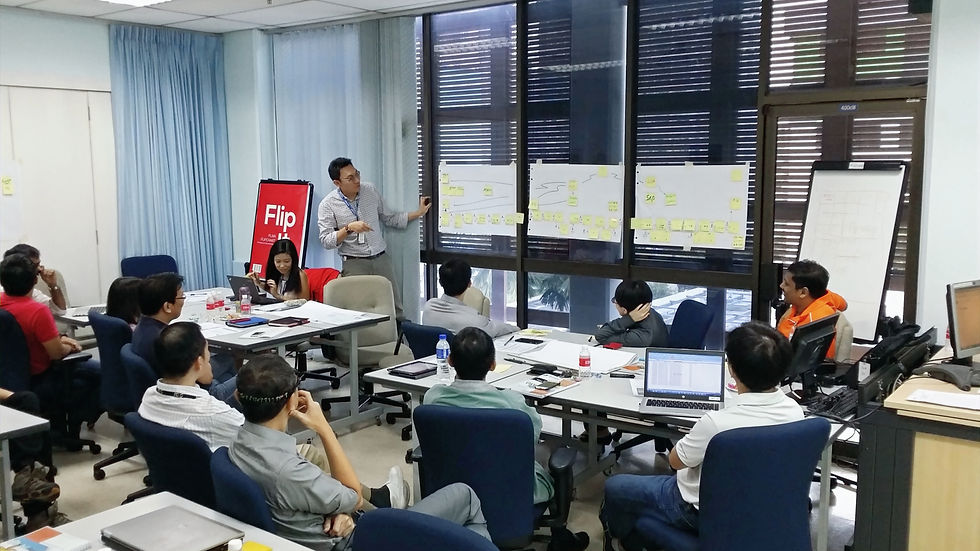
A current-state VSM makes waste visible — wait times, inventory queues, rework loops, and information gaps are all captured and quantified. A future-state VSM articulates the redesigned process after waste elimination, providing the implementation team with a clear target.
In OEC's Lean Practitioner workshops with NileDutch, participants mapped the container deployment process from forecasting to container release — quantifying waiting times, rework loops, and information handoff failures that collectively contributed to repositioning costs estimated at USD 2 million annually. The future-state VSM became the foundation for a structured PDCA improvement project that targeted a forecasting accuracy improvement from 66% to 90%.
5S Workplace Organisation
5S is the foundational Lean tool for creating a clean, organised, and visually managed workplace. It consists of five sequential steps:
Sort (Seiri): Remove everything that is not needed for current work
Set in Order (Seiton): Organise what remains so everything has a designated place
Shine (Seiso): Clean the workspace and use cleaning as inspection
Standardise (Seiketsu): Establish standards to maintain the first three S's
Sustain (Shitsuke): Embed 5S as a daily habit through discipline and leadership
5S is often the first Lean tool introduced in a new engagement because it makes other problems visible. A well-organised, visually managed workspace reveals defects, delays, and shortfalls that clutter and disorder conceal.
Kaizen (Continuous Improvement)
Kaizen — literally "change for the better" — is both a tool and a mindset. As a practice, Kaizen events are focused, time-bounded improvement sprints (typically three to five days) in which a cross-functional team maps a process, identifies waste, implements improvements, and standardises the results.
As a mindset, Kaizen is the conviction that no process is ever good enough — that every person at every level has both the ability and the responsibility to identify and act on improvement opportunities every day.
The Kaizen philosophy rejects the idea that improvement is the exclusive domain of specialists or management. At MSF, frontline officers participated directly in identifying wastes in their own workflows — and their insights consistently surfaced problems that management could not see from a distance.

Gemba Walk
"Gemba" is Japanese for "the actual place" — the location where value is created. A Gemba Walk is the practice of leaders and practitioners going directly to the workplace to observe processes, ask questions, and see waste firsthand.
The Gemba Walk is grounded in a simple insight: real understanding comes from observation, not from reports. When OEC facilitators conducted Gemba walks with MSF division heads, they consistently identified wastes — waiting, motion, overprocessing — that did not appear in any dashboard or workflow diagram.
Effective Gemba Walks follow a disciplined structure: observe with curiosity, ask "why" rather than "who," and look for systemic causes rather than individual failures.
Standard Work
Standard Work is the documented, agreed-upon method for completing a task — capturing the best current practice as the baseline from which improvement will be measured. It defines the sequence of steps, the time required for each step, and the materials and tools needed.
Standard Work serves two purposes: it prevents regression (ensuring that improvements are not lost over time), and it creates a stable foundation from which the next improvement can be made. Without Standard Work, kaizen improvements tend to decay as individuals revert to their own methods.
Visual Management
Visual Management makes the current state of a process immediately apparent to everyone who works in or manages it — without needing to ask, check a system, or read a report. Colour-coded status boards, andon lights, shadow boards, and daily management boards are all visual management tools.
The goal is simple: if something is normal, it should look normal. If something is abnormal, it should look abnormal — immediately and unmistakably.
Poka Yoke (Error-Proofing)
Poka Yoke refers to any mechanism that prevents errors from occurring or makes errors immediately detectable before they become defects. The principle is to design quality into the process so that doing the right thing is easier than doing the wrong thing.
In office and service environments, Poka Yoke might take the form of a form that cannot be submitted until all required fields are completed, or a workflow system that flags missing information before a case is forwarded for review.
A3 Thinking
A3 Thinking is a structured problem-solving and communication methodology that captures a complete problem-solving story on a single A3-sized (11" x 17") sheet of paper. The A3 format follows the PDCA logic — current situation, problem analysis, target condition, countermeasures, implementation plan, and review — forcing clarity and conciseness.
A3 Thinking was central to the NileDutch strategy deployment engagement. The "Mother A3" captured the organisation's strategic intent across key dimensions — Quality, People, Profitability, and Delivery — while "Daughter A3s" translated strategic goals into departmental action plans.
Heijunka (Production Levelling)
Heijunka is the practice of levelling the volume and mix of work over a defined time period to achieve consistent throughput and avoid the alternation between feast and famine that characterises batch-and-queue systems.
In Toyota's famous analogy: work more like the tortoise than the hare. Consistent, level flow is more productive than bursts of intense activity followed by idle waiting.
In a service context, Heijunka might mean distributing incoming cases or requests evenly across a team's day, rather than processing everything that arrives in the morning and leaving the afternoon empty — or vice versa.
PDCA (Plan-Do-Check-Act)
PDCA is the foundational problem-solving cycle that underpins all Lean improvement. Its four steps are:
Plan: Identify the problem, analyse root causes, and define the improvement hypothesis
Do: Implement the countermeasure on a small scale to test the hypothesis
Check: Measure the result and compare it to the expected outcome
Act: Standardise what worked; adjust and repeat if the result was insufficient

In OEC's Lean Practitioner workshop for NileDutch, the PDCA cycle was the backbone of the container deployment improvement project. Teams followed the eight-step problem-solving process — from theme selection and current-state analysis through root cause investigation, countermeasure implementation, result evaluation, and standardisation.
Lean in Service and Office Environments
A persistent misconception about Lean is that it belongs in factories. The reality is that the principles and tools of Lean apply with equal — and arguably greater — force in service and office environments, precisely because the waste in these settings is so much less visible.
When OEC was engaged by the Ministry of Community Development, Youth & Sports (MCYS) to introduce Lean to its senior management team, the objective was specifically to surface the wastes embedded in administrative and service workflows. These included excessive approval layers, redundant reporting, information rework caused by unclear handoffs, and waiting time embedded in case management processes.
Similarly, OEC's engagement with the Ministry of Social and Family Development (MSF) involved both a general Lean training for all division officers and specialised training for selected teams, who brought their own processes to the workshop and mapped them using Value Stream Mapping — identifying waste, defining a future state, and building Kaizen charters to drive implementation.

The results of Lean in service environments are well-documented. Benchmarking data from organisations that have applied Lean principles across service and administrative processes consistently shows:
Performance Dimension | Typical Improvement |
Quality (Defects/Rework) Reduced | 50 – 90% |
Inventory / WIP Reduced | 60 – 90% |
Space Reduced | 35 – 50% |
Lead Time Reduced | 50 – 90% |
Source: Adapted from Virginia Mason Medical Center; representative of organisations with 1–7+ years of Lean application.
Key Roles in Lean Deployment
Successful Lean implementation is not a solo effort. It requires clearly defined roles and responsibilities at every level of the organisation. Ambiguity about who owns what — and who decides what — is one of the leading causes of stalled Lean programmes.
Lean Steering Committee: Sets the strategic direction for the Lean initiative; defines goals and measures; makes resources available; establishes rewards and recognition; creates an environment conducive to Lean practice.
Lean Deployment Leader: Responsible for Lean deployment within a region, division, or business unit; aligns goals and objectives; facilitates project identification; removes barriers; communicates progress.
Lean Champion (Project Sponsor): The political owner of a Lean project; removes barriers for teams; aligns resources; communicates progress to the deployment leader; leads project scoping and prioritisation.
Process Owner: Takes ownership of the process when a Lean project is complete; maintains the gains; ensures countermeasures remain active and compliant; supports the project team during implementation.
Lean Coach: A technical expert in Lean tools and concepts; works on high-level, cross-functional projects; trains practitioners; coaches team leaders; consults to the steering committee.
Lean Team Leader: Leads, executes, and completes Lean projects and kaizen events; teaches tools to team members; transfers knowledge across the organisation.
Lean Team Member: Trained in a subset of Lean methodology; contributes to data collection, solution development, and implementation; works improvement projects within their own area.
Client Story: NileDutch — Lean Thinking in Global Shipping

NileDutch — one of the world's top 25 container shipping companies, with a focus on the Africa–Asia trade corridor — engaged OEC to build Lean capability in its Singapore subsidiary as part of a broader Operational Excellence journey.
The engagement began with a 1-Day Lean Thinking Workshop for all management and staff, creating shared awareness of Lean principles and tools. A 1-Day Lean Practitioner Workshop followed for a selected problem-solving team, focusing on value stream mapping and PDCA problem-solving.
The team then applied these tools to a specific, high-stakes challenge: the inefficiency of the container deployment process across the South-East Asian region. The problem statement was clear — current repositioning costs were estimated at USD 2 million annually, driven by forecasting inaccuracies that caused container imbalances across ports.
Following the eight-step PDCA problem-solving process, the team:
Defined the problem and established a measurable target (forecasting accuracy from 66% to 90%)
Conducted root cause analysis using process data and stakeholder input
Designed and implemented countermeasures
Standardised improvements and documented lessons learned for the wider NileDutch group
The engagement also included an A3 Strategy Deployment Workshop using Hoshin Kanri, enabling the NileDutch Singapore management team to align their operational strategy with the company's three-to-five-year growth objectives in the Asia-Africa trade market.
Implementing Lean: A Practical Roadmap
Lean implementation does not happen overnight. The following three-month roadmap, derived from OEC's client engagements, provides a structured starting point.
Month 1 — Create Awareness
Senior management awareness session
Organisation-wide information sessions
Launch Lean communication channel (newsletter, intranet updates)
Month 2 — Build Capability
Lean Thinking training for all staff
Lean Leadership training for managers and team leaders
Lean Tools training for practitioners
Train-the-Trainer programme for internal coaches
Month 3 — Management and Improvement
Build Lean Activity Board and daily management system
Conduct Value Stream Mapping for two to three key processes
Launch Kaizen #1: 5S Workplace Organisation
Launch Kaizen #2: Waste Elimination
Launch Kaizen #3: Standardisation
This roadmap is intentionally simple. Complexity at the start of a Lean journey is an enemy of momentum. Begin with the fundamentals — see waste, eliminate waste, standardise the improvement — and let the organisation's capability grow through practice.
Common Challenges and How to Navigate Them
Even well-designed Lean programmes encounter predictable obstacles. Based on OEC's experience across manufacturing, logistics, and public-sector clients, the most common failure modes and their countermeasures are:
Lack of leadership commitment. Lean cannot be delegated. If senior leaders are not visibly engaged — participating in Gemba walks, reviewing improvement results, modelling Lean behaviours — the programme will stall. Countermeasure: secure explicit leadership commitment before launch; make senior engagement a scheduled, non-negotiable programme element.
Focusing on tools, not culture. Installing kaizen events and VSM exercises without changing underlying behaviours and leadership practices produces temporary results that decay. Countermeasure: invest in the behavioural dimensions of Lean as deliberately as the technical ones. Define what "thinking Lean" looks and sounds like in daily management practice.
Resistance to change. The Enrollment Curve model describes a typical distribution: roughly 5% are initiators who embrace change immediately; 15% are early enrollers; 30% are middle enrollers; 30% are late enrollers; 15% are slugs; and 5% are die-hards who resist regardless. Countermeasure: focus energy on the middle and late enrollers — the largest moveable groups. Leverage the enthusiasm of initiators and early enrollers to carry the change. Do not invest disproportionate effort in die-hards within a limited timeframe.
Not dedicating resources. Lean is not a part-time effort. Teams cannot sustain improvement work while simultaneously carrying a full operational workload without any adjustment. Countermeasure: build resource commitments (time and budget) into the programme plan from the outset; treat them as non-negotiable.
Misalignment with organisational vision. Lean projects that do not connect to strategic priorities struggle to maintain executive attention and resources. Countermeasure: use Hoshin Kanri to anchor Lean initiatives within the organisation's strategic framework, ensuring that every project has a clear line of sight to a meaningful business outcome.
Sustaining a Lean Culture
Starting a Lean journey is relatively straightforward. Sustaining it — embedding the habits, disciplines, and thinking patterns that make continuous improvement a permanent feature of how the organisation operates — is the harder and more important work.
Based on OEC's client experience, the factors that most reliably sustain a Lean culture are:
Visible management commitment: Leaders who walk the gemba, participate in reviews, and practise Lean thinking themselves send a signal that cannot be substituted by any policy or programme.
Clear success measures: Lean work that cannot be measured cannot be managed. Define KPIs that reflect both process performance (lead time, error rate, cost per transaction) and Lean activity (number of improvements implemented, kaizen participation rate).
Alignment to vision and mission: Teams sustain effort when they understand how their improvement work connects to the organisation's purpose and direction.
Regular management review: Structured, disciplined review of Lean progress — using visual boards and A3 reports rather than lengthy presentations — keeps the work visible and the organisation accountable.
Rewards and recognition: Acknowledge improvement effort explicitly and publicly. The signal this sends — that the organisation values improvement, not just results — is powerful.
Addressing "what's in it for me?": Lean changes how people work. Employees who understand the personal benefits — less frustrating work, greater autonomy, more meaningful contribution — are far more likely to engage than those who perceive Lean as a management initiative designed to extract more effort from them.
As experienced practitioners note: "Getting Lean takes a long time. Lean is not a part-time effort. Lean is more than tools — it is behaviour. There will be resistance to change. And the journey to Lean never ends."
OEC's Lean Thinking Services
Operational Excellence Consulting delivers Lean Thinking engagements across three modalities, tailored to client context and maturity:
Lean Thinking Workshop (1 Day): Targeted at all management and staff. Creates shared awareness of Lean principles, concepts, and tools. Includes business simulations and hands-on exercises that make abstract concepts tangible.
Lean Practitioner Workshop (1-2 Days): Targeted at improvement team leads and practitioners. Introduces value stream mapping, the PDCA problem-solving cycle, and kaizen planning in a hands-on format. Participants work with their own process data.
Lean Consultancy: Hands-on facilitation of improvement projects and strategy deployment initiatives, including value stream mapping, problem-solving guidance, future-state design, and implementation planning. OEC's consultants bring both technical Lean expertise and deep cross-industry experience — from semiconductor manufacturing and container shipping to government ministries and professional services.
OEC has delivered Lean Thinking programmes for clients including Lam Research, Panasonic, Tokyo Electron, Micron, Sika Group, Toyota Tsusho, Fugro Subsea Technologies, BRC Weldmesh, NileDutch, the Ministry of Social and Family Development, Health Sciences Authority, the Ministry of Education, and the Ministry of Community Development, Youth & Sports.
Frequently Asked Questions
Is Lean only for manufacturing? No. Lean principles apply wherever there is a process, a customer, and waste to be eliminated — which describes every industry and every function. OEC has delivered Lean programmes to government ministries, shipping companies, healthcare providers, and professional services firms with consistent results.
How long does it take to see results from Lean? Early wins from focused kaizen events are often visible within weeks. Sustainable culture change — where continuous improvement becomes embedded in how the organisation operates — typically takes two to three years of consistent effort.
What is the difference between Lean and Six Sigma? Lean focuses on eliminating waste and creating flow. Six Sigma focuses on reducing process variation and defects using statistical tools. The two are complementary: Lean accelerates processes, Six Sigma makes them more reliable. Many organisations combine them as Lean Six Sigma.
Can Lean be applied in the public sector? Yes. Singapore's public sector has been an active adopter of Lean principles, using them to improve service delivery, reduce processing times, and improve the quality of citizen-facing services. OEC's work with MSF and MCYS demonstrates that Lean tools — adapted appropriately to the public sector context — produce meaningful and measurable improvements.
What is the first step to getting started with Lean? The most important first step is leadership alignment. Define why Lean matters for your organisation, secure visible commitment from senior leadership, and identify two or three processes where waste elimination would have the greatest impact. Then begin — imperfectly and iteratively, guided by the PDCA discipline of learning from every cycle.
Conclusion
Lean Thinking is one of the most thoroughly validated management philosophies ever developed. From Toyota's production floors to Singapore's government ministries, from global shipping companies to semiconductor manufacturers, the evidence is consistent: organisations that embed Lean thinking — systematically eliminating waste, creating flow, pulling to customer demand, and pursuing perfection relentlessly — outperform those that do not.
But Lean is not a technique to be installed. It is a discipline to be practised, a culture to be built, and a journey that never ends. As Klaus Schwab of the World Economic Forum has observed: "In the new world, it is not the big fish which eats the small fish — it's the fast fish which eats the slow fish."
Speed, efficiency, and value creation are not optional. They are the price of competitive relevance. Lean Thinking is how organisations pay that price — sustainably, systematically, and with the full engagement of every person in the value stream.
About the Author

Allan Ung is an internationally recognized author, thought leader, and master practitioner in the field of Operational Excellence, with a career spanning more than thirty years at the absolute forefront of organizational transformation and quality management. As the Founder and Principal Consultant of Operational Excellence Consulting, a premier management training and consulting firm established in Singapore in 2009, he has dedicated his professional life to helping organizations bridge the critical gap between complex academic frameworks and practical, shopfloor execution. His unique advisory philosophy emphasizes the creation of "fit-for-purpose" management systems that democratize continuous improvement, intentionally stripping away unnecessary statistical complexity and "math anxiety" to empower frontline workers with accessible, high-impact problem-solving tools.
Prior to establishing his successful consultancy practice, Allan held senior regional leadership and advisory roles within some of the world's most prominent multinational corporations and regulatory bodies, including IBM, Microsoft, and Underwriters Laboratories. His deep expertise in managing large-scale quality transformations was further forged during his foundational tenure at Singapore's National Productivity Board, which has since evolved into Enterprise Singapore, where he actively pioneered national quality process initiatives and coached enterprises across multiple sectors on productivity enhancement. His extensive cross-border experience includes completing advanced consultancy training in Japan as a prestigious Colombo Plan scholar, an experience that allowed him to study the roots of lean thinking directly from Japanese master practitioners and adapt those methodologies for global deployment.
Allan’s comprehensive professional credentials reflect a deep commitment to mastery across multiple operational disciplines. He is a Certified Management Consultant accredited in Japan, a Lean Six Sigma Black Belt, a JIPM-certified Total Productive Maintenance Instructor, and a Training Within Industry Master Trainer. Demonstrating his deep standing within the national quality ecosystem, he has also served as a Singapore Business Excellence Award National Assessor, evaluating leading organizations against world-class business excellence frameworks. He holds a Bachelor of Engineering in Mechanical Engineering from the National University of Singapore, a world-class academic foundation that complements his highly practical, results-driven consulting approach. Through his development of proprietary methodologies like the OEC Green Lean Matrix™, OEC TPM Maturity Diagnostic, and the 4-Lens of Critical Thinking Model, Allan continues to stand out as a pioneering voice in management consulting, helping global enterprises transform their daily operational realities into sustainable competitive advantages.
His philosophy: "Manufacturing excellence is achieved through disciplined systems, capable leadership, and sustained execution on the shopfloor."
His practitioner-led toolkits have been utilized by managers and organizations across Asia, Europe, and North America to build Design Thinking and Lean capability and drive organizational improvement.
👉 Learn more at: www.oeconsulting.com.sg
Further Learning Resources
This article is the hub of OEC's Lean Thinking content cluster. Each spoke article explores one dimension of Lean in depth:
Hub article
Lean Production System
5S Workplace Organization
Kaizen
Standard Work
Value Stream Mapping
Total Productive Maintenance
Training Within Industry
Hoshin Kanri
Lean Daily Management System
Gemba Walk
Visual Management
Lean Six Sigma for Service and Administration
Green Lean
Flow Engineering
Ready to Equip Your Team with Practical Lean Tools?
👉 Explore our Lean Training Courses and Facilitation-Ready Training Presentations to master waste elimination and continuous improvement.
Training Courses and Workshops:
Training Presentations:
Operational Excellence Consulting offers a full catalog of facilitation‑ready training presentations and practitioner toolkits covering Lean, Design Thinking, and Operational Excellence. These resources are developed from real workshops and transformation projects, helping leaders and teams embed proven frameworks, strengthen capability, and achieve sustainable improvement.
👉 Explore the full library at: www.oeconsulting.com.sg


