


Value Stream Mapping (VSM): The Complete Practitioner Guide to Seeing, Analysing, and Redesigning Your Processes
Updated: Oct 4
By Allan Ung | Founder & Principal Consultant, Operational Excellence Consulting
Updated on 12 April 2026
Allan Ung is the Founder and Principal Consultant of Operational Excellence Consulting, a Singapore-based firm established in 2009. With over 30 years of experience leading operational excellence and quality transformation across manufacturing, technology, and global operations—including senior roles at IBM, Microsoft, and Underwriters Laboratories—Allan brings deep shopfloor expertise to every learning room he enters. A Certified Management Consultant (CMC, Japan), Lean Six Sigma Black Belt, TPM Instructor, TWI Master Trainer, and former Singapore Quality Award National Assessor, he has facilitated Value Stream Mapping workshops and Lean programmes for organisations including the Ministry of Social & Family Development, Temasek Polytechnic, Tokyo Electron, Panasonic, Micron, Lam Research, Toyota Tsusho, NileDutch, Sika Group, and Infineon Technologies.
Introduction: The Tool That Makes Waste Visible
Every organisation believes it understands its own processes. In practice, almost none of them do — not completely, not accurately, and not from the customer's point of view.
This is not a criticism. It is the structural reality of how most organisations are built: by function, by department, by system. Each team understands its own piece of the process. Almost no one can see the whole — the end-to-end flow of work from the moment a customer request is triggered to the moment value is delivered.
Value Stream Mapping (VSM) exists to solve that problem. It is a structured, visual technique — rooted in the Toyota Production System and systematised by Karen Martin and Mike Osterling in their definitive practitioner handbook — that makes the complete flow of work visible: every step, every handoff, every queue, every delay, and every piece of information that moves alongside the product or service.
When practitioners see their value stream for the first time — really see it, with data attached — two things invariably happen. First, they are surprised by how much of the elapsed time is pure waiting. Second, they see clearly, often for the first time, exactly where the leverage points for improvement lie.
That combination of surprise and clarity is what makes VSM one of the most powerful tools in Lean practice. This guide covers the complete methodology — from foundational concepts through all four mapping phases — with real client examples from OEC's work across semiconductor manufacturing, logistics, engineering education, and the public sector.
What Is Value Stream Mapping?
Value Stream Mapping is a Lean technique used to analyse and design the flow of materials and information required to bring a product or service from request to delivery. It creates a visual representation — drawn on paper, on a wall with post-it notes, or on a shared digital canvas — of every step a product or service takes from the customer's initial request through to fulfilment.
The key distinction from conventional process mapping is scope. Process mapping typically documents a single step or department. Value Stream Mapping captures the entire system — all processes, all handoffs, all information flows, and all inventory queues — from the first supplier action to the last customer receipt. This system-level view is what enables VSM to surface the wastes that no individual department can see from within its own silo.
A working definition: Value stream mapping allows organisations to understand where their resources are tied up in delivering a product or service to customers. By analysing and identifying waste, organisations can then develop and implement future-state maps to improve overall Quality, Cost, and Delivery (QCD) performance.
The technique applies to both manufacturing and service environments. In manufacturing, the value stream tracks physical materials, equipment, and production steps. In service and office environments — government ministries, logistics companies, engineering faculties, professional services firms — the value stream tracks information, decisions, documents, and case-processing steps. The wastes are different in texture but identical in category: waiting, overproduction, excess motion, defects, unnecessary inventory, over-processing, transportation, and non-utilised talent.
VSM vs. Process Mapping: A Critical Distinction
Practitioners new to VSM sometimes ask how it differs from the process mapping they already do. The distinction matters because the two tools answer different questions and drive different types of improvement.
Dimension | Value Stream Mapping | Process Mapping |
Scope | The whole value stream, end to end | A single process or department |
Waste identified | Between processes (queues, handoffs, delays) | Within a process (steps, rework, redundancy) |
Improvement type | Systemic — significant but requires cross-functional effort | Local — smaller but easier to implement |
Planning horizon | Long-term strategic | Short-term tactical |
Typical output | Future-state blueprint + implementation plan | Revised process procedure |
VSM and process mapping are complementary, not competing. VSM sets the strategy: it reveals where the biggest systemic wastes are and where to focus improvement energy. Process mapping and kaizen events then execute tactically within those identified areas. Together they operate at two levels of granularity: VSM at the strategic level ("what has to happen"), and kaizen projects at the tactical level ("how it will happen").
Why Value Stream Mapping? Five Reasons That Matter
Organisations that embed VSM into their improvement practice consistently cite five reasons the tool earns its place:
1. It sets strategy before diving into tactics. One of the most common Lean failures is the "tool-first" approach — launching 5S events or kaizen workshops without first understanding where in the value stream those tools will have the greatest impact. VSM prevents that mistake. It forces the organisation to see the whole system before acting on any part of it.
2. It visualises process at multiple levels. VSM creates an end-to-end view of the system that simultaneously shows material flow, information flow, process performance data, and inventory queues. No other single tool provides that combined picture.
3. It provides a common language. In organisations where different functions use different terminology, VSM's standardised icons and format create a shared visual language that enables genuinely cross-functional analysis. When engineers, operations managers, finance staff, and frontline workers can all read the same map, alignment becomes possible.
4. It makes waste visible in a way that provokes action. Shigeo Shingo, one of the architects of TPS, observed: "The most dangerous kind of waste is the waste we don't recognise." VSM makes the unrecognised visible — particularly the waiting time embedded between process steps, which is typically the largest single category of waste in any value stream and the one most invisible to people working within it.
5. It promotes system thinking. The fundamental insight of VSM is that individual efficiency and system efficiency are different things — and often in conflict. A department that optimises its own throughput at the expense of downstream handoffs creates systemic waste. VSM shifts the focus from local optimisation to total value stream performance.
The Value Stream: A Precise Definition
A value stream is all of the activities — both value-added and non-value-added — required to fulfil a customer request from the point of order to the point of delivery.
The value stream is the primary unit of work in Lean thinking. It crosses departmental boundaries. It includes both the flow of physical materials or service outputs and the flow of information that directs that work. In a manufacturing context, the value stream runs from raw material receipt through production processes to customer shipment. In a service context, it runs from the moment a customer submits a request through every processing, review, and approval step to the moment the service is delivered.
Identifying the right value stream to map is an important scoping decision. Common value streams include order fulfilment, procurement, new product design, IT request fulfilment, staff claims processing, accounts payable, hiring and onboarding, and any patient or citizen service pathway. In OEC's work with Temasek Polytechnic's Engineering faculty, the value stream examined was the end-to-end flow of academic administrative processes relevant to lecturers — a service context that looks very different from a semiconductor fab but follows identical VSM logic.
The Four-Phase VSM Process
OEC's VSM methodology — grounded in the Martin and Osterling framework and refined through years of client engagements across Asia-Pacific — follows four sequential phases. Each phase has distinct activities and deliverables. Each builds on the previous one.

Phase 1: Define the Product or Service Family
The first phase establishes the scope of the mapping exercise. A product or service family is a group of products or services that pass through the same — or nearly the same — sequence of process steps. Mapping a family rather than a single product or service gives the improvement team the greatest leverage: improvements to the shared process steps benefit everything in the family simultaneously.
Selecting the family uses a product-family matrix: rows list individual products or services, columns list key process steps, and an "X" marks which steps each product or service requires. Families emerge from clusters of products sharing the same downstream steps — particularly the final steps closest to the customer, where variation in flow is most costly.
Scoping the map also requires defining boundaries: where does the value stream begin and where does it end? What specific customer needs does it address? What volumes flow through it?
The VSM charter is the Phase 1 deliverable — a concise document that commits the team and the organisation to the mapping effort. A well-structured VSM charter captures: the value stream name and boundaries; customer demand (volume per time period); the trigger event that initiates the value stream; the first and last process steps; boundaries and limitations (what the team is not authorised to change); the improvement timeframe; current state problems and business needs; measurable target conditions; and the benefits expected for both customers and the business. It also names the executive sponsor, value stream champion, facilitator, team members, and on-call subject matter experts.
The charter is not bureaucracy — it is the mechanism that prevents the most common VSM failure mode: "creating maps but taking no action." By establishing measurable targets and named accountabilities before the mapping begins, the charter converts a mapping exercise into a change initiative.
Phase 2: Document the Current State
The current-state map is a factual, data-driven picture of how the value stream actually operates today — not how it is supposed to operate, not how it operated last year, and not how it looks in the procedure manual. Reality is invariably different from perception. Few processes work the way we think they do.
Go to the gemba. The cardinal rule of current-state mapping is to walk the actual process and collect data at the source. As OEC's VSM workshop materials put it: observe the actual place where the process is performed, talk to the actual people involved, and chart the actual process. Downloading data from an ERP system is a starting point, not a substitute for direct observation. The 80/20 rule applies: 80% of the knowhow needed to make good decisions can be gathered from direct observation without perfect data.
VSM icons provide the common language. The standard VSM icon set includes:
Process block — a rectangle representing a process step or group of steps, with a data box below it capturing cycle time, changeover time, uptime, batch size, number of operators, and yield
External source — the supplier (upper left) and customer (upper right), the anchor points of every map
Inventory triangle — representing work-in-process (WIP) between steps, with quantity noted below
Push arrow — material or work pushed to the next step regardless of whether it is needed
Information flow arrows — both manual (hand-drawn) and electronic (lightning bolt), showing how scheduling, instructions, and data move through the system
Timeline — the row at the bottom of the map that distinguishes value-added time (process time at each step) from non-value-added time (queue time between steps)
Kaizen burst — a starburst symbol marking identified improvement opportunities directly on the map
Takt time is the critical reference point for current-state analysis. Takt time is the rate at which the customer is consuming the product or service — it is calculated by dividing the available work time by customer demand (for example, 8 hours × 3600 seconds ÷ 15 patients per day = 1,920 seconds per patient). Once takt time is established, every process step's cycle time can be compared to it: steps running faster than takt are creating overproduction; steps running slower are creating bottlenecks.
Key metrics captured in the current-state map include: cycle time per step (the time required to complete one unit of work at that step), changeover time, uptime or availability, WIP between steps, lead time (total elapsed time from first step to last), and process time (the sum of cycle times across all steps). The ratio of lead time to process time — sometimes called the process cycle efficiency — is one of the most revealing diagnostics in VSM. In most office and service environments, process cycle efficiency is below 10%, meaning more than 90% of elapsed time is non-value-added.
Interim briefing after Phase 2 is critical. Before moving to future-state design, the team presents the current-state findings to leadership and key stakeholders. The purpose is to establish a shared mental framework for the need to change, gain consensus on the diagnosis, and challenge any policies or assumptions embedded in the current state. Without this briefing, future-state recommendations arrive without the foundation of shared understanding — and resistance follows.

Phase 3: Design the Future State
The future-state map is a design exercise grounded in Lean principles. It answers a single overarching question: given what we now know about the current state, what is the best achievable flow?
Designing the future state is guided by a series of questions that OEC's practitioners work through systematically with each client team:
What does the customer really need? The future state begins with the customer's demand — the takt time — as its governing constraint. The process must be designed to deliver at the customer's pace, no faster and no slower.
Where can we create continuous flow? Continuous flow — one piece moving from step to step without waiting — is the ideal. The future state identifies which adjacent process steps can be physically or logistically linked to eliminate the queues between them.
Where is a pull system with a supermarket needed? Where continuous flow is not achievable (due to batch constraints, equipment limitations, or shared resources), a pull system using a supermarket — a controlled buffer from which downstream processes draw what they need, when they need it — is the Lean alternative to a push system.
What is the pacemaker process? The pacemaker is the process step that sets the rhythm for the entire value stream — typically the step closest to the customer. All upstream processes are synchronised to the pacemaker's output rate.
How can we level the workload? Heijunka — load levelling — distributes work evenly across the available time period to prevent the feast-and-famine cycles that create both overburden and waiting.
What process improvements are needed to achieve the future state? The future-state map is annotated with kaizen bursts — markers identifying the specific improvement projects required to bridge the gap between current and future state. These become the basis for the implementation plan.
The future state is not a perfect state — it is the best achievable state given current constraints, designed to be reached within a defined timeframe (typically 90–120 days). The iterative nature of VSM means that once the future state is achieved and becomes the new baseline, another cycle of current-state mapping and future-state design begins. This is how organisations progress from incremental improvement to transformational performance.

Phase 4: Create the Implementation Plan
The implementation plan converts the future-state design into an executable action agenda. It answers: who will do what, by when, and with what expected result?
The plan is built around the kaizen projects identified on the future-state map, sequenced according to their strategic priority and interdependency. Each project receives a project charter that names the problem, the target condition, the team lead, the timeline, and the success metrics.
Management approval is sought at this phase — not as a rubber stamp but as a genuine commitment of resources, time, and authority. The interim briefing at Phase 4 presents the full implementation plan: priorities, approach, timeframes, and accountability. The goal is to obtain full commitment from leadership at that moment, not weeks later after the momentum from the mapping event has dissipated.
Monitoring progress through a regular management review cadence — typically monthly — keeps the implementation accountable and visible. VSM is not complete when the future-state map is drawn. It is complete when the future state has been achieved, verified, and sustained.
VSM in Practice: Common Pitfalls to Avoid
VSM is powerful when practised with discipline. It fails — and fails predictably — when specific mistakes are made. Based on OEC's experience facilitating VSM workshops across diverse industries, the most common failure modes are:
Using the map as a work design exercise without follow-through. The map is not the outcome — the improved value stream is. Teams that spend days creating beautiful maps and then return to business as usual have gained nothing. The charter, the interim briefings, and the implementation plan all exist to prevent this.
Using VSM to make tactical improvements. If the goal is to fix a single step, use a kaizen event. VSM is a strategic tool. Applying it tactically squanders its power and exhausts the team with effort disproportionate to the result.
Creating the map without metrics. A map without data is a process diagram, not a value stream map. Cycle times, WIP quantities, lead times, and demand rates are not optional — they are what make the current state analysable and the future state measurable.
Mapping with the wrong team. VSM requires cross-functional participation. A map created by a single department captures a departmental view, not a value stream view. The team must include representatives from every process step in the value stream, plus leadership with the authority to approve the changes the future state will require.
Not walking the gemba. The discipline of going to see the actual process — rather than mapping from memory or from system data — is what makes VSM accurate. What people believe happens and what actually happens are almost always different. The gemba walk closes that gap.
VSM Metrics: What to Measure and Why
The current-state map captures several metrics that together paint a complete performance picture of the value stream.
Lead time (LT): The total elapsed time from the first step of the value stream to the last — the time the customer experiences. Lead time includes both process time and all waiting time between steps. It is typically measured in days or hours.
Process time (PT): The sum of cycle times across all value-added process steps — the time actually spent working on the product or service. Process time is typically measured in minutes.
Process cycle efficiency (PCE): Process time divided by lead time, expressed as a percentage. A PCE below 10% — meaning more than 90% of elapsed time is non-value-added — is common in office and service environments and is always a target for improvement.
Work-in-process (WIP): The quantity of units sitting in queue between each pair of process steps. High WIP indicates that upstream processes are producing faster than downstream processes can consume — a manifestation of overproduction.
Changeover time (C/O): The time required to switch from processing one type of work to another. Long changeover times drive batch-and-queue behaviour and are a common root cause of both overproduction and waiting.
Uptime/availability: The percentage of time a process step is available and functioning as intended. Low uptime — from equipment downtime, system failures, or resource unavailability — creates waiting and forces overproduction as a buffer.
Takt time: As described above, the pace of customer demand. Every other metric in the value stream is evaluated relative to takt time.
Client Story: Micron Technology — VSM in Semiconductor Manufacturing

Micron Technology — a global semiconductor leader with over 35 years of history in DRAM, NAND, NOR Flash memory, SSDs, and a broad portfolio of silicon-to-semiconductor solutions — engaged OEC to help redefine its value streams and build continuous improvement capability within its Singapore operations.
Despite Micron's considerable success with traditional industrial engineering methods, the team recognised that further optimisation opportunities remained — particularly in the Assembly, Test, and Module departments. The goal was to apply Value Stream Mapping to uncover additional cost savings and process efficiencies that IE methods had not surfaced.
OEC's engagement design followed a three-component structure: a Lean Thinking Workshop to build shared awareness and common language; a Value Stream Mapping Workshop for 20 participants including managers and engineers from all three departments; and a month of hands-on coaching for three project teams working on their respective value streams.
The VSM workshop enabled participants to create current-state value stream maps for each department, develop data collection plans capturing WIP, cycle times, lead times, downtimes, changeovers, defects, and distance travelled, conduct value-added versus non-value-added assessments, and design future-state maps with implementation plans for each value stream.
On-site Gemba walks — paired with spaghetti diagrams and layout analysis — gave the teams a ground-truth understanding of actual process flows that no ERP download could replicate.
The results were significant. Within four weeks of the workshop, the three project teams — Assembly, Test, and Module — had identified additional improvement opportunities valued at approximately US$1 million beyond the gains already achieved through prior IE methods. The project teams presented their VSM-derived recommendations to senior management and gained approval for implementation. Lessons learned and good practices were documented and shared across other Micron subsidiaries in the Asia-Pacific region.
Participant Andrew Neo from the Module Department reflected: "Practical examples; applied principles are easy to understand." Donald Cheok from Assembly added: "Learnt in-depth about VSM and lean culture. The lean culture is a good culture to inject into the normal daily work." Joel Pagadora from Manufacturing noted: "This will help me a lot in my current job."
The Micron engagement illustrates VSM's unique capacity to surface systemic waste that resists detection by methods focused within single departments. When the full value stream becomes visible — with all its queues, handoffs, and information gaps exposed — improvement opportunities of a scale and kind that internal teams could not previously see become actionable.
VSM in Service and Office Environments
The most persistent misconception about Value Stream Mapping is that it belongs in factories. The VSM methodology was developed in manufacturing, but the wastes it surfaces — waiting, over-processing, defects, excess motion, unnecessary transportation — are equally present in every service and office environment. In fact, because service and office processes are less visible than physical production lines, the waste in them is often both larger and less recognised.
In OEC's experience facilitating Lean and VSM programmes for Singapore government agencies, the following service value streams are consistently rich with improvement opportunity: case management workflows, approval and sign-off processes, inter-departmental information transfers, document processing chains, and citizen or client service pathways.
At Temasek Polytechnic, OEC worked with lecturers in the Engineering faculty to apply VSM to their administrative processes — examining how work flowed through academic planning, course preparation, and resource allocation workflows. The cross-functional mapping revealed bottlenecks and redundancies invisible within individual departments.
During my tenure supporting Underwriters Laboratories (UL) across the Asia-Pacific region, Kaizen VSM events were conducted with regional teams to map certification and compliance processes — service value streams with multiple information handoffs, approval gates, and client touchpoints that responded well to VSM discipline.
When applying VSM in service environments, several adaptations to the standard technique improve effectiveness. "Service families" replace "product families" — grouping similar service types that follow the same or nearly the same process steps. The flow of documents, decisions, and information replaces the flow of physical materials. Cycle times are measured in hours or days rather than seconds or minutes. Takt time is recalculated using available work hours and the volume of service requests received per period.
The analytical logic is identical to manufacturing VSM. The questions are the same: where is the work waiting? where is it being processed more than once? where are the handoffs breaking down? where is information lost or delayed? The future state — a redesigned service flow with less waiting, fewer handoffs, and faster throughput — is designed and implemented using the same four-phase process.
VSM Roles and Responsibilities
Successful VSM engagements require clearly defined roles. The following are the key participants in a VSM event:
Executive sponsor: A director, VP, or C-suite leader who provides organisational authority for the effort, removes structural barriers, and signals to the organisation that the VSM work is a strategic priority — not an extracurricular activity.
Value stream champion: Typically a director or senior manager who owns the end-to-end value stream and has the authority to approve the changes the future state will require. The champion participates in interim briefings and approves the implementation plan.
VSM facilitator / manager: The skilled practitioner who leads the VSM event — guiding the team through the four phases, ensuring the rules of engagement are maintained, keeping the team focused on facts rather than opinions, and drawing the emerging map. OEC's consultants serve in this role for client engagements.
Mapping team: A cross-functional group of six to ten people with direct knowledge of the value stream. The team should be "leadership-heavy" — not composed only of frontline workers, but also including supervisors and managers who have both process knowledge and the authority to commit to change. The team conducts the gemba walk, collects and validates data, and debates and designs the future state.
On-call subject matter experts: Technical or functional specialists who are available to answer specific questions during the mapping event but are not needed as full-time participants.
Coordinator: The person who manages the logistics — room booking, materials, scheduling, and communications. These practical details determine whether the mapping event can focus fully on the process.
Practical Tips for Effective VSM Events
From decades of VSM facilitation across manufacturing, logistics, education, and the public sector, OEC's consultants have distilled the following principles for effective VSM practice:
Allocate sufficient time. A mapping event takes one to three days depending on the complexity and scope of the value stream. Trying to compress this into a few hours produces a superficial map that misses the critical details.
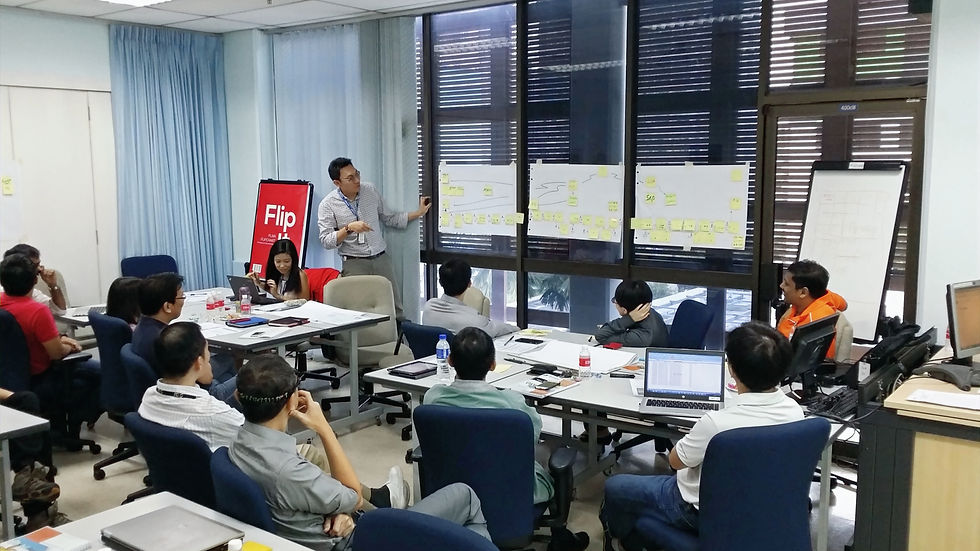
Use pencils and post-it notes, not PowerPoint. The physical act of drawing the map on a large wall with sticky notes — moving things, erasing things, arguing about things — is not inefficiency. It is the learning process. The map drawn collaboratively on a wall is understood and owned by the team in a way that a polished digital diagram never is.
Measure rather than download. Where possible, go to the gemba and measure cycle times with a stopwatch rather than relying on system-reported times. Systems report planned or average times; stopwatches reveal actual times. The difference is often startling.
Apply the 80/20 rule. Perfect data is not required to design a better future state. 80% of the knowhow needed to make good decisions can be gathered from direct observation and team knowledge. Waiting for perfect data before proceeding is itself a form of waste.
Protect the event from interruption. Phones on silent, no email, no side conversations. The rules of engagement in OEC's VSM workshops are explicit: rank has no privilege; finger-pointing and blame have no place; "we've always done it this way" is not a valid argument; silent objectors are not permitted — if you disagree, you say so and you explain why. These norms create the psychological safety required for people to honestly describe a process rather than defending it.
Conduct interim briefings. The briefings after Phase 2 (current state) and Phase 3 (future state) are not optional extras — they are structural elements of the VSM methodology. They build the organisational consensus that makes implementation possible.
Prioritise kaizen projects strategically. The future-state map typically identifies more improvement opportunities than can be addressed simultaneously. Prioritise based on impact on customer value, alignment with strategic objectives, and feasibility given available resources. Not all kaizen bursts need to be addressed in the first implementation cycle.
OEC's VSM Services
Operational Excellence Consulting delivers Value Stream Mapping services in three formats:
VSM Workshop (1–2 Days): A structured, facilitated workshop that introduces VSM principles, methodology, and icons; guides participants through the four-phase process; and enables teams to create both current-state and future-state maps for real value streams from their own organisation. Participants leave with a completed current-state map, a future-state design, and an implementation plan.
VSM Coaching and Project Guidance: Hands-on facilitation of VSM improvement projects post-workshop, including Gemba walks, data collection support, current-state analysis, future-state design, and implementation plan development. OEC's consultants work alongside the client team throughout the mapping and analysis process.
VSM Training Presentation and Practitioner Toolkit: OEC's facilitation-ready VSM training materials — developed and refined across engagements with clients including Micron, NileDutch, Temasek Polytechnic, and organisations in the public sector — are available as training presentations and practitioner toolkits for organisations building internal VSM capability.
OEC has delivered VSM programmes for clients spanning semiconductor manufacturing (Micron), global container shipping (NileDutch), engineering education (Temasek Polytechnic), and Singapore government agencies. Each engagement is tailored to the client's industry context, value stream type, and current capability level.
Frequently Asked Questions
How long does a VSM event take? A typical VSM event runs one to three days depending on the complexity of the value stream and the number of process steps. Simpler service value streams with five to eight steps can be mapped in a day. Complex manufacturing value streams with many steps, multiple product families, and significant information flows may require three days. Post-event coaching for implementation typically adds four to six weeks.
How many people should be on the mapping team? Six to ten people is the practical range. Fewer than six risks missing critical process knowledge from key steps. More than ten becomes difficult to facilitate — side conversations multiply and the wall gets crowded. The team should be cross-functional, spanning every major step in the value stream, and should include at least some members with decision-making authority.
Can VSM be done virtually? Yes, with the right facilitation tools. Digital VSM platforms allow distributed teams to map collaboratively using virtual sticky notes and icon libraries. The main adaptation required is more structured timekeeping and explicit norms around participation, since the social cues that regulate engagement in a physical room are less visible in a virtual setting. OEC has facilitated virtual VSM sessions for international teams.
What is the difference between VSM and process mapping? Process mapping documents a single process or department from a workflow perspective. VSM maps the entire value stream — from supplier to customer — capturing both material/service flow and information flow, with time data attached to every step and every queue. VSM reveals systemic waste; process mapping reveals local inefficiency. Both are valuable; they operate at different levels of scope and strategic intent.
What happens after the future-state map is completed? The future state is not the finish line — it is the starting point for implementation. The implementation plan, created in Phase 4, translates the future-state design into a portfolio of kaizen projects with named owners, clear targets, and defined timelines. Monthly management reviews track progress. When the future state is achieved, it becomes the new baseline, and the next cycle of VSM begins.
Is VSM only for manufacturing organisations? No. VSM applies to any environment where work flows from a trigger to a customer outcome — which includes every service, office, logistics, healthcare, government, and professional services context. The techniques adapt to the service environment (service families instead of product families, information flow instead of material flow), but the analytical logic and the four-phase methodology are identical.
Conclusion
Value stream mapping is one of the most consequential tools in the Lean practitioner's repertoire — not because it is technically complex, but because of what it does to an organisation's understanding of itself. When a cross-functional team walks a value stream together, sees its actual performance for the first time, and then collaboratively designs a better future state, something shifts. The silo thinking that previously made systemic improvement impossible gives way to system thinking that makes it inevitable.
The organisations that sustain this shift — that embed VSM as a regular discipline rather than a one-off event — are the ones that continuously close the gap between their current performance and their customer's expectations. In a competitive environment where, as Klaus Schwab has observed, the fast fish eat the slow fish, that discipline is not optional. It is the operational foundation of competitive relevance.
The first step is always the same: go see. Walk the process. Draw the map. Then build the future you can now see clearly.
About the Author

Allan Ung is the Founder and Principal Consultant of Operational Excellence Consulting, a Singapore-based management training and consulting firm established in 2009. With over 30 years of experience leading operational excellence and quality transformation in manufacturing-intensive environments, Allan's expertise spans Lean Thinking, Total Quality Management (TQM), TPM, TWI, ISO systems, and structured problem solving.
He is a Certified Management Consultant (CMC, Japan), Lean Six Sigma Black Belt, TPM Instructor (Japan Institute of Plant Maintenance), TWI Master Trainer, ISO 9001 Lead Auditor, and former Singapore Quality Award National Assessor.
During his tenure with Singapore's National Productivity Board (now Enterprise Singapore),
Allan pioneered Cost of Quality and Total Quality Process initiatives that enabled companies in the electrical and fabricated metals industries to reduce quality costs by up to 50 percent. In senior regional and global roles at IBM, Microsoft, and Underwriters Laboratories, he led Lean deployment, quality system strengthening, and cross-border operational transformation.
Allan has facilitated Value Stream Mapping and Lean programmes for organisations including Ministry of Education, Temasek Polytechnic, Health Sciences Authority, Tokyo Electron, Panasonic, Micron, Lam Research, Sika Group, Toyota Tsusho, NileDutch, and NEC. He holds a Bachelor of Engineering (Mechanical Engineering) from the National University of Singapore and completed advanced consultancy training in Japan as a Colombo Plan scholar.
His philosophy: "Manufacturing excellence is achieved through disciplined systems, capable leadership, and sustained execution on the shopfloor."
His practitioner-led toolkits have been utilized by managers and organizations across Asia, Europe, and North America to build Design Thinking and Lean capability and drive organizational improvement.
👉 Learn more at: www.oeconsulting.com.sg
Further Learning Resources
This article forms part of the hub of OEC's Lean Thinking content cluster. Each spoke article explores one dimension of Lean in depth:
Hub article
Operational Excellence
Lean Production System
5S Workplace Organization
Kaizen
Hoshin Kanri
Lean Daily Management System
Lean Six Sigma for Service and Administration
Flow Engineering
Theory of Constraints
Operational Excellence Consulting offers a full catalog of facilitation‑ready training presentations and practitioner toolkits covering Lean, Design Thinking, and Operational Excellence. These resources are developed from real workshops and transformation projects, helping leaders and teams embed proven frameworks, strengthen capability, and achieve sustainable improvement.
👉 Explore the full library at: www.oeconsulting.com.sg