


Standard Work: The Complete Practitioner Guide to Eliminating Process Variation and Sustaining Lean Gains
Updated: Aug 1
By Allan Ung | Founder & Principal Consultant, Operational Excellence Consulting
Updated on 30 March 2026

Allan Ung is the Founder and Principal Consultant of Operational Excellence Consulting, a Singapore-based firm established in 2009. With over 30 years of experience leading operational excellence and quality transformation across manufacturing, technology, and public sector environments — including senior roles at IBM, Microsoft, and Underwriters Laboratories — he is a Certified Management Consultant (CMC, Japan), Lean Six Sigma Black Belt, JIPM-certified TPM Instructor, TWI Master Trainer, and former Singapore Quality Award National Assessor. He has facilitated Standard Work and Lean Thinking programmes for organisations including Micron Semiconductor, NileDutch, Temasek Polytechnic, the Ministry of Social and Family Development, and the Ministry of Community Development, Youth and Sports.
The Principle that Makes Everything Else in Lean Work
There is a quote from Taiichi Ohno — the architect of the Toyota Production System — that I return to constantly in workshops and consulting engagements:
"Where there is no standard, there can be no Kaizen."
It is deceptively simple. But it captures something fundamental about why so many Lean programmes fail to produce lasting results. Organisations implement 5S, run Kaizen events, deploy visual management, train their people in problem-solving tools — and then watch the improvements erode. Six months later, they are back where they started.
The missing element, in almost every case, is Standard Work.
Without a defined standard — the best-known method for performing a process, documented and communicated and consistently followed — there is no stable baseline to improve from. Every Kaizen event produces a better result, but without a standard to lock that result in, the process drifts back toward whatever each individual operator, supervisor, or shift thinks is the right way to do it. The improvement evaporates. The next Kaizen starts from scratch.
This is the fundamental role of Standard Work in a Lean management system: it is the wedge that holds the gains in place. It converts improvement from a one-time event into a permanent capability.

What Standard Work Actually Is — and what it Is Not
Standard Work is an agreed-upon set of work procedures that establish the best and most reliable methods and sequences for each process and each worker, with the aim of maximising performance while minimising waste.
That definition contains a word that is frequently overlooked: agreed-upon. Standard Work is not a set of rules imposed from above. Taiichi Ohno was explicit about this: "Standards should not be forced down from above but rather set by the production workers themselves." Standard Work created without the involvement of the people who do the work tends to be theoretically correct and practically ignored. Standard Work created with them tends to be followed because the people who wrote it understand why each step matters.
It is also important to be clear about what Standard Work is not. It is not a rigid work standard that never changes. The moment a better method is identified, the standard should be updated to reflect it. Standard Work is a living document — the current best-known method, not the permanent and unchangeable method. The SDCA cycle (Standardise-Do-Check-Act) stabilises and locks in the current process; the PDCA cycle then improves it. Together they create the foundation for genuine continuous improvement.
The Three Elements of Standard Work
Standard Work consists of three specific elements that must be understood and balanced together. Each addresses a different dimension of work performance.
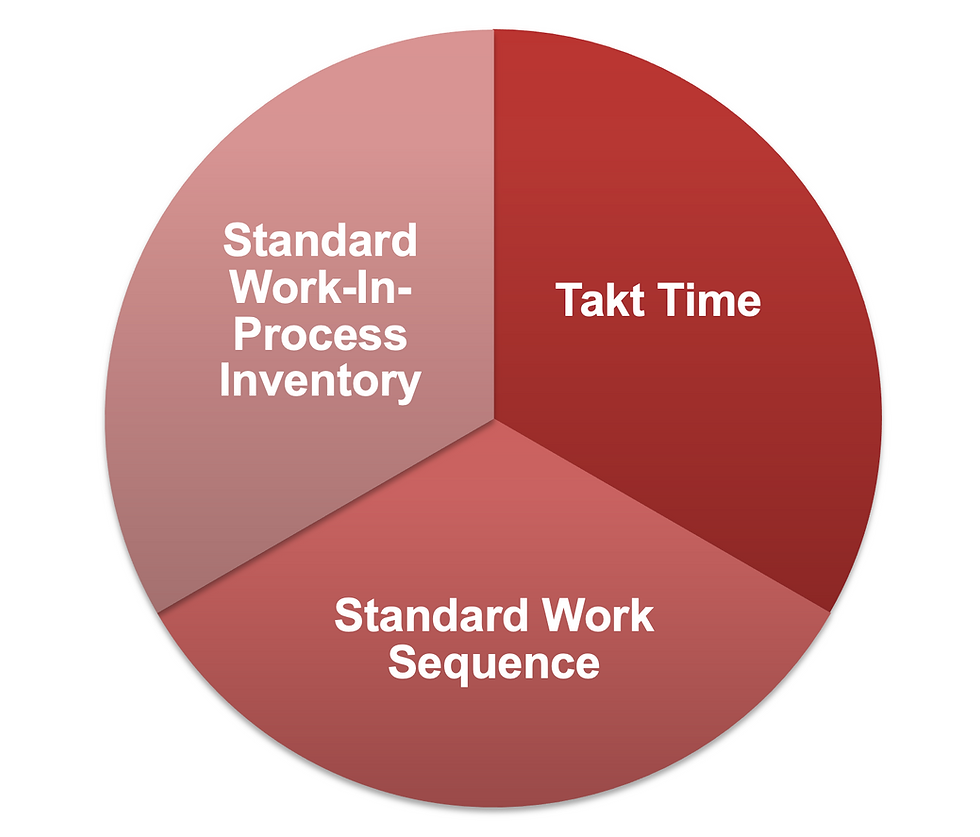
1. Takt Time
Takt Time is the rhythm of production in harmony with the pulse of customer orders. It is calculated by dividing the available production time per shift by the number of products required by the customer per shift — producing a time value that represents how frequently a finished product must be completed to meet demand.
Takt Time is the master clock of Standard Work. Everything else — how many operators are needed, how work is distributed across a cell, what constitutes an acceptable cycle time — is derived from it. When customer demand changes, Takt Time changes, and the Standard Work must be updated to reflect the new rhythm.
The formula is straightforward: if a shift has 27,000 seconds of available production time and the customer needs 450 products per shift, the Takt Time is 60 seconds per unit. Every element of the Standard Work for that process must be designed to meet that 60-second rhythm consistently.
2. Standard Work Sequence
Standard Work Sequence defines the series of steps in a single process that is fastest, most efficient, of acceptable quality, and safe — and specifies the order in which those steps must be performed. When the work sequence is carefully followed, the cycle time will be constant, no steps will be skipped, and quality and safety will be maintained.
The sequence is not simply the most logical order of steps from a process design perspective. It is the order that produces the best result when performed by a trained operator working to the Takt Time. A poor sequence creates unnecessary motion, interrupts flow, and introduces variation. A good sequence eliminates motion waste, supports consistent quality, and makes the work visible to supervisors and auditors.
Standard Work Sequences must be created for every possible combination of operators in a cell. If demand changes and three operators become two, the sequence changes — but the individual task content generally does not.
3. Standard Work-In-Process Inventory (SWIP)
Standard Work-In-Process Inventory is the minimum amount of inventory needed for work to progress without creating idle time or interrupting production flow. It is not a buffer against poor process performance — it is a precisely defined quantity that supports the smooth execution of the Standard Work Sequence.
SWIP includes units on machines, units between workstations, and units at quality check points. Too little SWIP creates stoppages; too much creates waste and obscures problems. Getting SWIP right requires understanding the process thoroughly — which is itself a valuable discipline.
The Six Pillars of Effective Standard Work
Establishing the technical elements of Standard Work is only half the battle. For a standard to be sustainable and effective on the shop floor, it must meet six qualitative criteria. If a standard fails on any one of these dimensions, it will underperform in practice, regardless of how technically accurate it appears on paper.

Completeness — Ensuring all required steps are documented so the standard can deliver the intended result. Incomplete standards are often the result of shortcuts during documentation or a lack of deep process understanding during the writing phase.
Clarity — Writing so that every operator understands the instruction in the same way. What is clear to a veteran may be ambiguous to a new hire. The ultimate test for clarity is whether someone unfamiliar with the process can follow the standard correctly on their first attempt.
Correctness — Providing accurate information and proper sequencing. Incorrect standards are worse than no standard at all; they systematically produce defects and make problem-solving harder by obscuring the true causes of error.
Concision — Containing only what is essential in a usable format. A document can be complete and clear but still fail if it is not concise. Excess information creates waste in learning and effort, making the standard significantly harder to follow in practice.
Currency — Reflecting the actual process as it is performed today, not as it was originally designed or performed before the last improvement. A standard that does not match current practice is a historical document, not an operational tool.
Communication — Ensuring the standard is documented, accessible, and known to those who need to use it. A perfect standard that remains in an unopened binder or an inaccessible digital folder is functionally equivalent to having no standard at all.
Standard Work in Practice: The Four-Step Implementation Process
Implementing Standard Work follows a structured four-step process that builds from measurement through documentation to visual management.

Step 1 — Process Capacity Table
The Process Capacity Table is the foundational measurement tool. It captures the manual time, automatic time, and changeover time for each operation in a process, and calculates the maximum output possible under current operating conditions. It identifies where the constraints are — where a single operation limits the capacity of the entire cell — and provides the data needed to balance work across operators.
For each operation, the table records the process name, machine number, manual time, automatic time, total cycle time, number of pieces per changeover, and shift capacity. The production capacity for each step equals the available time divided by the sum of manual and changeover time per piece.
Step 2 — Standard Work Combination Chart
The Standard Work Combination Chart uses Takt Time as the basis for work allocation across a cell or process. It maps manual work, walking, automatic machine time, and waiting time for each operator against the Takt Time line — making man-machine combination problems immediately visible.
A vertical red line drawn at the Takt Time position reveals instantly whether each operator can complete their work within the Takt, where waiting time is being created, and how to rebalance work elements to achieve better flow. The Combination Chart is the primary tool for line balancing — the process of evenly distributing work in a cell so that Takt Time can be consistently met. It answers the practical question that every production manager faces: how many operators do we actually need in this cell, and how should their work be distributed?
Step 3 — Work Methods Chart
The Work Methods Chart provides detailed process instructions at each workstation — telling operators not just what to do but how to do it, in the sequence that produces the best result. It is the practitioner-level documentation that translates the Combination Chart's work allocation into specific task instructions.
Good Work Methods Charts are visual, concise, and written from the operator's perspective. They include quality checkpoints, safety checkpoints, and key points — the elements of each step that, if not done correctly, will cause quality problems, safety incidents, or process failures. The connection to TWI Job Instruction is direct: JI's Job Breakdown Sheet and the Work Methods Chart serve the same purpose — capturing the key points that make the difference between a job done correctly and a job done approximately.
Step 4 — Standard Work Chart
The Standard Work Chart brings all three elements of Standard Work together in a single visual document: Takt Time, work sequence, and Standard WIP. It is posted at the workstation as a visual control tool — not filed away — so that any observer can see at a glance whether the process is being performed to the standard.
The chart includes a drawing of the cell layout with the work sequence mapped onto it, quality and safety checkpoints marked, WIP positions noted, and the Takt Time and net cycle time displayed prominently. It serves simultaneously as a training document for new operators, a reference for experienced ones, and an audit tool for supervisors. When Takt Time changes because customer demand changes, the Standard Work Chart must be updated to reflect the new rhythm — reinforcing the principle that Standard Work is a living document, not a permanent fixture.
Standard Work and the Lean System
Standard Work does not exist in isolation. It is the connective tissue that holds the Lean management system together — the element that makes every other Lean tool effective and sustainable.
5S Workplace Organisation creates the stable, organised physical environment in which Standard Work can be performed consistently. Labelled locations, shadow boards, and visual controls ensure that tools are where the Standard Work says they should be, every time.
TPM's Autonomous Maintenance depends on Standard Work for its cleaning, inspection, and lubrication routines. The seven steps of Autonomous Maintenance are themselves a form of Standard Work applied to equipment care.
Kaizen requires Standard Work as its starting point. The PDCA cycle of improvement begins with a current standard, improves it, confirms the improvement, and then updates the standard. Without a starting standard, Kaizen produces local variations rather than systematic improvements.
TWI Job Instruction is the primary mechanism for training people to the Standard Work. The four-step JI method ensures that every new operator or cross-trained employee learns the standard correctly — not a variation of it based on what a colleague happened to show them.
The Lean Management Assessment's Process Definition and Process Discipline dimensions directly evaluate whether Standard Work is documented and whether it is actually followed. Organisations that score poorly on these dimensions almost always have weak Standard Work.
Standard Work in Manufacturing and Beyond
Standard Work originated in manufacturing — in the Toyota Production System, where the discipline of Takt Time, work sequence, and SWIP was developed to support lean, high-quality, just-in-time production. But the principles apply wherever work is performed repeatedly and quality and consistency matter.
In the Lean Thinking and Value Stream Mapping workshops I have facilitated, Standard Work emerges as a theme regardless of the industry.
At Micron Semiconductor Asia in 2015, the value stream improvement programme was grounded in understanding and improving how work flowed through semiconductor manufacturing processes — which required clear process standards as the baseline for any meaningful improvement analysis. In a semiconductor environment where process variation directly affects yield and quality, the discipline of Standard Work is not optional.
At NileDutch Singapore — one of the world's top 25 container shipping companies, where a Lean project focused on container logistics efficiency achieved over USD 2 million in cost savings — the Lean Thinking foundation that preceded the improvement work required teams to establish clear process standards for the operational workflows they were improving. You cannot map the future state of a value stream without understanding and documenting the current state standard.
At Temasek Polytechnic's School of Engineering in 2013, academic staff applied Value Stream Mapping to their own processes — an application that required them to define and document their current work standards before they could identify waste and design improvements. Standard Work applies in academic environments just as it does on a factory floor, because the underlying problem is the same: variation in how work is performed produces variation in outcomes.
At the Ministry of Social and Family Development and its predecessor the Ministry of Community Development, Youth and Sports, Lean Thinking workshops introduced Standard Work principles to public sector professionals as a framework for improving the consistency and efficiency of government services. The principles translate directly: whether the process is a manufacturing cell or a social services workflow, the goal is the same — the best-known method, documented and followed, with a clear mechanism for improvement.
Improving Standard Work — The Continuous Cycle
Standard Work is not the end of the improvement journey. It is the beginning of each improvement cycle. Once a standard is established and stable, the organisation's attention turns to improving it — and then standardising the improvement.
The approaches to improving Standard Work include eliminating the eight types of waste across the value stream, applying the three MUs (Muda, Mura, Muri — waste, unevenness, and overburden), reducing lot sizes to expose quality problems earlier, improving motion efficiency, separating human and machine work, and applying 5S to create the physical conditions for better work.
The distinction between true efficiency and apparent efficiency is one of the most important concepts in Standard Work improvement. Producing 120 units with 10 people when the customer only needs 100 is apparent efficiency — it looks like improvement because output went up. True efficiency is producing 100 units with 8 people. Standard Work provides the discipline to make this distinction visible and to drive improvement in the right direction.
The Standard Work Toolkit
The OEC Standard Work Toolkit provides the complete set of practitioner-level tools for implementing Standard Work in your organisation — all based on the Toyota Production System methodology and designed for real workshop and shopfloor use.
The toolkit includes the Process Capacity Table, Standard Work Combination Chart, Work Methods Chart, Standard Work Chart, Time Observation Sheet, and Takt Time Calculator — all in editable formats ready for immediate use.
Build Standard Work Capability in Your Organisation
At Operational Excellence Consulting, I deliver Lean Thinking and Standard Work workshops for manufacturing, operations, and service organisations across Singapore and the Asia-Pacific region — grounded in real operational contexts and practitioner-led from first principle to implemented standard.
Explore our Standard Work and Lean training courses and practitioner-led resources:
Contact us directly or visit www.oeconsulting.com.sg.
About the Author

Allan Ung is the Founder and Principal Consultant of Operational Excellence Consulting, a Singapore-based management training and consulting firm established in 2009. With over 30 years of experience leading operational excellence and quality transformation in manufacturing-intensive environments, Allan's expertise spans Lean Thinking, Total Quality Management (TQM), TPM, TWI, ISO systems, and structured problem solving.
He is a Certified Management Consultant (CMC, Japan), Lean Six Sigma Black Belt, JIPM-certified TPM Instructor (Japan Institute of Plant Maintenance), TWI Master Trainer, ISO 9001 Lead Auditor, and former Singapore Quality Award National Assessor.
During his tenure with Singapore's National Productivity Board (now Enterprise Singapore), Allan pioneered Cost of Quality and Total Quality Process initiatives that enabled companies to reduce quality costs by up to 50 percent. In senior regional and global roles at IBM, Microsoft, and Underwriters Laboratories, he led Lean deployment, quality system strengthening, and cross-border operational transformation.
Allan has facilitated Standard Work, Lean Thinking, and Value Stream Mapping programmes for organisations including Micron Semiconductor, NileDutch, Temasek Polytechnic, Ministry of Social and Family Development, Panasonic, Tokyo Electron, and NEC. He holds a Bachelor of Engineering (Mechanical Engineering) from the National University of Singapore and completed advanced consultancy training in Japan as a Colombo Plan scholar.
His philosophy: "Manufacturing excellence is achieved through disciplined systems, capable leadership, and sustained execution on the shopfloor."
His practitioner-led toolkits have been utilized by managers and organizations across Asia, Europe, and North America to build Design Thinking and Lean capability and drive organizational improvement.
👉 Learn more at: www.oeconsulting.com.sg
Further Learning Resources
This article forms part of the hub of OEC's Lean Thinking content cluster. Each spoke article explores one dimension of Lean in depth:
Hub article
Lean Production System
5S Workplace Organization
Kaizen
Training Within Industry
Lean Daily Management System
Gemba Walk
Visual Management
Lean Six Sigma for Service and Administration
Operational Excellence Consulting offers a full catalog of facilitation‑ready training presentations and practitioner toolkits covering Lean, Design Thinking, and Operational Excellence. These resources are developed from real workshops and transformation projects, helping leaders and teams embed proven frameworks, strengthen capability, and achieve sustainable improvement.
👉 Explore the full library at: www.oeconsulting.com.sg