


Human-Centred Systems Thinking: A Practitioner's Guide to Solving Complex Problems at Their Root
By Allan Ung | Founder & Principal Consultant, Operational Excellence Consulting
Updated on 10 April 2026

Allan Ung is the Founder and Principal Consultant of Operational Excellence Consulting, a Singapore-based firm established in 2009. A veteran practitioner with over 30 years of experience — including senior leadership roles at IBM, Microsoft, and Underwriters Laboratories — Allan specialises in bridging the gap between human-centred discovery and operational execution. As a Design Thinking Coach and Certified Management Consultant (Japan), he integrates Design Thinking with the analytical rigour of Systems Thinking to help organisations solve problems that are dynamic, multi-layered, and deeply human. His approach has been applied across manufacturing, healthcare, public sector, technology, and logistics clients including Integrated Health Information Systems, Ministry of Social & Family Development, ST Electronics (Satcom & Sensor Systems), Cisco, and organisations across 50+ countries.
Introduction: Why Smart Solutions Often Make Problems Worse
In 1990, a team of Yellowstone National Park managers, frustrated by decades of elk overgrazing, decided to reintroduce wolves to the ecosystem. What they expected was a modest reduction in elk numbers. What they got was the transformation of the entire park.
With wolves present, elk changed their grazing behaviour — avoiding the valleys and riverbanks where they were most vulnerable. Vegetation regrew along those banks. The roots stabilised the soil. Rivers changed course. The ecosystem, dormant for decades, regenerated. This phenomenon — where changing one element of a system triggers cascading effects across the entire network — is what systems thinkers call a leverage point.
The Yellowstone story is memorable precisely because it is counterintuitive. The obvious intervention (reduce elk numbers through culling) had been tried repeatedly and failed. The systemic intervention (reintroduce a predator that changed elk behaviour, not just elk numbers) succeeded because it addressed the structure of the system rather than one of its symptoms.
Most organisational problems share this character. Customer complaints keep recurring despite process improvements. Employee engagement scores fall despite new initiatives. Service delivery failures repeat despite retraining. These are not problems of effort or intention — they are problems of depth. Teams are solving at the level of events and actions when the actual causes sit several layers deeper, in the patterns, structures, and mental models that generate those events.
Human-Centred Systems Thinking (HCST) is the discipline that addresses this depth problem. It integrates the empathy and creativity of Design Thinking with the analytical rigour of Systems Thinking — enabling organisations to understand not just what users experience (the surface) but what systemic forces create and sustain those experiences (the root). The result is solutions that are desirable to the people who use them, feasible within the organisation's capabilities, and — critically — durable, because they change the system rather than patch its outputs.
The World Economic Forum's Future of Jobs Report 2025 identifies Systems Thinking as a critical leadership capability for 2030. HCST represents its most practically useful form — systems analysis anchored in human reality rather than abstraction.
What Human-Centred Systems Thinking Is — and Why It Is Needed Now
Problems that are straightforward — where cause and effect are clear, where the solution is known, where the fix is technical — don't require HCST. They require competent execution of established methods. Lean, Six Sigma, and standard process improvement tools handle these well.
HCST is for a different category of problem: problems that are dynamic (they change over time and resist simple fixes), multi-layered (the visible symptoms are driven by invisible structures), and deeply human (the behaviour of people — customers, employees, stakeholders — is central to how the problem perpetuates itself). These are what complexity theorists call "wicked problems" — problems where the solution changes the problem, where there is no single correct answer, and where the consequences of interventions are difficult to predict.
Consider a hospital system struggling with patient readmission rates. A conventional improvement approach might analyse discharge processes, audit medication adherence, and implement follow-up call protocols. These are useful. But if the underlying causes include fragmented care coordination across departments, clinician time pressures that reduce the quality of discharge conversations, patient health literacy gaps that prevent self-management, and social determinants of health that make recovery at home structurally difficult — then surface-level process improvements will produce marginal gains at best. The system will continue generating the same outcomes until the structures that produce those outcomes are changed.
HCST provides the analytical framework to see those structures, the human-centred tools to understand how users experience them, and the design capability to prototype interventions that address both the human experience and the systemic root.
Design Thinking without Systems Thinking produces solutions that are human-desirable but systemically fragile. A beautifully designed patient discharge process that ignores the coordination gap between hospital and community care will fail when that gap reasserts itself.
Systems Thinking without Design Thinking produces analytically rigorous diagnoses that nobody acts on, because they are disconnected from the lived experience of the people involved and expressed in language that stakeholders cannot engage with.

HCST integrates both: it uses empathy and design tools to understand the human experience, and systems tools to understand the structures generating that experience — before designing interventions that address both dimensions simultaneously.
The Iceberg Model: Seeing Below the Surface
The most foundational framework in HCST is the Iceberg Model, which describes four levels of reality at which any problem can be observed and addressed:
Events (visible, above the waterline) — What happened? The customer complaint. The service failure. The quality defect. Most organisations operate at this level, reacting to events as they occur.
Patterns and Trends (just below the surface) — What has been happening over time? Recurring customer complaints about the same touchpoint. Steadily declining engagement scores. Seasonal failure spikes. Recognising patterns moves the organisation from reactive to anticipatory — but the cause is still unseen.
Structures (deeper) — What is causing the pattern? The system of policies, incentives, processes, information flows, and organisational design that produces the pattern. This is where leverage lives. Changing a structure changes the pattern of events it generates.
Mental Models (deepest) — What beliefs, assumptions, and worldviews cause people to design and maintain those structures? This is the deepest and most durable level of change. Mental models are the invisible governance layer that determines how structures are built and rebuilt. The hospital manager who believes "patients are responsible for their own recovery" will design very different discharge processes from one who believes "recovery is a shared responsibility between patient and system."

Most improvement efforts operate at the events level — extinguishing fires. Some reach the patterns level — identifying trends and setting targets. Fewer reach the structures level — redesigning the processes, incentives, and information flows that generate the pattern. Almost none work at the level of mental models — the hardest and highest-leverage change of all.
HCST explicitly works across all four levels, using systems mapping tools to make structures visible and empathy tools to surface the mental models held by users and stakeholders.
The Five Core Systems Thinking Tools in HCST
1. System Maps (Stakeholder Maps and Causal Loop Diagrams)
A system map visualises the actors, relationships, and feedback loops within a system. Stakeholder maps identify who is involved in and affected by the problem — including non-obvious actors whose behaviour shapes the system. Causal Loop Diagrams (CLDs) map the cause-and-effect relationships between variables in the system, distinguishing between reinforcing loops (where change in one variable amplifies change in the same direction — driving growth or collapse) and balancing loops (where change in one variable triggers a correction — maintaining stability or creating resistance to change).
Understanding the loop structure of a system reveals why problems persist despite repeated interventions. A balancing loop that counteracts every improvement — the organisational equivalent of a thermostat — will continue to restore the original condition unless the loop structure itself is changed.
2. Behaviour Over Time (BOT) Graphs
BOT graphs plot how key variables in a system change over time, revealing the dynamic behaviour that underlies current conditions. A hospital's readmission rate plotted over five years may reveal a reinforcing growth pattern (the problem is accelerating), an oscillating pattern (the problem cycles — improving and then deteriorating), or a goal-seeking pattern (the system is being held near a target by a balancing loop). Each pattern implies a different systemic diagnosis and a different leverage strategy.
3. The Five Whys — Applied Systemically
The Five Whys — familiar from Lean and quality improvement — takes on a more powerful form in HCST. Rather than seeking a single root cause, the systems practitioner uses iterative "why" questioning to trace causal chains through the system, looking for the feedback loops and structural conditions that allow the problem to perpetuate. The question is not just "why did this happen?" but "what systemic condition made this outcome the most likely result?"
4. System Archetypes
System archetypes are recurring structural patterns that appear across organisations and industries — generic templates of how systems generate problematic behaviour. The most relevant for practitioners include: Fixes that Fail (where short-term solutions create unintended consequences that worsen the original problem); Shifting the Burden (where symptomatic solutions divert attention from fundamental solutions, weakening the system's capacity to address root causes); and Limits to Growth (where a reinforcing growth process encounters a constraining factor that, if not addressed, will halt or reverse the growth).
Recognising an archetype in operation allows the practitioner to predict where an intervention will fail before implementing it — and to identify the structural change needed to break the archetype.
5. Leverage Points
Meadows' framework of leverage points identifies where in a system an intervention will produce the greatest systemic change. From lowest to highest leverage: changing numbers (parameters like taxes, subsidies, or targets) produces small effects; changing rules (incentives, constraints, policies) produces larger effects; changing information flows (who has access to what information when) produces larger effects still; changing the goals of the system produces transformational effects; and changing the mindset or mental model out of which the system arises produces the deepest and most durable change.
In practice, most organisations spend most of their improvement energy at the lowest leverage levels — adjusting parameters. HCST directs attention to the higher-leverage interventions: changing rules, information flows, goals, and — ultimately — mental models.
The Five-Phase HCST Framework
OEC's HCST methodology integrates design and systems tools into a coherent five-phase process.

Phase 1: Empathy — Understanding the Human Experience
HCST begins in the same place Design Thinking does: with the human. Before any system analysis, the practitioner must understand what users and stakeholders actually experience — not what the organisation assumes they experience.
This means conducting empathy interviews, building personas, and creating empathy maps that capture what users think and feel, see and hear, say and do, and the pains and gains that shape their experience. It means observing users in their actual context — not asking them to report on their experience from memory. And it means engaging not just primary users but the full range of stakeholders who interact with, influence, and are affected by the system.
The human-centred starting point is what distinguishes HCST from pure systems analysis. Systems diagrams built without empathy data tend to reflect the mental models of the analysts — not the reality of the people the system is supposed to serve. Empathy grounds the analysis in lived experience.
Phase 2: Define — Framing the Right Problem
With empathy research in hand, the team crafts a clear problem statement that captures both the human experience and the systemic challenge. The Point of View (POV) statement — [User] needs [need] because [insight] — anchors the problem in a specific human truth. The How Might We (HMW) question reframes the POV into an open-ended challenge that invites systemic solution-finding rather than symptomatic fixes.
The critical discipline at this phase is avoiding premature closure. Teams under pressure to show progress are tempted to move quickly from problem framing to solution generation. The Iceberg Model disciplines this impulse — it requires the team to ask not just "what is the event we are responding to?" but "what pattern, structure, and mental model is generating this event?"
Phase 3: System Analysis — Mapping the Structures That Generate the Problem
This is the phase that distinguishes HCST from conventional Design Thinking. Having understood the human experience (empathy) and framed the problem (define), the team now uses systems tools to understand the structural causes.
The team builds a stakeholder map — identifying every actor who influences or is influenced by the system, including those who are invisible to frontline teams but structurally significant. It traces causal relationships using a Causal Loop Diagram, identifying the reinforcing and balancing loops that drive the system's behaviour. It applies the Iceberg Model to move from events to patterns to structures to mental models. It applies archetypes to recognise recurring structural patterns. And it uses leverage point analysis to identify where intervention will produce the most durable change.
For public sector organisations — where HCST has particular power — this phase often reveals that problems experienced by citizens at service touchpoints are generated by structural misalignments deep within the delivery system: conflicting incentives between agencies, information silos that prevent joined-up service, performance metrics that optimise individual departmental outputs rather than the citizen's end-to-end experience. The Ministry of Social & Family Development and Integrated Health Information Systems are contexts where this kind of structural analysis is essential to designing services that actually improve citizen outcomes — not just touchpoint satisfaction scores.
Phase 4: Ideate — Generating Solutions That Address Both Human Needs and Systemic Causes
With a systems map and leverage point analysis in hand, the team moves into ideation — but with an important constraint: solutions must be evaluated not just for desirability (does it meet human needs?) but for systemic impact (does it change a structure, not just a symptom?).
Ideation techniques from Design Thinking apply here — brainwriting, SCAMPER, "What If?" — but the evaluation criteria are extended. The prioritisation map now asks not just "ease of implementation vs. benefit to users" but "leverage level vs. feasibility." A highly feasible intervention at a low leverage level (changing a parameter) is less valuable than a moderately difficult intervention at a high leverage level (changing a rule or information flow).
The Design Hypothesis framework — "We believe [this new experience] will solve [this human need / systemic issue], enabled by [this structural change], resulting in [this new behaviour / outcome]" — provides the template for articulating solutions that explicitly connect human desirability to systemic change.
Phase 5: Prototype and Test — Validating Systemic Interventions Before Full Commitment
The most dangerous feature of systems interventions is unintended consequences. A change to one part of a system propagates through feedback loops to affect parts of the system that were not the target of the intervention — sometimes in ways that worsen the original problem or create new ones.
Prototyping in HCST therefore has a dual purpose: it tests whether the solution meets user needs (the Design Thinking purpose) and it simulates the systemic behaviour of the intervention before full-scale implementation (the Systems Thinking purpose). Low-fidelity prototypes — role plays, service blueprints, pilot programmes, small-scale trials — allow teams to observe the systemic ripple effects of their intervention in a contained context, adjust the design, and iterate before committing.
The HCST Design Brief synthesises the team's work into a structured document that captures user insights, systems analysis, proposed intervention, prototype findings, and implementation plan — providing a clear handoff from the design phase to execution.
HCST in Practice: What Changes When You See the System
In over 30 years of consulting practice across manufacturing, healthcare, logistics, public sector, and technology, the same pattern emerges when organisations apply HCST for the first time: the problem they thought they were solving turns out to be a symptom of a problem one or two levels deeper.
A technology company investing in customer service training discovers that the root cause of customer dissatisfaction is not agent skill but information system fragmentation — agents cannot access the complete customer history, so every interaction begins from scratch. Training addresses the symptom; redesigning the information architecture addresses the structure.
A manufacturing firm implementing a new quality inspection process finds that defect rates barely change. Systems analysis reveals a reinforcing loop: production pressure (driven by delivery targets) creates time pressure (which reduces inspection thoroughness) which increases defects (which creates rework) which creates more production pressure. The new inspection process is a parameter change. Breaking the loop requires changing the goal — explicitly trading short-term delivery metrics against quality outcomes.
A public sector agency redesigning a citizen-facing service discovers through empathy research that citizens' most significant pain point is not the service itself but the anxiety and uncertainty that precedes it — not knowing what to expect, not understanding the process, not feeling in control. A service that is technically efficient but emotionally opaque will never achieve high satisfaction. The systemic fix requires changing the information flow — providing citizens with clear, anticipatory communication at every stage of the process.
In each case, the HCST practitioner's task is to resist the pull of the obvious fix and stay in the diagnostic mode long enough to understand the system's structure. The Iceberg Model is the discipline that makes this possible.
HCST and the Broader Innovation System
Human-Centred Systems Thinking is the advanced spoke in OEC's Design Thinking and Human-Centred Innovation cluster — positioned above Design Thinking in analytical complexity and scope, and complementary to it in methodology.
Design Thinking provides the foundational human-centred problem-solving process: empathise, define, ideate, prototype, test. HCST extends this with systems analysis between define and ideate — ensuring that ideas are informed not just by user needs but by the structures generating those needs.
Customer Journey Mapping provides the specific tool for visualising and redesigning the end-to-end customer experience — a particularly important input to the stakeholder mapping and empathy phases of HCST.
Lean Thinking provides the operational implementation layer — eliminating waste from the redesigned service or process, building the standard work and management systems that sustain change, and preventing the systemic drift back to old patterns that undermines even well-designed interventions.
Critical Thinking using OEC's 4-Lens Model provides the analytical rigour to challenge assumptions, stress-test causal loop diagrams, and evaluate competing systemic hypotheses with evidence.
The integration of all four disciplines — HCST for diagnosis, Design Thinking for solution framing, Lean for implementation, Critical Thinking for evaluation — produces the most durable organisational change. Each discipline compensates for the blind spots of the others.
Further Learning: The Design Thinking Cluster
This article is part of OEC's Design Thinking and Human-Centred Innovation cluster. Related practitioner guides and resources:
Cluster articles:
Design Thinking: A Practitioner's Guide to Human-Centred Innovation — The hub article: the 5-step Design Thinking process, 5 mindsets, and how Design Thinking integrates with Lean, Systems Thinking, and HCST
Customer Journey Mapping: A Practitioner's Guide to Designing Seamless Experiences — The 7 map elements, 5-step CJM process, and real workshop examples from Cisco, DHL, Hai Sia Seafood, and Creadits
Systems Thinking — The feedback loops, archetypes, and leverage point frameworks that underpin HCST's systems analysis phase
Critical Thinking: The 4-Lens Model — Analytical rigour for stress-testing systems diagnoses and evaluating competing intervention hypotheses
Training courses and workshops:
Training presentations:
About the Author

Allan Ung is the Founder and Principal Consultant of Operational Excellence Consulting, a Singapore-based firm established in 2009. With over 30 years of experience, Allan specializes in the intersection of human-centered innovation and operational discipline. While his roots are in manufacturing-intensive environments, he has pioneered a "Design-to-Delivery" approach that ensures creative solutions are both desirable for users and sustainable within complex systems.
As a Design Thinking Coach and Certified Management Consultant (CMC, Japan), Allan helps organizations move beyond ideation to tangible impact. His expertise spans Lean Thinking, Total Quality Management (TQM), and Systems Thinking, providing a pragmatic framework that allows teams to prototype, test, and scale innovations rapidly.
In senior regional and global roles at IBM, Microsoft, and Underwriters Laboratories, Allan led cross-border operational transformations that balanced technical efficiency with human-centered service design. He has facilitated Design Thinking, Lean, and Quality programmes for diverse organizations, including Ministry of Social & Family Development, Integrated Health Information Systems, ST Electronics (Satcom & Sensor Systems), Ministry of Education, Health Sciences Authority, PSA, Cisco, Vermeg, Walldorf Consulting, Tokyo Electron, Panasonic, Sika Group, Toyota Tsusho, Fugro Subsea Technologies, Lam Research, and NEC.
Allan holds a Bachelor of Engineering from the National University of Singapore and completed advanced consultancy training in Japan as a Colombo Plan scholar. He is a Lean Six Sigma Black Belt, JIPM-certified TPM Instructor, and TWI Master Trainer.
His philosophy: "True innovation is found at the intersection of empathy and discipline—identifying the right human problems through Design Thinking and solving them permanently through Lean execution."
His practitioner-led toolkits are used by managers across 50+ countries to build internal capability and drive sustainable organizational improvement.
👉 Learn more at: www.oeconsulting.com.sg
Further Learning Resources
Operational Excellence Consulting offers a full catalog of facilitation‑ready training presentations and practitioner toolkits covering Lean, Design Thinking, and Operational Excellence. These resources are developed from real workshops and transformation projects, helping leaders and teams embed proven frameworks, strengthen capability, and achieve sustainable improvement.
👉 Explore the full library at: www.oeconsulting.com.sg

Critical Thinking for Problem Solving 
Design Thinking 
Human-Centered Systems Thinking 
Analytical Thinking 
Lean Thinking 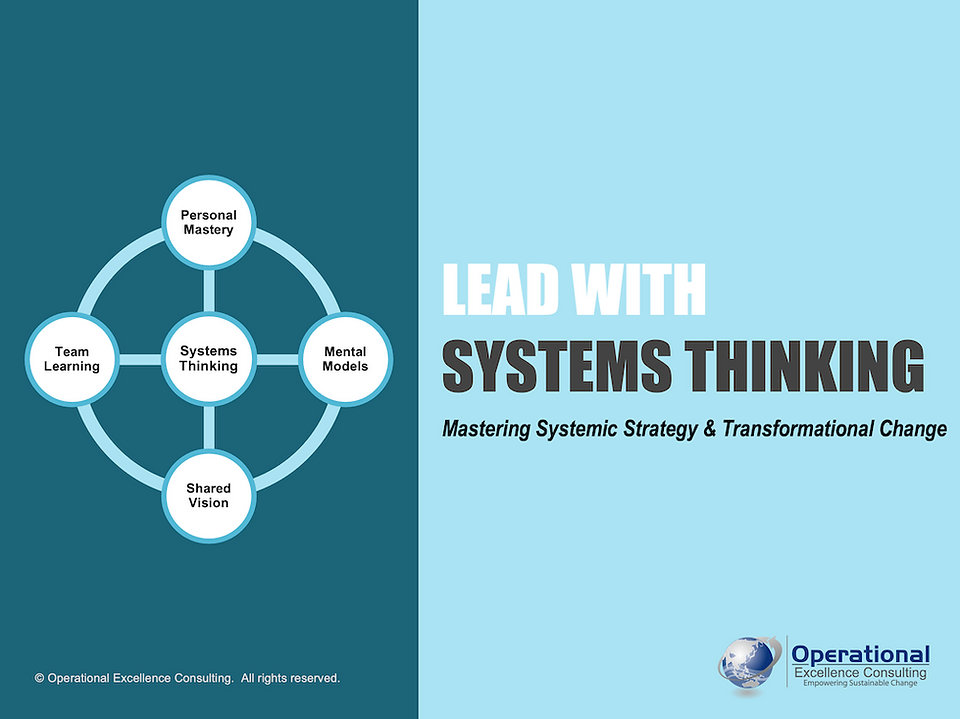
Lead with Systems Thinking 
Customer Journey Mapping 
Change Management 
Customer-Centricity