


Systems Thinking: A Practitioner's Guide to Leading in Complexity
Updated: Sep 17
By Allan Ung | Founder & Principal Consultant, Operational Excellence Consulting
Updated on 10 April 2026

Allan Ung is the Founder and Principal Consultant of Operational Excellence Consulting, a Singapore-based firm established in 2009. A veteran practitioner with over 30 years of experience — including senior leadership roles at IBM, Microsoft, and Underwriters Laboratories — Allan specialises in bridging the gap between human-centred discovery and operational execution. As a Design Thinking Coach and Certified Management Consultant (Japan), he integrates Systems Thinking with Design Thinking and Lean to help organisations solve problems that are dynamic, multi-layered, and deeply interconnected. His approach has been applied across manufacturing, healthcare, public sector, technology, and logistics clients including Integrated Health Information Systems, ST Electronics (Satcom & Sensor Systems), Cisco, PSA, and organisations across 50+ countries.
Introduction: The Skill That Connects Everything Else
In the World Economic Forum's Future of Jobs Report 2025, Systems Thinking is explicitly identified as a core workforce skill — alongside analytical thinking, empathy, leadership, and resilience — that will be in high demand by 2030.
This recognition is not coincidental, and it is not new. Peter Senge codified Systems Thinking as a leadership discipline in The Fifth Discipline in 1990. What has changed is the context that makes the skill urgent. The challenges organisations face today — AI acceleration, ESG pressures, global supply chain disruption, healthcare systems under strain, workforce transformation — share a common character: they are not isolated problems. They are systems problems. And they will not be solved by the same linear, event-focused thinking that created them.
The data makes the gap between current practice and what is needed unambiguous. Seventy percent of organisational change efforts fail, in large part due to the absence of systems thinking and organisational learning. Ninety-four percent of problems in organisations are system-driven, not people-driven — yet most improvement efforts target people. Organisations that apply systems thinking are five times more likely to achieve their long-term strategic goals than those that do not.
This is the capability gap that Systems Thinking addresses. And it is the discipline that — in OEC's practice — integrates and amplifies every other: Design Thinking, Lean, Human-Centred Systems Thinking, and Critical Thinking all work better when the people applying them can see the system they are working within.
What Systems Thinking Is — and Why It Is Needed Now
Systems Thinking is a discipline for seeing the whole rather than the parts. It focuses on patterns, interrelationships, and the systemic structures that generate behaviour over time — rather than on individual events, isolated causes, or symptomatic fixes.
The contrast with traditional thinking is precise. Traditional problem-solving focuses on events and symptoms, applies short-term fixes, assigns individual blame, and treats challenges as isolated failures. Systems Thinking focuses on patterns and structures, applies long-term systemic solutions, builds shared responsibility, and treats challenges as emergent properties of the system that generates them.
This is not merely a philosophical distinction — it has direct operational consequences. As Peter Senge observed: "When we fail to grasp the systemic source of problems, we are left to 'push on' symptoms rather than eliminate underlying causes." The organisation that repeatedly retrains its customer service staff without addressing the information system fragmentation that prevents agents from accessing complete customer histories is pushing on a symptom. The organisation that redesigns its hiring process without addressing the management culture that drives attrition is solving the wrong problem. Systems Thinking redirects the effort to where it will have durable effect.
Three mindset shifts characterise effective systems thinkers:
From control to learning. Leaders move from the assumption that they have the answers to creating conditions for experimentation, adaptation, and collective intelligence. The goal shifts from managing outcomes to building capacity.
From blame to shared responsibility. Problems are understood as system-driven, not people-driven — echoing Deming's insight that the vast majority of organisational failures originate in the system, not in the individuals operating within it. This is not a moral stance but a practical one: blaming individuals without changing the system produces the same outcomes with different people.
From reacting to redesigning. Instead of responding to events as they occur, leaders redesign the structures, incentives, information flows, and feedback loops that generate those events in the first place.
The VUCA Context: Why Complexity Has Outpaced Traditional Leadership
The business environment that Systems Thinking was designed for has only become more demanding since Senge first described it.
Volatile — The environment demands rapid response to ongoing changes that are unpredictable and outside organisational control. Supply chain shocks, regulatory shifts, technological disruption, and geopolitical events create conditions where yesterday's strategy becomes today's liability.
Uncertain — The environment requires action without certainty. Leaders cannot wait for complete information before making decisions. The capacity to act on partial information — and to learn from the results — is itself a competitive advantage.
Complex — The environment is dynamic, with deep interdependencies across functions, organisations, industries, and geographies. What happens in one part of the system propagates, often unexpectedly, into others.
Ambiguous — The environment is frequently unfamiliar, outside established expertise. Problems arrive in forms that prior experience does not directly address.
Linear thinking fails in VUCA conditions. Systems Thinking was built for them. The capacity to see patterns over time, to understand feedback dynamics, to identify high-leverage intervention points, and to anticipate second- and third-order consequences is precisely what VUCA environments demand of leaders.
The AI dimension adds a further layer of urgency. AI amplifies both capability and systemic risk. Algorithms optimise locally — and leaders must think systemically. Automation improves efficiency but can erode human capability and institutional knowledge if the skill development systems that compensate for it are not deliberately maintained. AI-driven decisions can reinforce bias through hidden feedback loops that are invisible without systems awareness. Productivity gains from AI can create long-term skill atrophy if the learning architecture of the organisation is not protected. Systems Thinking is the leadership capability that allows organisations to capture AI's benefits without inadvertently destroying the human systems that make those benefits sustainable.
The Learning Organisation: The System That Makes Systems Thinking Work
Systems Thinking does not succeed in isolation. It thrives — and its tools become genuinely powerful rather than decorative — within what Peter Senge described as a Learning Organisation: an entity that continuously enhances its capacity to create its future, that fosters learning at individual, team, and organisational levels simultaneously, and that is built to evolve in the face of complexity rather than resist it.
A Learning Organisation is not defined by its training catalogue. It is defined by three integrated elements: Guiding Ideas (the purpose, vision, and core values that provide strategic direction and align individual purpose with organisational goals), Infrastructural Innovations (the platforms, systems, and processes that enable collaboration and knowledge sharing), and Theories, Tools and Methods (the Systems Thinking practices, dialogue tools, and reflection disciplines embedded into daily work rather than reserved for workshops).
These elements are enacted through a continuous Learning Cycle with three reinforcing stages. Awareness and Sensibilities — cultivating the ability to see patterns, recognise systemic issues, and sense early signals of change. Attitudes and Beliefs — shifting mindset from control to learning, fostering curiosity, reflection, and willingness to challenge assumptions. Skills and Capabilities — building practical tools, collaborative methods, and systems thinking competencies that translate awareness and mindset into effective action.
The critical point is that these stages are interdependent and mutually reinforcing. Skills without awareness produce technically competent people operating with the wrong mental models. Awareness without skills produces frustrated diagnosis without the ability to act. Mindset without either produces goodwill without impact.
The Six Learning Disabilities: Why Organisations Fail to Learn
Before the disciplines that build a Learning Organisation can be applied, the barriers that prevent learning must be named. Senge identified six recurring patterns — learning disabilities — that exist across industries and organisational types, reinforcing themselves over time unless addressed systemically.
1. I Am My Position — Employees see themselves only through their role, losing connection to the larger system they operate within. The result is silo mentality, limited accountability, and an inability to understand how one's actions affect others downstream. The fix requires expanding individual identity beyond job boundaries and fostering system-wide accountability.
2. The Enemy Is Out There — Problems are attributed to external forces or other departments, avoiding responsibility for systemic issues. The culture becomes fragmented and defensive. The fix requires shared vision and collective ownership of challenges — a recognition that "out there" and "in here" are parts of the same system.
3. The Illusion of Taking Charge — Action is taken without understanding systemic causes, confusing activity with effective change. Quick fixes are implemented that address symptoms, leaving the underlying structures intact and generating the same problems again. The fix requires applying Systems Thinking tools to identify and address root causes before acting.
4. The Fixation on Events — Attention is consumed by short-term events rather than the long-term patterns that reveal system structure. Leaders become reactive, fighting the latest fire without noticing the recurring pattern that connects all the fires. The fix requires shifting from event-driven responses to pattern recognition and structural analysis.
5. The Parable of the Boiled Frog — Slow, incremental threats go unnoticed because each individual change is too small to trigger a response. The organisation habituates to gradually worsening conditions until the situation is serious. The fix requires cultivating systemic awareness and developing early sensing capabilities — the organisational equivalent of peripheral vision.
6. The Myth of the Management Team — Management teams suppress dissent, avoid difficult conversations, and present a unified front that conceals the divergence of views beneath it. Real collective intelligence is replaced by the appearance of alignment. The fix requires fostering open dialogue, psychological safety, and genuine team learning practices where uncertainty is shared rather than hidden.
The Five Disciplines: Building the Learning Organisation
The five disciplines that Senge identified are the building blocks of the Learning Organisation. They develop in parallel rather than in sequence — each strengthening the others — and they require leadership commitment to model before they can be embedded in teams and systems.

Personal Mastery is the discipline of individual growth and lifelong learning. It begins with clarity of personal vision: understanding one's own purpose, values, and aspirations, and aligning them with the organisation's direction. The engine of Personal Mastery is creative tension — the productive gap between current reality and desired future that, rather than being resolved by lowering the vision, is held as a source of learning energy and motivation. Leaders who model Personal Mastery create permission for others to be honest about their own development gaps.
Mental Models is the discipline of surfacing and challenging assumptions. Every person operates from mental models — deeply ingrained beliefs, assumptions, and mental habits that shape how they understand the world and make decisions. These models are largely invisible, which is precisely what makes them powerful and dangerous. The practice of Mental Models requires slowing down to examine thinking habits, sharing reasoning transparently with others, and balancing advocacy (expressing one's views) with genuine inquiry (inviting challenge to those views). When mental models remain unexamined, they become the invisible architecture that ensures the organisation continues to produce the same outcomes regardless of what changes are made at the surface level.
Shared Vision is the discipline of building common purpose — creating a shared picture of the future that fosters genuine commitment rather than mere compliance. The distinction matters enormously: compliance produces effort directed at satisfying a requirement; commitment produces energy directed at achieving a genuinely desired outcome. Shared Vision is built through co-creation — engaging all levels of the organisation in shaping the future rather than communicating it downward. Vision connected to individual purpose and core values creates the alignment that makes coordinated action possible without requiring constant managerial coordination.
Team Learning is the discipline of collective dialogue. Teams that learn together develop the capacity to think collectively, to build shared understanding of complex situations, and to produce insights that exceed what any individual could generate alone. Team Learning requires dialogue — a quality of listening and exchange that suspends individual assumptions and allows new thinking to emerge — as distinct from discussion, where positions are defended. It also requires what Chris Argyris called "skillful discussion": the ability to hold opposing views in productive tension rather than forcing premature resolution.
Systems Thinking is the Fifth Discipline — the integrating discipline that "makes the whole greater than the sum of its parts." It connects and aligns Personal Mastery, Mental Models, Shared Vision, and Team Learning into a coherent practice. Without Systems Thinking, the other four disciplines remain isolated tools. With it, they become mutually reinforcing — each discipline strengthening the others and all of them strengthening the organisation's capacity to navigate complexity.
Key Systems Thinking Tools for Practitioners
The analytical power of Systems Thinking is made practical through a set of visual tools that make the invisible visible — allowing teams to see system structure, diagnose feedback dynamics, and identify leverage points for intervention.
The Iceberg Model
The most foundational diagnostic tool distinguishes four levels of reality at which any problem can be observed and addressed:
Events — the observable, visible behaviour that triggers a response. Customer complaints. Quality defects. Staff turnover. Most organisations operate here, reacting to events as they occur.
Patterns and Trends — what has been happening over time. Recurring complaints about the same service failure. Steadily increasing defect rates. Seasonal attrition spikes. Recognising patterns moves the organisation from reactive to anticipatory — but the structural cause remains invisible.
Underlying Structures — the policies, incentives, processes, information flows, and organisational design that generate the pattern. This is where leverage lives. Changing a structure changes the pattern of events it generates.
Mental Models — the beliefs, assumptions, and worldviews that cause people to design and maintain those structures. This is the deepest and most durable level of intervention. A healthcare system designed by leaders who believe patients are primarily responsible for their own recovery will generate very different structures — and very different patterns of events — than one designed by leaders who believe recovery is a shared responsibility.
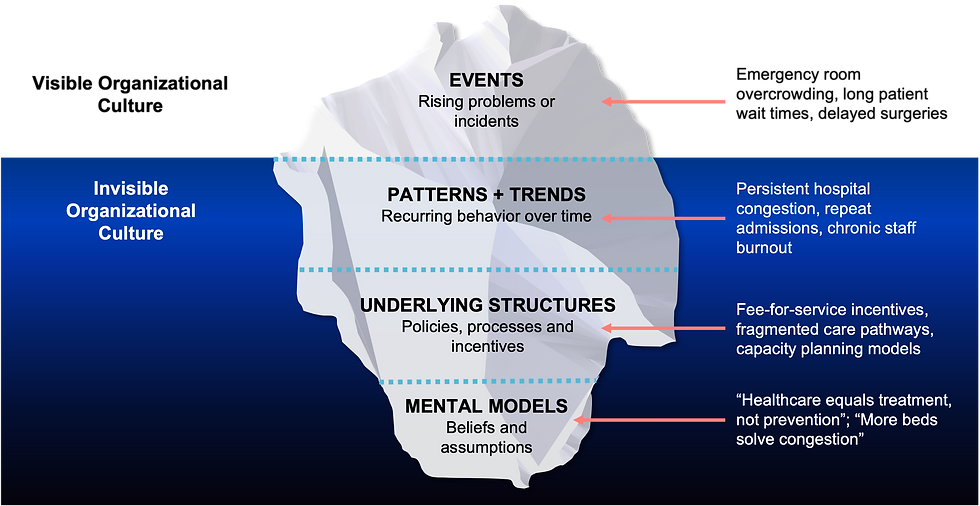
The Iceberg is not merely a diagnostic tool — it is a discipline for resisting the pull of the obvious fix. By requiring teams to descend through all four levels before intervening, it ensures that solutions address structures and mental models rather than events and symptoms.
Causal Loop Diagrams
Causal Loop Diagrams (CLDs) map the cause-and-effect relationships between variables in a system, making feedback dynamics visible. Two types of feedback loop drive all system behaviour:
Reinforcing loops (also called positive feedback loops) amplify change in one direction. More population leads to more births leads to more population. More customer satisfaction leads to more referrals leads to more customers. More organisational capability leads to better results leads to more investment in capability. Reinforcing loops drive growth — or collapse, depending on direction.

Balancing loops (also called negative feedback loops) resist change and seek stability. More population leads to more deaths, which reduces population — a self-correcting mechanism that prevents unbounded growth. More errors trigger quality inspection, which reduces errors — a stabilising feedback. Balancing loops are the system's homeostatic mechanisms; they are also the reason that many improvement efforts fail. A balancing loop that counteracts every performance improvement — the organisational equivalent of a thermostat — will continue to restore the original condition unless the loop structure itself is changed.
Understanding the loop structure of a system reveals why problems persist. The manager who asks "why does this keep happening despite everything we've tried?" is usually facing a reinforcing loop driving the problem or a balancing loop resisting the fix — and often both simultaneously.
Stock and Flow Diagrams
Where Causal Loop Diagrams reveal structure, Stock and Flow Diagrams reveal dynamics — how the state of the system changes over time as variables accumulate and deplete. Stocks are what accumulates: inventory, knowledge, trust, skilled employees, customer goodwill, cash. Flows are the rates at which stocks increase (inflows) or decrease (outflows). Understanding stocks and flows is essential for understanding delays — the time between an intervention and its observable effect — which is one of the most common sources of poor decision-making in complex systems.

Leaders who cut training investment to reduce costs often do not see the capability depletion that results until years later, when the inflow of skilled talent has dried up and the stock has depleted below operational threshold.
System Archetypes
System archetypes are recurring structural patterns that appear across organisations and industries — generic templates of how systems generate problematic behaviour. Recognising an archetype in operation allows the practitioner to predict where an intervention will fail before implementing it.
The three most important archetypes for organisational leaders are: Fixes That Fail — where a short-term fix addresses the symptom and relieves pressure, but the unintended side effect worsens the original problem over time (and the pressure mounts again); Shifting the Burden — where symptomatic solutions divert attention and resources from the fundamental solution, atrophying the organisation's capacity to address root causes; and Limits to Growth — where a reinforcing growth process encounters a constraining factor that, if not identified and addressed, will halt and eventually reverse the growth.
Leverage Points: Where Small Interventions Produce Large Effects
Donella Meadows' framework of leverage points identifies where in a system an intervention will produce the greatest systemic change. From lowest to highest leverage: changing numbers and parameters (adjusting budgets, targets, rules) produces small, temporary effects; changing the structure of information flows (who has access to what information, when, and in what form) produces significantly larger effects; changing the rules of the system (incentives, constraints, policies) produces yet larger effects; changing the goals of the system produces transformational effects; and changing the mental models and paradigms out of which the system arises produces the deepest and most durable change.

In practice, most improvement efforts concentrate at the lowest leverage levels — adjusting parameters. Systems Thinking directs attention upward: to information flows, rules, goals, and ultimately mental models. The insight that changes the way people see the system is the highest-leverage intervention of all.
The Five Whys — Applied Systemically
The Five Whys is familiar from Lean and quality improvement practice. In its Systems Thinking form it takes on greater power. Rather than seeking a single linear root cause, the systems practitioner uses iterative "why" questioning to trace causal chains through the system, looking for the feedback loops and structural conditions that allow the problem to perpetuate.
The example from the PPT is instructive: customer complaints about delayed shipments lead to the discovery that orders were not processed on time — because the order system crashed — because server maintenance was missed — because the IT team did not receive maintenance alerts — because the notification system was not configured correctly. Root cause: faulty alert system in IT operations. But the Systems Thinking practitioner goes further: why was the faulty configuration not caught? What feedback loop should have detected it? What structural condition allowed a misconfiguration to persist long enough to become a customer complaint? The Fifth Why is the beginning of structural analysis, not the end of it.
Complementary Thought Leaders Who Extend Systems Thinking
OEC's Systems Thinking framework draws on a rich intellectual tradition beyond Senge. Several complementary thinkers add important dimensions:
Donella Meadows (Thinking in Systems) contributed the leverage points framework and the identification of system traps — common failure patterns in complex systems that produce predictable bad outcomes unless the underlying archetype is recognised and redesigned.
Russell Ackoff introduced the concept of "messes" — complex, interconnected challenges that cannot be solved by addressing any single component in isolation — and Idealized Design, which asks organisations to design their systems from scratch as if unconstrained by current reality, before working back to identify the changes needed to move toward the ideal.
Fritjof Capra extended systems thinking into the ecological dimension — understanding organisations as nested within societal, ecological, and planetary systems. His framework is increasingly relevant as ESG pressures require leaders to understand how their organisations interact with systems beyond their immediate operational context.
Peter Checkland developed Soft Systems Methodology (SSM) — a participatory, structured approach to tackling complex, ill-defined problems. Its CATWOE framework (Customers, Actors, Transformation, Worldview, Owners, Environment) provides a disciplined way to explore multiple stakeholder perspectives before designing solutions, preventing the trap of optimising for one worldview at the expense of others.
Gregory Bateson contributed the distinction between single-loop and double-loop learning. Single-loop learning improves the system as it exists — solving problems within current assumptions. Double-loop learning questions the assumptions themselves — asking whether the problem is the right problem to be solving, whether the goals are the right goals, whether the underlying mental models that define the situation are accurate. Learning organisations that remain at single-loop are efficient but not adaptive. Double-loop learning is what makes genuine organisational transformation possible.
Global Organisations That Lead with Systems Thinking
The proof that Systems Thinking is practical rather than theoretical is visible in how leading organisations embed it into their operations.
Toyota's entire Lean Production System is understood as a socio-technical system — a unified structure that balances operational efficiency with human development. Kaizen, practised at all levels, is Systems Thinking in action: continuously adjusting system performance, adapting to reality, and aligning with evolving goals. Leaders at Toyota are teachers; the system is designed to surface problems so they can be solved at their root, not concealed so the production line keeps running.
Unilever's Sustainable Living Plan embedded systems thinking into business strategy — recognising that business performance, social outcomes, and environmental health are not trade-offs but interdependencies. The plan integrated environmental and social systems into supply chain and product decisions, demonstrating that systems thinking at the strategic level is both commercially viable and increasingly necessary.
Shell's scenario planning practice is perhaps the most famous application of systems thinking in strategic leadership — developing multiple coherent futures rather than a single forecast, and using systems analysis to understand the structural forces that make each future more or less plausible. The practice has given Shell strategic resilience through energy transitions that have disrupted less systemically aware competitors.
Common Pitfalls: Why Systems Thinking Fails in Practice
Even well-intentioned organisations stumble when applying systems thinking. The failure modes are themselves systemic — they reflect the same learning disabilities that Systems Thinking is designed to address.
Fixation on events. Teams use systems thinking tools to document what happened rather than to understand what structures are generating the pattern. The Iceberg becomes a more elaborate way of describing the waterline rather than a discipline for descending below it.
Quick fixes masquerading as structural change. The language of systems thinking is adopted — "root cause," "feedback loop," "leverage point" — but the interventions remain at the parameter level. Nothing structural changes. The learning disability of the Illusion of Taking Charge persists under new vocabulary.
Silo thinking. Systems maps are built within departmental boundaries. The interdependencies across those boundaries — where the most significant leverage points typically live — remain invisible.
Blame culture. Even after systems mapping reveals structural causes, individuals are held responsible for outcomes generated by the system. This undermines the psychological safety required for genuine dialogue and learning.
Suppressed dialogue at leadership level. The Myth of the Management Team persists. Systems maps are created but their implications are never surfaced in leadership conversations. The tools are present; the learning culture is not.
The antidote to all of these is the same: Systems Thinking must be embedded in the practices of the organisation, not applied as a one-off analytical exercise. It requires leadership modelling, psychological safety for genuine dialogue, and the structural conditions — time, incentives, information architecture — that allow learning to become a daily practice rather than a quarterly workshop.
Further Learning: The Design Thinking Cluster
This article is part of OEC's Design Thinking and Human-Centred Innovation cluster. Related practitioner guides and resources:
Cluster articles:
Design Thinking: A Practitioner's Guide to Human-Centred Innovation — The hub: 5-step process, 5 mindsets, and the broader innovation system within which Systems Thinking operates
Customer Journey Mapping: A Practitioner's Guide — Visualising and redesigning the customer experience using the seven map elements and five-step CJM process
Human-Centred Systems Thinking: A Practitioner's Guide — Integrating Design Thinking and Systems Thinking to solve complex, multi-layered organisational problems
Critical Thinking: The 4-Lens Model — Analytical rigour for stress-testing systems diagnoses and evaluating competing intervention hypotheses
Behavioural Root Cause Analysis (bRCA): A Practitioner's Guide — The behavioural diagnostic tools required to address the deep-seated structures and mental models
Training courses and workshops:
Training presentations:
About the Author

Allan Ung is the Founder and Principal Consultant of Operational Excellence Consulting, a Singapore-based firm established in 2009. With over 30 years of experience, Allan specializes in the intersection of human-centered innovation and operational discipline. While his roots are in manufacturing-intensive environments, he has pioneered a "Design-to-Delivery" approach that ensures creative solutions are both desirable for users and sustainable within complex systems.
As a Design Thinking Coach and Certified Management Consultant (CMC, Japan), Allan helps organizations move beyond ideation to tangible impact. His expertise spans Lean Thinking, Total Quality Management (TQM), and Systems Thinking, providing a pragmatic framework that allows teams to prototype, test, and scale innovations rapidly.
In senior regional and global roles at IBM, Microsoft, and Underwriters Laboratories, Allan led cross-border operational transformations that balanced technical efficiency with human-centered service design. He has facilitated Design Thinking, Lean, and Quality programmes for diverse organizations, including Ministry of Social & Family Development, Integrated Health Information Systems, ST Electronics (Satcom & Sensor Systems), Ministry of Education, Health Sciences Authority, PSA, Cisco, Vermeg, Walldorf Consulting, Tokyo Electron, Panasonic, Sika Group, Toyota Tsusho, Fugro Subsea Technologies, Lam Research, and NEC.
Allan holds a Bachelor of Engineering from the National University of Singapore and completed advanced consultancy training in Japan as a Colombo Plan scholar. He is a Lean Six Sigma Black Belt, JIPM-certified TPM Instructor, and TWI Master Trainer.
His philosophy: "True innovation is found at the intersection of empathy and discipline—identifying the right human problems through Design Thinking and solving them permanently through Lean execution."
His practitioner-led toolkits are used by managers across 50+ countries to build internal capability and drive sustainable organizational improvement.
👉 Learn more at: www.oeconsulting.com.sg
Further Learning Resources
Operational Excellence Consulting offers a full catalog of facilitation‑ready training presentations and practitioner toolkits designed to support leaders in driving innovation, aligning teams, and leading organizational transformation. These resources are developed from real workshops and executive programs, helping organizations embed strategic frameworks, strengthen leadership capability, and achieve sustainable growth.
👉 Explore the full library at: www.oeconsulting.com.sg

Critical Thinking for Problem Solving 
Design Thinking 
Human-Centered Systems Thinking 
Analytical Thinking 
Lean Thinking 
Lead with Systems Thinking 
Customer Journey Mapping 
Change Management 
Customer-Centricity