


Mastering the Lean Production System: A Practitioner's Guide to Flow, Signaling, and Waste Elimination
Updated: 6 days ago
By Allan Ung | Founder & Principal Consultant, Operational Excellence Consulting (OEC)
Published: 01 August 2026

Allan Ung is the Founder and Principal Consultant of Operational Excellence Consulting (OEC), a Singapore-based management training and consulting firm established in 2009 specialising in Lean management and Design Thinking practices. With over 30 years of experience leading shopfloor transformation programmes — including senior roles at IBM, Microsoft, and Underwriters Laboratories (UL) — Allan teaches the Lean Production System as the backbone of his Lean Thinking, Value Stream Mapping, and 5S workshops for manufacturing teams across Singapore and the region.
He holds a Bachelor of Engineering (Mechanical) from the National University of Singapore and completed advanced consultancy training in Japan as a Colombo Plan Scholar. Allan is a Certified Management Consultant (Japan), a Certified Lean Six Sigma Black Belt, and an accredited TPM Instructor.
Every shopfloor manager has, at some point, stood in front of a mountain of work-in-process and felt reassured by it. It looks like productivity. It is usually the opposite.
I have run this exercise dozens of times in Lean Thinking workshops: I ask a room of operations leaders what a "well-run" line looks like, and the first answers are almost always the same — machines running, people busy, shelves full. Then I ask them to walk their own floor with a stopwatch and mark every point where a part sits still. The mountain of "productivity" turns out to be inventory waiting between departments, WIP piling up because the next station isn't ready, and finished goods sitting in a warehouse because a forecast said to build them. None of that is value. All of it is cost, disguised as busyness.
Just-in-Time thinking exists to correct exactly this illusion. It is not a scheduling technique bolted onto an existing factory. It is a different definition of what "good" looks like on the floor — one where the right items, in the right amount, arrive at the right time, and nothing more. That reframing is the foundation this whole guide, and the three practitioner guides that follow it, are built on.
🚀 Stop managing inventory and start mastering flow. This practitioner guide is based on our Just-in-Time (JIT) Training Presentation & Implementation Toolkit, a comprehensive 100+ slide masterclass designed for high-authority shopfloor delivery. Why download this toolkit? ✅ Eliminate the costliest wastes: Step-by-step blueprints to target overproduction and excess inventory. ✅ Synchronize with demand: Learn the professional mechanics of Heijunka (Leveling) and Takt Time calculation. ✅ Facilitation-Ready: Includes 4 interactive team activities and a 30-day action plan template to move from theory to floor-level results. 👉 Download the JIT Masterclass PPTX Toolkit. “JIT is not a program you install—it is a way of thinking about flow and waste every day.” |
The Real Goal Is Waste Elimination, Not Speed
It is a common misreading to treat JIT as a speed initiative — get product out the door faster. The actual target is narrower and more useful: eliminate the waste (Muda) that consumes resources without adding value the customer would pay for. Speed is a downstream effect of waste removal, not the goal itself.
Waste in manufacturing sorts into eight recognisable categories: defects, waiting, over-processing, overproduction, motion, excess inventory, transportation, and underused talent. Of these, two deserve special attention because they compound the other six.
Overproduction — making more than the next process needs, or before it needs it — is the costliest waste of all, because it consumes materials and labour too early, ties up cash and space, and creates piles of WIP that hide defects rather than expose them. The JIT countermeasure is simple to state and hard to practice: produce only to actual, current demand, and let the next process pull what it needs rather than pushing whatever you finished.
Inventory looks like security. It is, in practice, cash and problems sitting on the floor. The visible cost is what you paid to purchase or make the item. The hidden costs run underneath: storage, handling labour, damage and obsolescence risk, and — the one that matters most to a practitioner — the way inventory conceals quality and scheduling problems that would otherwise surface immediately. "We might need it someday" is an expensive sentence. Inventory should be the exception a team can justify, not the default plan.

Seeing this waste is rarely automatic — most of it hides in the gaps between departments, invisible to anyone working within a single station. It takes a structured technique to pull it into view across an entire value stream, not just one process.
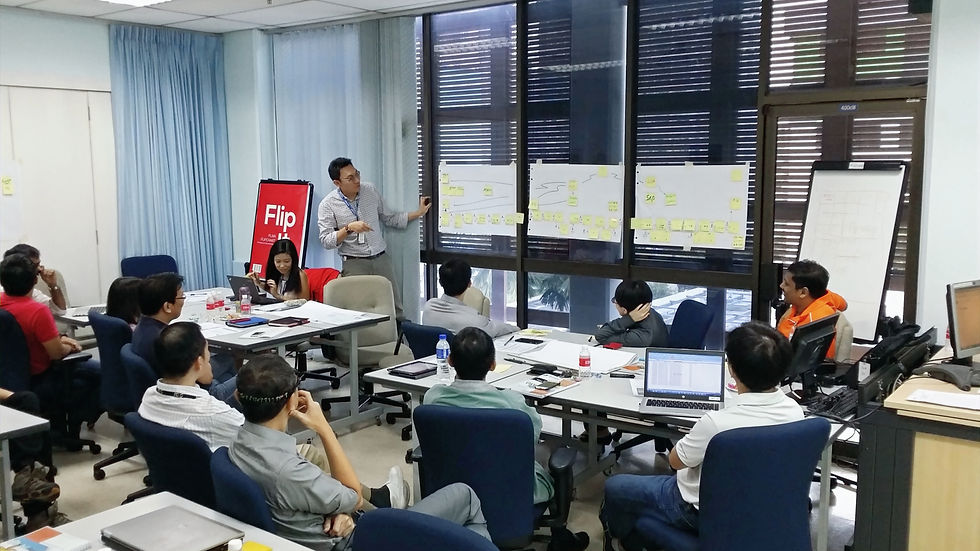
This is not a hypothetical exercise. When OEC facilitated Value Stream Mapping with Micron's Assembly, Test, and Module departments in Singapore, the current-state maps the teams drew — with real cycle times, WIP counts, and changeover data attached — surfaced additional improvement opportunities worth close to US$1 million within four weeks, on top of what earlier industrial-engineering methods had already found. The overproduction and inventory waste described above rarely announces itself. It takes a team mapping the whole flow, end to end, to see where it is actually sitting. I cover the full methodology behind that kind of exercise — the four-phase VSM process, the icons, and the metrics that make waste measurable — in Value Stream Mapping (VSM): The Complete Practitioner Guide.
Seeing Work as Process and Operation, at the Same Time
JIT improvement requires holding two different views of the same work in your head simultaneously, and most improvement efforts fail because they only ever use one.
A process is the flow of material or information over time and space — from raw material, through every station, to the finished product delivered to the customer. Think of it as the whole river. An operation is the specific work performed by a person or machine at one station — one bend in that river. Cutting, welding, painting: each is an operation nested inside the larger process.
The reason this distinction matters practically is that the two are improved by entirely different means. You improve a process by redesigning layout, sequencing, and how material flows between stations — reducing distance, waiting, and handoffs. You improve an operation by addressing motion, method, and skill at that single station — reducing wasted movement and variation. Fix only one side of this scale and real waste stays in place. A beautifully redesigned layout with sloppy work at each station still underperforms. A perfectly drilled-in standard operation inside a badly laid-out process still walks miles of unnecessary travel every shift. True JIT improvement addresses both, together — which is exactly why this guide splits into the spoke articles it does: Cellular Manufacturing tackles the process side in depth, while the JIT Support Tools guide tackles operation-level stability.
Leveling and Kanban: Pacing the Line to Real Demand
Once a team can see waste and can distinguish process from operation, JIT gives them two practical systems to act on that understanding: leveled production and kanban.
Leveling (Heijunka) replaces large, single-product batches with a small, repeating mix. Picture two ways of scheduling the same total volume. A "shish-kebab" schedule runs one long block of Product A, then Product B, then Product C — like giant chunks of meat on a skewer rather than a mixed kebab. It looks efficient on a Gantt chart, but a customer ordering Product C may wait weeks for that run to come around, and large WIP piles build up between runs. A leveled schedule instead builds A, B, C, A, B, C in small, repeated batches all day. Every product ships every day, workload stays smooth and predictable, and far less WIP sits idle.

Leveling needs a pace to level to — that pace is takt time, calculated as available production time divided by customer demand. If a line has 420 minutes available per shift and the customer orders 240 units, takt time is 1.75 minutes per unit. Run faster than takt, and the line overproduces. Run slower, and it falls behind the customer. Takt time is the heartbeat every station on the line answers to, and it resurfaces — recalculated for different contexts — in both spoke guides that follow this one.
Kanban is the signal that turns leveling from a schedule on paper into a live, physical discipline. A kanban is a card or signal that authorises exactly what to produce or move, and nothing more — pulling material through the process on real demand rather than letting an upstream process push whatever it finished. The mechanism is a loop: a container and its card move downstream together; when the container empties, the card authorises a refill; the empty container and card return upstream to trigger replenishment. Six basic rules protect this loop — from "downstream withdraws only what is needed" through to "reduce the number of kanban over time," which is the discipline that turns kanban from an inventory-control tool into a continuous-improvement engine. Fewer cards mean less permitted inventory, which exposes the next problem worth solving.
Leveling and kanban divide the work cleanly: leveling sets the pace — what mix to build and how fast each unit must be completed to match demand. Kanban sends the signal — exactly when to build the next unit, authorised by real consumption. Leveling decides the rhythm; kanban keeps everyone dancing to it in real time.
Process-Flow Layout: Arranging the Floor Around the Part, Not the Machine
Most factories that have never touched JIT are laid out by operation — all lathes together, all mills together, all presses together. It feels organised. It scatters the part's actual journey. A single component zigzags across the floor: lathes to presses to mills to lathes to paint, crossing paths again and again. The hidden cost is heavy transport waste, large WIP piles waiting between departments, and long lead times even when each individual operation is fast.
The JIT alternative arranges machines in the order the part is actually made, not by machine type. The same part now flows straight through, station to station, in one direction. Travel distance and handling collapse, WIP shrinks because there is nowhere left to pile it, and lead time can drop from weeks to hours or minutes for the same physical operations, performed in a different order in space.

This is where JIT hands off to a body of implementation detail too large for one article: designing the physical cell itself — U-shapes, operator walk-paths, multi-machine operation, and the structured three-phase method for converting a scattered layout into a working cell — is the entire subject of the Cellular Manufacturing guide in this series.
Support Tools and Signaling: What Keeps the System Honest Day to Day
Two further bodies of practice sit underneath everything covered so far, and each earns its own dedicated guide rather than a summary here.
The first is the daily discipline that keeps flow, quality, and equipment dependable: 5S, quick changeover (SMED), poka-yoke and Zero Quality Control, and Total Productive Maintenance. None of these are optional add-ons — a leveled schedule that still takes an hour to change over a machine is a leveled schedule in name only, and low-inventory JIT depends on equipment that rarely breaks down without warning. I cover the full mechanics of these support tools, including SMED's three-stage method and TPM's autonomous-maintenance routines, in JIT Support Tools: Building the Foundations of Stability.
The second is the operational detail of how a kanban system is actually sized, run, and extended — production versus withdrawal kanban, how many cards a process needs, one-stage versus two-stage pull with supermarkets and water beetles, and the Five Steps that take a factory from its current operation-based layout to genuine pull production. That detail lives in Pull Production: The Signal and Flow Control.
The Discipline, Not the Project
The single idea I most want a reader to leave this guide with is this: no tool in the Lean Production System works alone. Leveling needs kanban to enforce it on the floor. Kanban needs process-flow layout and cells to make the signal physically meaningful. Cells need standard work to hold their gains. Standard work needs 5S and visual management to stay visible. Pull it apart at any joint and the system degrades back toward the mountain of WIP I described at the start of this guide.
Just-in-Time is not a program you install over a weekend, and it does not end once the layout is redrawn or the kanban cards are printed. It is a daily discipline of asking, at every station, whether what's happening right now matches what the customer actually needs right now — and treating any gap between the two as the next problem to solve, not as a buffer to build. Start small. Start with one line, one cell, one kanban loop. Let the next problem you see on the floor be the next thing you fix.
Build Lean Production System Capability
Reading about waste elimination and pull signaling gets a team to the whiteboard. Applying it on a real floor — sizing a kanban loop, redesigning a layout around a monument machine, cutting a changeover from an hour to under ten minutes — is where the actual gains happen, and it is best learned hands-on.
Continue with Cellular Manufacturing: A Practitioner's Guide to the Physical Transformation for the three-phase method behind converting a scattered layout into a working cell
Continue with Pull Production: A Practitioner's Guide to Signal and Flow Control for kanban sizing, supermarkets, and the Five Steps to pull implementation
Continue with JIT Support Tools: Building the Foundations of Stability for SMED, poka-yoke, and TPM
Explore OEC's Lean Thinking, Value Stream Mapping, and 5S workshops, where these concepts are taught hands-on with your own shopfloor as the case study
About the Author

Allan Ung is the Founder and Principal Consultant of Operational Excellence Consulting (OEC), a Singapore-based management training and consulting firm he established in 2009 to help organisations maximise customer value and minimise waste through the disciplined application of Lean management and Design Thinking.
Over more than three decades in operations and quality leadership, Allan has held senior roles at IBM, Microsoft, and Underwriters Laboratories (UL), and spent formative years with Singapore's National Productivity Board, where Cost of Quality and Total Quality Process programmes he led achieved quality-cost reductions of up to 50% for participating organisations.
Allan holds a Bachelor of Engineering (Mechanical) from the National University of Singapore and completed advanced consultancy training in Japan as a Colombo Plan Scholar, studying the Toyota Production System and Japanese quality management practices at their source. He is a Certified Management Consultant (Japan), a Certified Lean Six Sigma Black Belt, and an accredited TPM Instructor.
The Lean Production System — Just-in-Time, kanban, cellular manufacturing, and the daily support tools that sustain them — sits at the centre of Allan's Lean Thinking, Value Stream Mapping, and 5S workshops, delivered to manufacturing and operations teams across sectors including electronics, marine and offshore, healthcare, and process industries. His training presentations and toolkits are used by organisations across Asia, Europe, and North America to build shopfloor capability that outlasts any single consulting engagement.
Allan's guiding philosophy: "Improvement is not an event — it is what happens every day, one small, honest fix at a time."
👉 Learn more at: www.oeconsulting.com.sg
Related Articles and Resources
This article forms part of the hub of OEC's Lean Thinking content cluster. Each spoke article explores one dimension of Lean in depth:
Hub article
Cellular Manufacturing
Cellular Manufacturing: A Practitioner's Guide to the Physical Transformation — the three-phase method for converting a scattered, operation-based layout into a process-based cell
Pull Production
Pull Production: A Practitioner's Guide to Signal and Flow Control — kanban sizing, the Five Steps to Pull Production, and supermarket/water-beetle mechanics
Just-in-Time
JIT Support Tools: Building the Foundations of Stability — SMED, poka-yoke, Zero Quality Control, and TPM
Value Stream Mapping
Value Stream Mapping (VSM): The Complete Practitioner Guide to Seeing, Analysing, and Redesigning Your Processes — the four-phase methodology behind mapping overproduction and inventory waste end to end
Training Courses & Workshops
🎓 Lean Thinking Workshop — the foundational programme this cluster's concepts are drawn from
🎓 Value Stream Mapping Workshop — mapping the current and future state before redesigning flow
🎓 5S Workshop — building the workplace-organisation foundation every cell and kanban system depends on
Operational Excellence Consulting offers a full catalog of facilitation‑ready training presentations and practitioner toolkits designed to support leaders in driving innovation, aligning teams, and leading organizational transformation. These resources are developed from real workshops and executive programs, helping organizations embed strategic frameworks, strengthen leadership capability, and achieve sustainable growth.
👉 Explore the full OEC training library at: www.oeconsulting.com.sg/training-presentations