


Pull Production: A Practitioner's Guide to Signal and Flow Control
Updated: 6 days ago
By Allan Ung | Founder & Principal Consultant, Operational Excellence Consulting (OEC)
Published: 01 August 2026

Allan Ung is the Founder and Principal Consultant of Operational Excellence Consulting (OEC), a Singapore-based management training and consulting firm established in 2009. With over 30 years of experience helping factories replace forecast-driven scheduling with demand-driven pull — including senior roles at IBM, Microsoft, and Underwriters Laboratories (UL) — Allan teaches kanban design and pull implementation within his Lean Thinking and Value Stream Mapping workshops for manufacturing teams across Singapore and the region.
He holds a Bachelor of Engineering (Mechanical) from the National University of Singapore and completed advanced consultancy training in Japan as a Colombo Plan Scholar. Allan is a Certified Management Consultant (Japan), a Certified Lean Six Sigma Black Belt, and an accredited TPM Instructor.
Ask an operator running a push line why they just made another batch, and the honest answer is almost always some version of "because I had material and nothing else to do." Ask the same question on a genuine pull line, and the answer is a single rule: "because I was signaled to."
That one-sentence difference is the entire discipline of pull production. It sounds almost too simple to be the thing that separates factories drowning in WIP from factories that carry a fraction of it. But simple rules, applied without exception, are exactly what a shopfloor needs — because the moment an operator is allowed to make more "just because material is sitting there," every downstream benefit of leveling and cellular layout quietly erodes. This guide covers the mechanics that turn "I will not produce unless signaled" from a slogan into a running system: the five-step implementation roadmap, kanban sizing, and the one-stage and two-stage architectures that connect one process to the next.
🚀 "I will not produce unless signaled!" Turn this slogan into a running system with the Pull Production Implementation Toolkit. This 120+ slide practitioner-led deck provides the operational blueprint to shift from "Product-out" to "Market-in" thinking. Toolkit Highlights: ✅ 5-Step Roadmap: A structured path from identifying current processes to achieving full one-piece flow. ✅ Kanban Sizing Logic: Exact formulas to calculate card counts based on lead time, safety margins, and container capacity. ✅ Advanced Signaling: Master the mechanics of Supermarkets, Water Beetles, and Milk Runs to link your entire supply chain. 👉 Download the Pull Production & Kanban Masterclass. Stop the waste of overproduction and transform your factory into a responsive, self-correcting system. |
The Five Steps, in the Order They Actually Have to Happen
Pull production is not installed by printing kanban cards on a Monday. It is built in a specific sequence, and the sequence matters — initiating a kanban system before the layout and cells beneath it are ready doesn't produce pull production, it produces confusion with cards attached.
Step One: Identify the current process. Map how material and people actually move today. Most factories, unsurprisingly, are still laid out by operation rather than process — the same scattered arrangement this cluster's Cellular Manufacturing guide addresses in full.
Step Two: Co-locate equipment in sequence. Reorganise machines to match the part's actual sequence, cutting travel distance and the WIP that travel distance invites — except around a "monument," a large or costly piece of equipment with a long changeover that simply cannot be moved into a cell. Design the flow around it rather than trying to eliminate it.
Step Three: Design manufacturing cells. Convert that sequence into a physical loop one or two cross-trained operators can walk — this is the step where the three-phase design method covered in the Cellular Manufacturing guide does its work.
Step Four: Initiate the kanban system. With cells and sequence in place, kanban becomes the signal that authorises production and replenishment — covered in full below.
Step Five: Shift to one-piece flow. Keep reducing lot sizes until each cell processes a single piece at a time, with no batch waiting between operations.

The people side of this roadmap matters as much as the mechanics. Before any of the five steps begin, a lean promotional structure needs to exist — a promotion director, a promotion committee, factory group leaders, and improvement teams, with a physical improvement room and a weekly cycle of short, focused kaizen events that spend the majority of their time on the factory floor rather than in a meeting room. Skipping this infrastructure is a quieter but equally common way for a pull implementation to stall.
Leveling and Line Balancing, One Layer Deeper
The hub article introduces takt time as the pace-setting heartbeat of a line. Here, that heartbeat becomes a scheduling tool: the load leveling box. One row per product type, one column per fixed time interval ("pitch"), and a kanban card placed in the cell for the exact slot it's scheduled to run — the physical mechanism that turns a level, mixed-model sequence from a plan on paper into something an operator on the floor executes without having to think about scheduling logic at all.
Line balancing takes the same takt time and distributes work content evenly across operators so no single station becomes the bottleneck. A worker loaded above takt time is not a labour problem to solve by adding overtime — it's a signal to rebalance work content first, and cross-training every operator across the cell's full set of tasks is what makes rebalancing possible at all: when demand shifts, people move between cells rather than sitting idle in one.
Quality sits inside this same system as a non-negotiable layer, not a separate department. Pull production recognises five levels of quality control, from after-the-fact independent inspection up through supplier process control, and holds every operator to three rules regardless of level: never allow a defective product to be pulled into your workstation, never produce a defective product at your workstation, and never allow a defective part to be pulled from your workstation. In a pull system, a defect that slips through doesn't just create rework — it breaks the trust the entire signaling mechanism depends on.
Kanban: Sizing the Signal, Not Just Understanding It
The hub article establishes kanban as a concept. Running a real pull system requires going one level deeper — knowing which type of kanban to use, and how many.
There are two major kanban families, each with two sub-types. Transport kanban authorise moving material: a withdrawal kanban moves parts from one process to the next, and a supplier kanban authorises an outside vendor to deliver. Production kanban authorise making material: a production-ordering kanban tells a process to make a specific part and quantity, and a signal kanban triggers a batch run once stock hits a reorder point. Whatever the type, every kanban carries the same minimal information — part number and name, the fixed container quantity, from/to location, and kanban type — deliberately simple, just enough to move and make the right thing in the right amount.
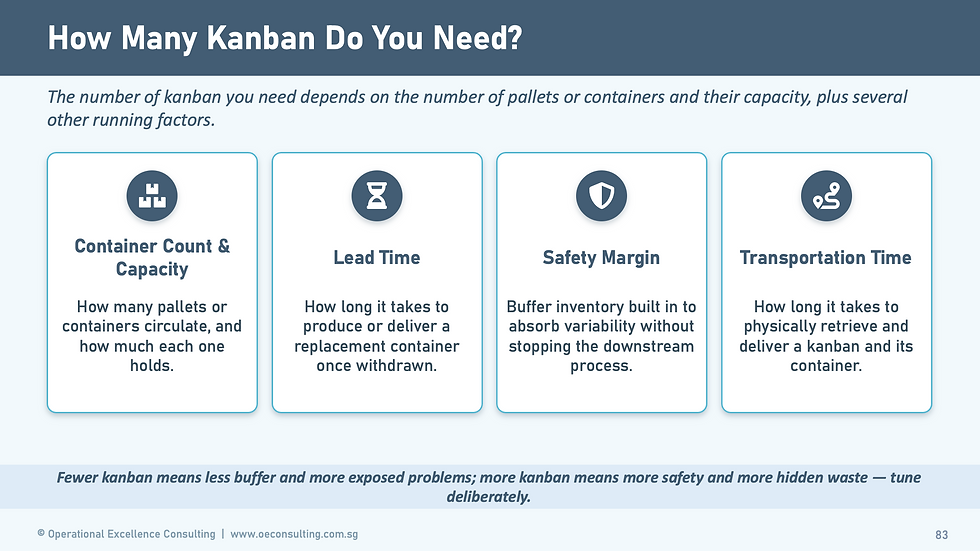
How many kanban a given loop needs is not a guess; it's a calculation built from four factors: container count and capacity, replenishment lead time, safety margin for variability, and the transportation time needed to physically retrieve and deliver a card and its container. Fewer kanban in circulation means less buffer and more exposed problems; more kanban means more safety margin and more hidden waste. Tuning that number deliberately — and reducing it over time as problems get solved — is what keeps kanban working as a continuous-improvement engine rather than settling into a comfortable, static buffer.
One-Stage vs. Two-Stage Pull: Supermarkets and Water Beetles
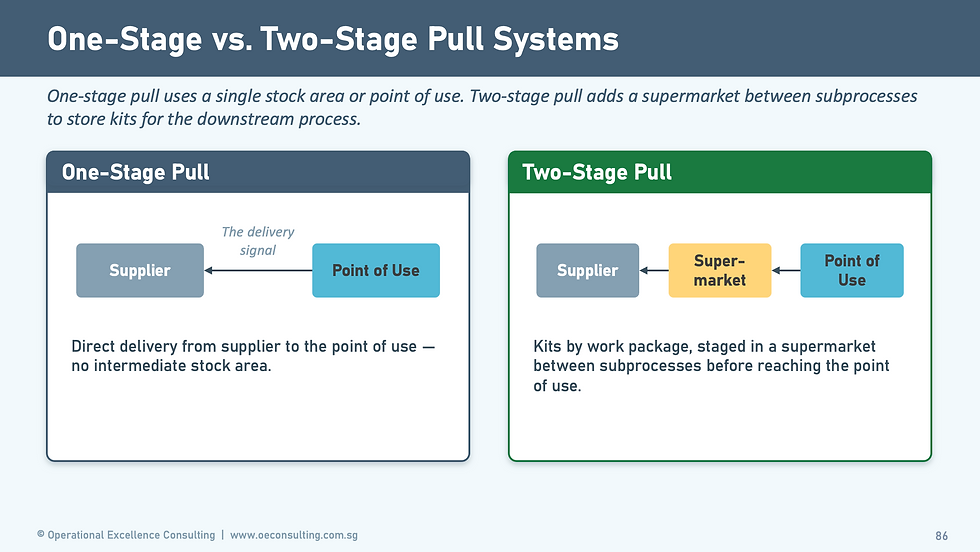
Not every hand-off between processes needs the same architecture. One-stage pull delivers material directly from a supplier or upstream process straight to the point of use — no intermediate stock area. Two-stage pull inserts a supermarket — an area, located near where parts are produced, that stages component kits between major process steps before they reach the point of use. The idea is borrowed directly from retail: a supermarket restocks a shelf only when a customer actually withdraws something from it, controlled the same way by withdrawal and production kanban, ensuring parts are always available but never overproduced. A supermarket is the single feature that distinguishes a two-stage system from a one-stage one, and it earns its place specifically where a process feeds several downstream consumers, or where consolidating parts into kits genuinely reduces how much running around an operator has to do.
Someone still has to move material between a supermarket and the cells it feeds — that's the job of a water beetle, an operator dedicated to delivering parts to others so they never have to leave their own station to replenish it themselves. A water beetle follows a fixed milk run, named for the daily rounds of a milk delivery, capable of serving several cells in a single pass out from the supermarket and back again. It's a small operational detail with an outsized effect: the moment a water beetle misses a run, the gap becomes visible almost immediately, precisely because the system was designed to carry so little buffer in the first place. That visibility is a feature, not a flaw — it's the same principle that makes low kanban counts valuable: problems surface fast enough to fix before they compound.
Extending Pull Beyond the Floor
Once a model line runs pull production well, the same logic extends outward in two directions. Lateral development takes the proven approach to other lines within the same plant. Vertical development takes it upstream to suppliers — the goal flipping from large, infrequent deliveries to smaller, more frequent ones, with the ideal outcome being a supplier who runs their own buffer as a genuine supermarket rather than a defensive warehouse stockpile, fed by a supplier kanban that shows destination and delivery frequency directly on the card.
None of this holds without a handful of unglamorous success factors: leadership commitment at every level, real investment in cross-training, cells read daily so obstacles get removed quickly rather than accumulating, and — above everything else — one non-negotiable behaviour change. Produce only when signaled. Not when material happens to be on hand. Not because the schedule says so. Only when the next process actually asks.
The System Runs on the Signal, Not the Schedule
The distance between a factory that talks about pull production and one that actually runs it comes down to whether that one rule — I will not produce unless signaled — survives contact with a busy shift, a rush order, or a supervisor asking why a station is "idle" with material sitting right there. Every mechanism in this guide, from the five-step roadmap to kanban sizing to the milk run, exists to make that rule easy to follow and hard to quietly break.
If there is one place to start, it's an honest kanban count on a single loop you already run. Count it, ask what each card is actually protecting against, and see how low you can push it before something breaks. Whatever breaks first is your next problem to solve — and that, more than any framework on a slide, is what running a real pull system feels like.
Build Pull Production Capability
Kanban sizing, load leveling boxes, and milk-run design are skills built by running them on a real loop, not by reading about the theory once.
Start with the hub article, Mastering the Lean Production System, for the waste-elimination grounding pull production builds on
Continue with Cellular Manufacturing: A Practitioner's Guide to the Physical Transformation for the cell design pull production assumes is already in place
Continue with JIT Support Tools: Building the Foundations of Stability for the changeover speed that makes small-lot pull economically viable
Explore OEC's Value Stream Mapping Workshop to trace your own current-state lead time before redesigning it around pull
Explore OEC's Lean Thinking Workshop, where kanban sizing and milk-run design are practiced on real shopfloor scenarios
About the Author

Allan Ung is the Founder and Principal Consultant of Operational Excellence Consulting (OEC), a Singapore-based management training and consulting firm he established in 2009 to help organisations maximise customer value and minimise waste through the disciplined application of Lean management and Design Thinking.
Over more than three decades in operations and quality leadership, Allan has held senior roles at IBM, Microsoft, and Underwriters Laboratories (UL), and spent formative years with Singapore's National Productivity Board, where Cost of Quality and Total Quality Process programmes he led achieved quality-cost reductions of up to 50% for participating organisations.
Allan holds a Bachelor of Engineering (Mechanical) from the National University of Singapore and completed advanced consultancy training in Japan as a Colombo Plan Scholar, studying the Toyota Production System and Japanese quality management practices at their source. He is a Certified Management Consultant (Japan), a Certified Lean Six Sigma Black Belt, and an accredited TPM Instructor.
Kanban system design and pull implementation are core modules within Allan's Lean Thinking and Value Stream Mapping workshops, delivered to manufacturing and operations teams across sectors including electronics, marine and offshore, healthcare, and process industries. His training presentations and toolkits are used by organisations across Asia, Europe, and North America to build shopfloor capability that outlasts any single consulting engagement.
Allan's guiding philosophy: "A system that cannot say 'not yet' has no real signal at all — it just has permission to keep producing."
👉 Learn more at: www.oeconsulting.com.sg
Related Articles and Resources
Mastering the Lean Production System — the hub article covering waste elimination and the process-vs-operation foundation this guide builds on
Cellular Manufacturing: A Practitioner's Guide to the Physical Transformation — the cell design pull production is built on top of
JIT Support Tools: Building the Foundations of Stability — SMED, poka-yoke, and TPM for keeping cell equipment dependable
🎓 Value Stream Mapping Workshop — mapping current and future-state flow before converting a layout
🎓 5S Workshop — the workplace-organisation discipline every cell depends on
Operational Excellence Consulting offers a full catalog of facilitation‑ready training presentations and practitioner toolkits designed to support leaders in driving innovation, aligning teams, and leading organizational transformation. These resources are developed from real workshops and executive programs, helping organizations embed strategic frameworks, strengthen leadership capability, and achieve sustainable growth.
👉 Explore the full OEC training library at: www.oeconsulting.com.sg/training-presentations