


JIT Support Tools: Building the Foundations of Stability
Updated: 6 days ago
By Allan Ung | Founder & Principal Consultant, Operational Excellence Consulting (OEC)
Published: 02 August 2026

Allan Ung is the Founder and Principal Consultant of Operational Excellence Consulting (OEC), a Singapore-based management training and consulting firm established in 2009. With over 30 years of experience building the daily disciplines that sustain lean transformations — including senior roles at IBM, Microsoft, and Underwriters Laboratories (UL) — Allan teaches SMED, poka-yoke, and TPM as core modules within his Lean Thinking workshop for manufacturing teams across Singapore and the region.
He holds a Bachelor of Engineering (Mechanical) from the National University of Singapore and completed advanced consultancy training in Japan as a Colombo Plan Scholar. Allan is a Certified Management Consultant (Japan), a Certified Lean Six Sigma Black Belt, and an accredited TPM Instructor.
A leveled schedule, a beautifully converted cell, and a well-sized kanban loop will all quietly fail if a machine takes an hour to change over or breaks down without warning. None of the glamorous parts of Lean survive contact with an unstable floor.
I say this to every workshop group that arrives excited about cell design or kanban and less excited about changeover time or preventive maintenance checklists: the tools in this guide are not the interesting part of Lean transformation, and they are the part that determines whether everything else holds. A cell only works if operators can trust the equipment inside it. A leveled schedule only works if changeovers are fast enough to make small batches economical rather than punishing. This guide covers the three disciplines that quietly make the rest of the Lean Production System — covered in this cluster's hub, Cellular Manufacturing, and Pull Production guides — sustainable on an ordinary Tuesday, not just on the day the consultant is on site.
🚀 Advanced Lean strategies fail on unstable floors. This guide covers the essential disciplines found in our JIT Support Tools modules, designed to ensure your equipment and quality systems never let your flow stop. Key Professional Tools Included: ✅ SMED Masterclass: A structured 3-stage method to shrink changeovers from hours to single-digit minutes. ✅ TPM & Autonomous Maintenance: Habit-building routines for operators to ensure equipment reliability. ✅ Zero Quality Control: Professional techniques for implementing Poka-Yoke (Mistake-Proofing) and Jidoka. 👉 Access the JIT Mastery Toolkit (Including SMED, TPM & Poka-Yoke) “The unglamorous fix—a locating pin or a five-minute cleaning routine—is usually the one that holds.” |
SMED: Making Small Batches Economically Possible
Leveled production, covered in the hub article, depends on running small, mixed batches rather than large single-product runs. But small batches mean changing over machines far more often — and if a changeover eats an hour every time, leveling stays a nice idea on a whiteboard and never becomes a real schedule. Single-Minute Exchange of Die (SMED) is the discipline that closes that gap: a structured, three-stage method — separate internal setup from external setup, convert as much of the remaining internal setup to external as its true function allows, then streamline everything left in both categories — for shrinking changeover time so small batches stop being painful. On the changeover shown above, that's what took a traditional 60-minute changeover down to 9 minutes: no new machinery bought, just three stages applied in sequence.
I cover all three stages in full — the checklists, function checks, and improved-transport techniques that drive Stage 1 alone toward a 30 to 50 percent cut on its own; the advance-preparation, function-standardization, and intermediary-jig techniques that make Stage 2 possible; and the parallel-operations, functional-clamp, and adjustment-elimination techniques Stage 3 depends on — in SMED: A Blueprint for Responsive, Small-Lot Production, the dedicated guide in this series. If quick changeover is the piece of this puzzle you need to solve first, start there.
Autonomation and Zero Quality Control: Building Quality In, Not Inspecting It In
Autonomation, or Jidoka, gives a machine or line the ability to detect an abnormality and stop itself — rather than continuing to run and building defects into every subsequent part. A stopped machine cannot make a bad part; more importantly, every stop becomes an immediate, impossible-to-ignore signal to fix the root cause rather than a defect quietly discovered downstream, weeks later, buried in a batch. As Taiichi Ohno put it, stopping the machine when there is trouble forces awareness on everyone — and once a problem is clearly understood, improvement becomes possible. The full cycle runs in four steps: detect the abnormality, stop the process, fix the immediate problem so production can safely resume, then investigate the root cause — often with a tool as simple as the 5 Whys — so the same failure doesn't recur.
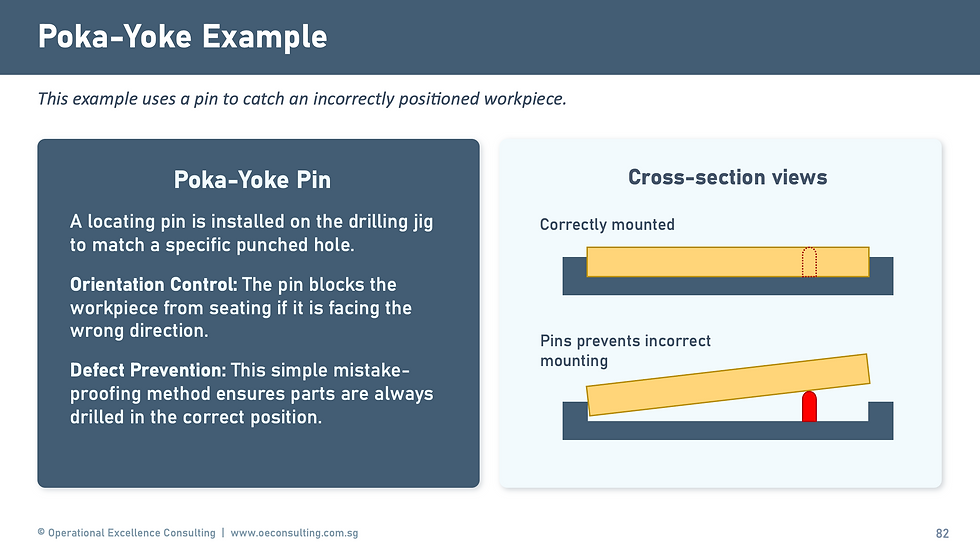
Zero Quality Control (ZQC) applies the same principle to defects specifically: instead of a separate inspection step catching finished parts after time and material are already spent, the process itself checks every part at the moment it's made, so a defect is caught or prevented right at the source. ZQC rests on four elements working together — source inspection, 100 percent inspection rather than sampling, a short feedback loop back to the point of the problem, and mistake-proofing devices. That last element is where poka-yoke does its work: simple, low-cost devices that either detect an abnormal condition before it becomes a defect, or physically prevent the defect from happening at all. A locating pin that only lets a part seat one way. A sensor that flags a missing component and halts the line. A fixture that won't release until every required step is complete. A counter that catches the wrong number of fasteners. None of these require sophisticated technology — they require someone on the floor who has actually watched the same mistake happen twice and decided to design it out permanently.
TPM: Equipment Dependable Enough for Low Inventory
Every other tool in this cluster assumes equipment that runs when it's supposed to. Just-in-Time deliberately carries little buffer inventory between processes — which means an unexpected breakdown doesn't stay contained to one station, it stops the whole line immediately. Total Productive Maintenance (TPM) exists precisely to make that risk acceptable: it treats equipment reliability as shared responsibility across everyone who uses a machine, not a problem that belongs exclusively to the maintenance department.
The practical entry point is autonomous maintenance — simple daily care operators themselves perform, before small issues become breakdowns. Four habits carry most of the value: cleaning, because wiping down equipment reveals leaks, wear, and loose parts while they're still minor; inspecting, because a quick visual and audible check catches abnormal sounds, heat, or vibration early; lubricating, because regular lubrication is the cheapest wear-prevention available; and tightening, because loose fasteners are an early warning sign long before they're a failure. None of these four habits require a maintenance technician — they require an operator who has been given five minutes and permission to treat their own machine as something worth caring for daily, not just something to run until it breaks.

Making Equipment Reliability Measurable: OEE
Autonomous maintenance only stays a genuine daily discipline, rather than a checklist filled in on autopilot, if someone can see whether it's actually working. That's the job of Overall Equipment Effectiveness (OEE) — Availability multiplied by Performance multiplied by Quality, expressed as a single percentage that turns "the line ran fine today" into a specific, trackable number tied directly back to the six big equipment losses TPM exists to eliminate.
I facilitated a two-day TPM workshop in Singapore for Temic Automotive (Phils.) Inc., the Continental Group's manufacturing facility in the Philippines, working with the company's TPM Steering Committee through the full eight pillars with particular depth on Autonomous Maintenance and its integration with Planned Maintenance — the same clean-inspect-lubricate-tighten discipline described above, built out at steering-committee level for a tier-one automotive supplier where equipment reliability is directly tied to customer quality commitments.
Measuring whether that discipline is paying off is where OEE earns its place. In 2014, I facilitated an OEE benchmarking study for Analog Devices General Trias (ADGT) — ADI's largest high-technology testing facility in the Philippines — comparing OEE measurement approaches across three semiconductor manufacturers in Singapore and Manila against JIPM and SEMI E10 standards. The most useful finding wasn't a single OEE score; it was that all three organisations were measuring OEE differently enough that their headline numbers weren't actually comparable until the definitions were aligned first. That's the same discipline a JIT-focused floor needs: an equipment reliability number that's measured inconsistently between shifts, lines, or sites hides exactly the kind of variation that undermines a low-inventory system's ability to trust its own machines.

What "Good" Looks Like Changes
These three tools share something worth naming directly: each one redefines what counts as good performance on the floor, and the redefinition is uncomfortable at first. A machine that's stopped because Jidoka caught a defect looks, to an old-fashioned production report, like downtime — a bad number. It is, in the framework this guide teaches, the system working exactly as designed. Full shelves used to look like a safety net; under JIT they're a warning sign. Keeping every machine running at all costs used to be the goal; keeping the line flowing smoothly, even if that means a machine sits idle waiting for the right signal, is the actual goal now. Peter Drucker's observation applies directly here: what gets measured gets managed — and a factory that keeps measuring 1960s-era metrics will keep managing toward 1960s-era outcomes, no matter how good its cell design or kanban loops are.
Stability Is Earned Daily, Not Installed Once
None of the three tools in this guide are a project with an end date. SMED's third stage is explicitly, permanently unfinished — every changeover is another chance to shave off a few seconds. Autonomous maintenance is a five-minute habit repeated every shift, not a one-time equipment overhaul. Poka-yoke devices get added one at a time, each time someone on the floor notices the same mistake happening twice and decides that's once too often.
That's the honest picture of what "building the foundations of stability" actually means in practice: not a single dramatic changeover event or a single cleverly placed pin, but hundreds of small, permanent fixes accumulated over months, each one making the next attempt at leveling, cells, or kanban slightly more likely to hold. If you take one thing from this guide back to your own floor, let it be this: pick the changeover on your line that everyone already complains about, time it honestly, and sort its steps into internal and external before you do anything else. That first sort, on its own, usually finds the first third of the time you were losing.
Build JIT Capability
SMED timing exercises, poka-yoke design sessions, and autonomous maintenance rollouts are all things a team learns by doing on their own equipment — theory alone won't shrink a changeover.
Start with the hub article, Mastering the Lean Production System, for the waste-elimination grounding these support tools protect
Read SMED: A Blueprint for Responsive, Small-Lot Production for the full three-stage changeover-reduction method summarised above
Continue with Cellular Manufacturing: A Practitioner's Guide to the Physical Transformation for the 5S and visual management discipline that pairs with autonomous maintenance at the cell level
Continue with Pull Production: A Practitioner's Guide to Signal and Flow Control for how fast, reliable changeovers make small-lot pull production viable
Read Total Productive Maintenance (TPM): The Complete Practitioner Guide for the full eight-pillar TPM system this article's autonomous maintenance section draws from
Read OEE Benchmarking: A Practitioner's Guide for how to measure equipment reliability rigorously enough to trust the comparison
Explore OEC's Lean Thinking Workshop, where SMED timing studies and poka-yoke design are practiced hands-on
Explore OEC's 5S Workshop for the workplace-organisation foundation that makes autonomous maintenance easier to sustain
About the Author

Allan Ung is the Founder and Principal Consultant of Operational Excellence Consulting (OEC), a Singapore-based management training and consulting firm he established in 2009 to help organisations maximise customer value and minimise waste through the disciplined application of Lean management and Design Thinking.
Over more than three decades in operations and quality leadership, Allan has held senior roles at IBM, Microsoft, and Underwriters Laboratories (UL), and spent formative years with Singapore's National Productivity Board, where Cost of Quality and Total Quality Process programmes he led achieved quality-cost reductions of up to 50% for participating organisations.
Allan holds a Bachelor of Engineering (Mechanical) from the National University of Singapore and completed advanced consultancy training in Japan as a Colombo Plan Scholar, studying the Toyota Production System and Japanese quality management practices at their source. He is a Certified Management Consultant (Japan), a Certified Lean Six Sigma Black Belt, and an accredited TPM Instructor.
SMED, poka-yoke, and TPM are core modules within Allan's Lean Thinking workshop, delivered to manufacturing and operations teams across sectors including electronics, marine and offshore, healthcare, and process industries. His training presentations and toolkits are used by organisations across Asia, Europe, and North America to build shopfloor capability that outlasts any single consulting engagement.
Allan's guiding philosophy: "The unglamorous fix — a locating pin, a five-minute cleaning routine, a bolt sorted into the right pile — is usually the one that holds."
👉 Learn more at: www.oeconsulting.com.sg
Related Articles and Resources
Mastering the Lean Production System — the hub article this cluster's support-tool discipline protects
SMED: A Blueprint for Responsive, Small-Lot Production — the full three-stage changeover-reduction method summarised above
Cellular Manufacturing: A Practitioner's Guide to the Physical Transformation — where 5S and visual management are covered at full depth
Pull Production: A Practitioner's Guide to Signal and Flow Control — how fast changeovers make small-lot pull economically viable
Total Productive Maintenance (TPM): The Complete Practitioner Guide — the full eight-pillar TPM system, including the Continental (Temic Automotive) and Analog Devices engagements referenced above
OEE Benchmarking: A Practitioner's Guide — how to align OEE measurement definitions before comparing equipment reliability across lines or sites
🎓 Lean Thinking Workshop — hands-on SMED and poka-yoke design practice
🎓 5S Workshop — the organisational foundation autonomous maintenance depends on
Operational Excellence Consulting offers a full catalog of facilitation‑ready training presentations and practitioner toolkits designed to support leaders in driving innovation, aligning teams, and leading organizational transformation. These resources are developed from real workshops and executive programs, helping organizations embed strategic frameworks, strengthen leadership capability, and achieve sustainable growth.
👉 Explore the full OEC training library at: www.oeconsulting.com.sg/training-presentations