


Lean Management Assessment: How to Measure Your Lean Implementation and Know Where to Improve
Updated: May 3
By Allan Ung | Founder & Principal Consultant, Operational Excellence Consulting
Updated: 30 March 2026

Allan Ung is the Founder and Principal Consultant of Operational Excellence Consulting, a Singapore-based firm established in 2009. With over 30 years of experience leading operational excellence and quality transformation across manufacturing, technology, and global operations—including senior roles at IBM, Microsoft, and Underwriters Laboratories—Allan brings deep shopfloor expertise to every learning room he enters. A Certified Management Consultant (CMC, Japan), Lean Six Sigma Black Belt, TPM Instructor, TWI Master Trainer, and former Singapore Quality Award National Assessor, he has facilitated structured problem-solving and Lean programmes for organisations including the Ministry of Education, Tokyo Electron, Panasonic, Micron, Lam Research, Toyota Tsusho, NileDutch, Sika Group, and NEC.
The Problem with Most Lean Programmes is that Nobody Measures Them
Organisations invest significantly in Lean. Training programmes, Kaizen events, 5S implementations, Value Stream Mapping workshops, Standard Work documentation — all of these require time, resources, and management attention. And yet, in most organisations, there is no structured answer to the most fundamental question about that investment: how good is our Lean implementation, really?
Most Lean programmes are measured by activity — how many events were held, how many people trained, how many improvement ideas submitted. These are input metrics. They measure effort, not capability. They tell you what was done, not whether it worked.
What is missing from most Lean programmes is a disciplined assessment of the management system behind the tools — the structures, behaviours, and disciplines that determine whether Lean improvements are sustained or whether they erode back toward the previous state after the improvement team disbands.
That is precisely what the Lean Management Assessment (LMA) is designed to measure.
What the Lean Management Assessment is — and What it is Not
The Lean Management Assessment is a structured evaluation tool that assesses the overall status of a Lean management implementation across eight dimensions, each rated on a five-level maturity scale. It was developed from the principles of Creating a Lean Culture by David Mann — one of the most practically grounded books on Lean management ever written — and adapted by OEC into a practical assessment toolkit.
It is important to be clear about what the LMA is not. It is not an audit. It is not a compliance check. It is not a tool for comparing one organisation against another on a league table. It is a diagnostic instrument — a structured way of seeing clearly where an organisation's Lean management system is strong, where it is weak, and where improvement effort will deliver the greatest return.
Compared to the Shingo Model or the Baldrige Excellence Framework, the LMA is deliberately simpler and more immediately applicable. It is designed to be used by leaders on the floor — through direct observation and conversation with the people doing the work — not by consultants in a conference room reviewing documentation.
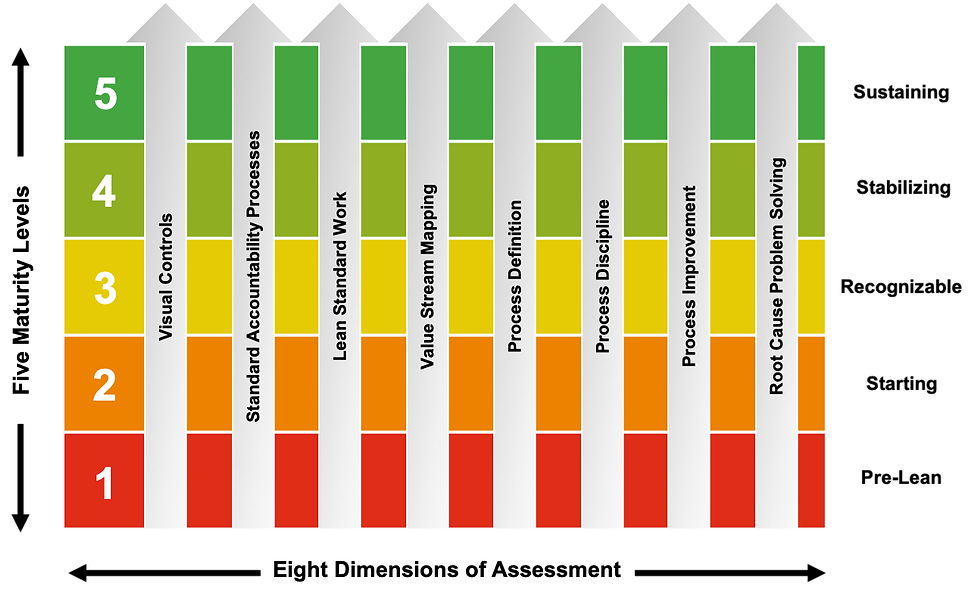
The three things a well-conducted LMA tells you are precise and actionable: where you are working toward, where you currently stand relative to that standard, and which specific areas most need improvement attention.
The Eight Dimensions of Lean Management
The LMA evaluates eight dimensions that together constitute the Lean management system. Each dimension addresses a different aspect of how Lean is embedded in the organisation's daily operations — not as a set of projects or initiatives, but as a way of managing.
Dimension 1 — Visual Controls
Visual Controls should do two things: reflect the actual versus expected pace or progression of work — in administrative, support, or line processes — and capture the delays, interruptions, and frustrations that arise during the work. The diagnostic question is simple: can you see, at a glance, whether the process is on track or off track right now?
At the Pre-Lean level, no visuals or cycle tracking exist. At the Sustainable level, visual controls are current, clearly interpreted, and actively used to drive the next step of improvement. Most organisations I have worked with sit somewhere in the middle — they have charts on the walls that record numbers but do not make the performance gap immediately visible, or visuals that are filled in retrospectively rather than in real time.
The test for a Visual Control is whether a new person walking onto the floor could understand the current process status in under thirty seconds. If they cannot, the visual is informative but not operational.
Dimension 2 — Standard Accountability Processes
Standard Accountability Processes convert the problems and opportunities identified through visual controls, floor observation, and employee suggestions into task assignments — for cause analysis or corrective action — through a structured daily process. The classic tool is the daily standup meeting at the visual board, where yesterday's misses generate today's assignments.
This dimension is where many Lean programmes break down. Organisations invest in visual controls but have no structured mechanism for converting what those visuals reveal into action. The information sits on the board. The problem recurs. The visual loses credibility. Teams stop filling it in.
At the Sustainable level, accountability processes are deeply ingrained — assignments are made, tracked, and followed up daily, and the process is self-sustaining rather than dependent on management pressure.
Dimension 3 — Leader Standard Work
Leader Standard Work (LSW) is one of the most powerful and least understood concepts in Lean management. It is the scheduled, documented set of activities that each level of leadership performs regularly to maintain the Lean management system — checking visuals, auditing processes, coaching operators, reviewing performance data, following up on improvement assignments.
The intent of LSW is to institutionalise the gemba — the practice of going to the place, talking with the people, and observing the process — at every level of the organisation. Without LSW, Lean activities depend on individual enthusiasm and management attention, both of which fluctuate. With LSW, the management behaviours that sustain Lean become part of the job definition.
At the Pre-Lean level, no leader standard work exists. At the Sustainable level, LSW is carried and followed by leaders at all levels, reviewed regularly, and updated as processes change.
Dimension 4 — Value Stream Mapping
Value Stream Maps show the step-by-step movement of information, materials, or patients through an area or an entire value stream — and communicate process performance measures and improvement plans. The LMA assesses not just whether VSMs exist but whether they are actively used as living management tools — displayed visibly, connected to improvement plans, and updated as the process changes.
A VSM that was created during a Lean workshop three years ago and has since been filed away scores at the Starting level, not the Sustainable level. The dimension is about whether Value Stream Mapping has been embedded as an ongoing management practice rather than a one-time analysis exercise.
Dimension 5 — Process Definition
Process Definition assesses whether line and support tasks are documented, whether that documentation is readily accessible to the people who need it, and whether it matches current actual practice across people and shifts. Documentation that is out of date, stored in binders nobody opens, or inconsistent with how work is actually performed scores at the lower maturity levels regardless of how comprehensive it appears.
The diagnostic questions are practical: can a new operator find the process documentation in under two minutes? Does the documentation reflect what actually happens today, or what was intended when it was written?
Dimension 6 — Process Discipline
Process Discipline assesses whether people actually follow the defined processes — not just when being observed, but consistently, across shifts, without management enforcement. This is the dimension that separates organisations that have documented their processes from organisations that have actually standardised them.
The most revealing diagnostic for Process Discipline is not an audit — it is an unannounced observation. Walk the floor at shift change, or observe a process during a period of high pressure. Does what you see match what the standard work says should happen? If the answer is "most of the time, for most people" rather than "consistently, for everyone", the organisation is at the Recognizable level, not the Sustainable level.
Dimension 7 — Process Improvement
Process Improvement assesses the breadth and continuity of improvement activity across the organisation. At the Pre-Lean level, improvements happen only through formal project teams responding to major failures — improvement is exceptional and episodic. At the Sustainable level, everyone's job includes process improvement: line workers, support functions, administrators, and executives, with improvements ranging from small individual suggestions to large cross-functional projects, all driven by process tracking data and employee observation.
The key question this dimension asks is whether improvement is a management programme or a cultural norm. The difference is whether people improve their processes because they have been tasked to, or because they believe it is part of their job.
Dimension 8 — Root Cause Problem Solving
Root Cause Problem Solving assesses whether problem solving in the organisation genuinely aims to eliminate the source of problems permanently — or whether it is primarily focused on workarounds, temporary fixes, and symptom management.
The diagnostic is straightforward: when a problem arises, do leaders immediately ask why? Do they initiate data-based root cause analysis? Are the countermeasures that result traced back to verified root causes rather than plausible explanations? This dimension connects directly to the Root Cause Analysis and 8D Problem Solving disciplines covered in our companion articles.
The Five Maturity Levels — What they Actually Mean
Each dimension is rated on a 1-to-5 scale corresponding to five maturity levels. Understanding what each level actually looks like in practice — rather than just what it is called — is essential to conducting an honest and useful assessment.
Level 1 — Pre-Lean: No meaningful implementation of Lean practices in this dimension. The organisation may be aware of the concept but has not taken substantive action.
Level 2 — Starting: Initial steps have been taken, but implementation is sporadic, inconsistent, and dependent on individual effort rather than system design. The practice exists in pockets but has not been standardised.
Level 3 — Recognizable: Lean practices in this dimension are visible and reasonably consistent. A knowledgeable observer walking the floor would recognise Lean practices at work. But they are not yet fully embedded — performance varies by shift, by area, or by who happens to be managing on a given day.
Level 4 — Stabilizing: Practices are well-established and consistently applied. Processes are stable enough that the dimension no longer requires constant management attention to maintain. The organisation is building the habits and systems that will make this sustainable.
Level 5 — Sustainable: Lean practices in this dimension are fully integrated into the organisation's operating culture. They are self-sustaining — maintained by the system and the people who work within it, not by management enforcement or periodic improvement initiatives.
How to Conduct the Assessment
The LMA is designed to be conducted on the floor — through direct observation and structured conversation with the people doing the work — not from a desk reviewing documentation.
Observe directly. Go to the place. Look at the visuals: are they current? Are the reasons for misses clear enough to drive the next action? Are people following the standard work? Is there evidence of active improvement?
Talk with the people. Ask operators: do you have a regular way to make your problems known? Do you understand what the visual control is showing you? Have you made any process improvements in the last month?
Rate honestly. The most common assessment error is rating aspirationally — scoring based on what the organisation intends to achieve rather than what is actually observable today. An LMA scored aspirationally provides false comfort and misdirects improvement effort. Rate what you see.
Use a calibrated team where possible. The most reliable assessments involve multiple assessors who score independently and then compare. Significant disagreement between assessors reveals genuine ambiguity about what good looks like in that dimension — which is itself useful information.
Interpret the results as a profile, not an average. The most meaningful output of the LMA is not a single overall score but the radar chart showing the score profile across all eight dimensions. A score of 3.5 average masks very different situations: an organisation with consistent 3s across all eight dimensions is in a very different position from one with 5s in three dimensions and 1s in three others. The profile reveals the pattern. The pattern guides the intervention.

Schedule regular assessments. The LMA is not a one-time exercise. Its value compounds when conducted on a regular schedule — typically every 90 days — so that the score profile over time shows whether the Lean management system is genuinely improving, plateauing, or eroding.
What the LMA Reveals that Other Lean Tools Miss
Most Lean assessment approaches focus on tools: is 5S implemented? Is standard work documented? Are Kaizen events being conducted? The LMA asks a different and more fundamental question: is the management system working?
The distinction matters enormously in practice. An organisation can have 5S implemented, standard work documented, and Kaizen events on the calendar — and still have a Lean management system that scores at Level 2 or 3 on most dimensions, because the management behaviours, accountability structures, and problem-solving disciplines that make those tools work consistently are not in place.
This is the insight at the heart of David Mann's work, and the reason I developed the OEC Lean Management Assessment toolkit from his framework. The tools are necessary but not sufficient. What makes them work — and what makes the improvements they generate sustainable — is the management system that surrounds and supports them.
The LMA makes that management system visible, measurable, and improvable.
The OEC Lean Management Assessment Toolkit
The OEC Lean Management Assessment toolkit provides the complete facilitation-ready resource for conducting and interpreting a Lean Management Assessment in your organisation. It includes the full assessment framework with detailed criteria for all eight dimensions across all five maturity levels, the scoring worksheets for individual and team assessments, the radar chart template for visualising the score profile, the diagnostic questions for each dimension, and guidelines for conducting, calibrating, and scheduling assessments.

It is designed for Lean practitioners, operations managers, and leaders who want a practical, rigorous diagnostic tool — not a theoretical framework that requires external consultants to use.
Where the LMA Fits in Your Broader Lean Journey
The LMA is most powerful when used as part of a coherent Lean management system rather than as a standalone diagnostic. The eight dimensions it assesses correspond directly to the Lean practices covered throughout the OEC content library:
Lean Daily Management System (LDMS) — the rhythm that sustains Leader Standard Work, Visual Management, Daily Accountability, and Leadership Discipline across all levels of the organization
5S Workplace Organization — the foundation on which Visual Controls and Process Discipline are built
Kaizen — the engine behind Process Improvement and Standard Accountability Processes
Root Cause Analysis — the discipline assessed directly in Dimension 8
TWI — the capability that makes Leader Standard Work and Process Definition operational
TPM — the system that operationalises Process Discipline and Process Improvement in equipment-intensive environments
TPM Self-Assessment and the TPM Excellence Award: A Practitioner's Guide — streamlines the TPM self-assessment and Excellence Award journey, empowering organizations to bridge operational gaps and achieve world-class manufacturing performance.
Use the LMA to establish where you are. Use the content and toolkits in the OEC library to address the specific dimensions where your score profile shows the greatest gaps.
Ready to Assess Your Lean Management System?
At Operational Excellence Consulting, I work with manufacturing, operations, and service organisations across Singapore and the Asia-Pacific region to conduct Lean Management Assessments, interpret results, and develop targeted improvement plans grounded in what the assessment reveals.
Explore our Lean Management Assessment resources:
Contact us directly visit www.oeconsulting.com.sg.
About the Author

Allan Ung is the Founder and Principal Consultant of Operational Excellence Consulting, a Singapore-based management training and consulting firm established in 2009. With over 30 years of experience leading operational excellence and quality transformation in manufacturing-intensive environments, Allan's expertise spans Lean Thinking, Total Quality Management (TQM), TPM, TWI, ISO systems, and structured problem solving.
He is a Certified Management Consultant (CMC, Japan), Lean Six Sigma Black Belt, JIPM-certified TPM Instructor (Japan Institute of Plant Maintenance), TWI Master Trainer, ISO 9001 Lead Auditor, and former Singapore Quality Award National Assessor.
During his tenure with Singapore's National Productivity Board (now Enterprise Singapore), Allan pioneered Cost of Quality and Total Quality Process initiatives that enabled companies to reduce quality costs by up to 50 percent. In senior regional and global roles at IBM, Microsoft, and Underwriters Laboratories, he led Lean deployment, quality system strengthening, and cross-border operational transformation.
Allan has facilitated Lean and operational excellence programmes for organisations including Panasonic, Micron, Lam Research, Tokyo Electron, NileDutch, Fugro Subsea Technologies, Health Sciences Authority, and NEC. He holds a Bachelor of Engineering (Mechanical Engineering) from the National University of Singapore and completed advanced consultancy training in Japan as a Colombo Plan scholar.
His philosophy: "Manufacturing excellence is achieved through disciplined systems, capable leadership, and sustained execution on the shopfloor."
Further Learning Resources
Operational Excellence Consulting offers a full catalog of facilitation‑ready training presentations and practitioner toolkits designed to support leaders in driving innovation, aligning teams, and leading organizational transformation. These resources are developed from real workshops and executive programs, helping organizations embed strategic frameworks, strengthen leadership capability, and achieve sustainable growth.
👉 Explore the full library at: www.oeconsulting.com.sg


