


Lean Daily Management System (LDMS): The Complete Practitioner Guide to Sustaining Lean Every Day
Updated: Sep 27
By Allan Ung | Founder & Principal Consultant, Operational Excellence Consulting
Updated on 12 April 2026

Allan Ung is the Founder and Principal Consultant of Operational Excellence Consulting (OEC), Singapore. A Certified Lean Six Sigma Black Belt, Certified Management Consultant (CMC, Japan), and Singapore Quality Award national examiner, Allan has designed and delivered Lean management programmes across manufacturing, healthcare, logistics, and the public sector for over 30 years. He developed OEC's Lean Daily Management System training curriculum and the OEC Lean Management Assessment (LMA) framework — an eight-dimension assessment tool grounded in David Mann's seminal work Creating a Lean Culture and refined through Allan's applied experience as a Lean practitioner and national quality assessor.
Introduction: The Lean Sustainability Problem
Ask any experienced Lean practitioner about the hardest part of a Lean transformation, and the answer is rarely "identifying the waste" or "designing the future state." It is almost always the same: sustaining the improvement.
The pattern is painfully familiar. An organisation launches a Lean initiative with energy and commitment. A 5S programme transforms a cluttered workspace into a model of visual clarity. A kaizen event cuts a process lead time by 40%. A VSM project identifies and eliminates a costly rework loop. Results are celebrated, leadership is encouraged, and the team disperses — back to their regular work.
Six months later, the gains have quietly eroded. The 5S discipline has softened. The rework loop has crept back. The lead time improvement has partially reversed. Nobody made a decision to let it happen — it just did. And the organisation faces a demoralising choice between accepting the regression or launching another kaizen event to win back the same ground it already fought for once.
This is not a failure of Lean tools. The tools worked — the improvements they produced were real. It is a failure of the management system: the daily habits, structures, accountability processes, and leadership behaviours that are required to hold the gains the tools create.
David Mann, whose landmark book Creating a Lean Culture provided the foundational framework for what we now call the Lean Daily Management System, articulated the problem with precision: most Lean organisations lack a management system to sustain their practices. They focus on eliminating waste and overlook the need for a structured system to keep the waste eliminated. As Dr. Jeffrey K. Liker, author of The Toyota Way, observed: "Most companies have focused too heavily on tools — without understanding Lean as an entire system that must permeate an organisation's culture."
The Lean Daily Management System (LDMS) is the answer to that problem. It is the structured management infrastructure that converts Lean from a series of improvement events into a permanent operating discipline — making continuous improvement the way the organisation works every day, not the subject of quarterly kaizen workshops.

What Is the Lean Daily Management System?
The Lean Daily Management System (LDMS) is a structured management approach that integrates Lean principles into the daily routines of leaders and teams at every level of the organisation. It ensures that strategy, processes, and people are aligned — every day — to deliver consistent performance and sustain continuous improvement.
The term goes by several equivalent names in different organisations and industries: Lean Management System (LMS), Daily Management System (DMS), Lean Daily Management (LDM), or simply Daily Management. The name varies; the concept is the same: a structured approach to align teams, sustain Lean practices, and drive improvement as a daily discipline rather than a periodic event.
LDMS operates at the strategic level of Lean — not the tactical level. The distinction matters enormously. Lean production tools (5S, VSM, kanban, standard work, kaizen events) operate tactically: they identify and eliminate specific wastes in specific processes. The LDMS operates strategically: it is the management infrastructure through which leadership guides, sustains, and continuously improves the entire Lean system.
As the OEC LDMS framework illustrates: Lean production tools are implemented by middle management and the workforce, while the Lean Management System is the domain of leadership — the mechanism through which leaders lead and sustain the Lean initiative rather than merely sponsoring it.
LDMS delivers six specific benefits:
Tracks actual performance against planned goals, making gaps visible in real time
Enhances process quality and consistency through structured leader engagement
Supports meeting customer demand by maintaining operational discipline daily
Reduces variation in operations through Leader Standard Work and process audits
Sustains improvement efforts over time by embedding accountability in daily routines
Standardises management practices across facilities, departments, and shifts
The Four Key Elements of the Lean Daily Management System
LDMS is built on four interdependent elements. Each element addresses a specific dimension of daily management. Together, they form a coherent system — and the sequence matters: the elements are most effective when implemented in a specific order, starting with Leader Standard Work and building from there.
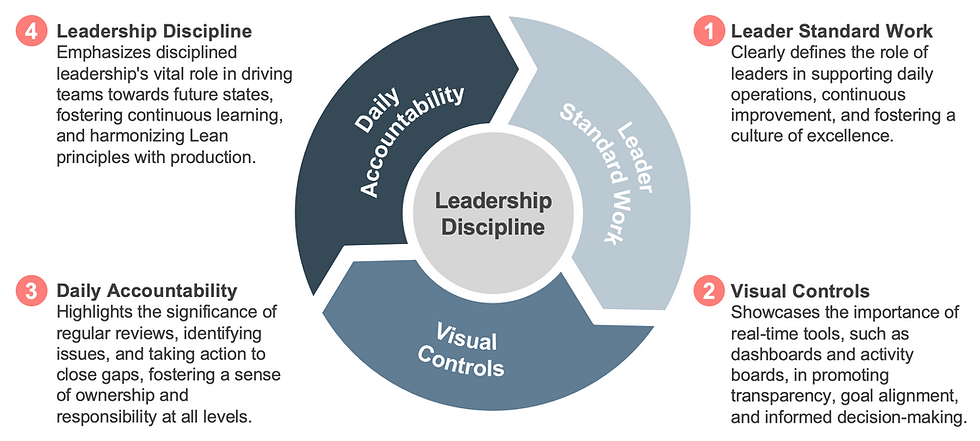
Element 1: Leader Standard Work
Leader Standard Work is the engine of the LDMS. It is the tool that most directly distinguishes a Lean management system from conventional management — and it is the element most commonly missing when Lean transformations stall.
What it is: Leader Standard Work is a structured set of daily, weekly, and monthly tasks that define how leaders at each level spend their time — not in terms of results they are accountable for, but in terms of the process-level activities they are expected to perform. It answers three questions for every leader: What do I do? When do I do it? Was it completed — and if not, why?

Leader Standard Work is layered from the bottom up. Team Leaders create standard work aligned with production takt time and operator process standards. Supervisors develop standard work to monitor and support Team Leaders. Value Stream Managers establish standard work to oversee Supervisors. Each layer's standard work interlocks with the layers above and below it — creating a continuous chain of process focus and accountability from the frontline to the executive suite.
The proportion of time covered by standard work varies by role:
Role | % of Work Time as Standard | Primary Responsibility |
Operators | 95% | Perform tasks consistently |
Team Leaders | 80% | Ensure operator standard work is followed |
Supervisors | 50% | Monitor and support Team Leaders |
Managers | 50% | Monitor and support Supervisors |
Value Stream Managers | 25% | Monitor and support Managers |
Executives | 15% | Verify production process is improving |
Source: OEC Lean Daily Management System Workshop
The pattern is clear: standard work is most specific and time-consuming closest to the process, and becomes progressively less prescriptive — but never absent — as seniority increases. Even executives have standard work: regular Gemba walks, process review meetings, and leadership audits that keep them genuinely connected to operational reality rather than insulated from it by layers of management reporting.
What Leader Standard Work includes:
Checking — systematic workplace checks to ensure processes meet standards, monitor performance metrics, and identify improvement opportunities. This includes 5S audits to verify workplace organisation and safety; performance spot checks using hour-by-hour production control boards; and system-level audits that verify processes are occurring as designed.
Teaching and support — informal, on-the-job guidance that builds team capability; problem-solving support that removes barriers and develops kaizen ideas; and coaching that develops the next generation of Lean-capable leaders.
Documentation — capturing the current state of Lean management best practices, providing a baseline for improvement, and defining the expected behaviours for leaders at each level. New leaders can learn the management system quickly because it is documented, not tacit.
Why it matters: Leader Standard Work acts as the critical wedge that prevents Lean gains from sliding back under the force of habit. Without it, the force of habit — the gravitational pull toward the way things used to be done — will erode every improvement the Lean tools create. With it, process focus becomes the leader's daily discipline rather than an occasional priority.
A Team Leader example illustrates the practical reality. Daily tasks (once per shift) include: conducting shift start meetings; reviewing and adjusting work plans; monitoring production startup and posting tracking sheets; attending department board meetings; and planning for the next day. Ongoing tasks (multiple times daily) include: addressing kaizen improvement items; updating hourly production control boards; training operators as needed; and monitoring start and stop times. Approximately 80% of a Team Leader's day is accounted for in standard work — leaving 20% for the genuine non-standard events that require judgement and response.
Element 2: Visual Controls
"The purpose of visual management is to make the invisible visible." — Taiichi Ohno
Visual Controls are the second element of LDMS — the transmission that channels the engine's power to where it is needed. They are the real-time information system that makes the current state of performance visible to everyone who works in or manages the value stream, without requiring a report, a meeting, or a query to a management information system.
What they are: Visual Controls are any tool that provides an immediate, clear, actionable picture of how the current state of a process compares to the planned state — making it obvious to anyone, at a glance, whether performance is normal or abnormal, and what action is required.
Effective Visual Controls share four attributes. They are clear and simple — prioritising graphics over numbers and words, enabling "understanding at a glance." They are actionable — providing decision-relevant information at the point of communication, not a data dump that requires interpretation. They are maintained by those doing the work — not by a central team or IT system — which empowers frontline staff to detect abnormalities first and own the response. And they are aligned with business goals — connected to the metrics that actually matter for customer value, not a separate performance management layer.
Three types of visual management operate at increasing levels of impact:
Showing — the most basic level: visual information, one-point lessons, and visual aids that communicate instructions, standards, or current status.
Warning — visual signals that alert team members when something is abnormal, triggering a response.
Mistake-proofing (Poka Yoke) — the highest level of visual management: mechanisms that make it physically impossible (or immediately detectable) to do the wrong thing, removing the human element from error prevention entirely.
Visual metrics are the primary practical application. The standard categories for visual metrics are Safety, Quality, Delivery, and Cost — each tracked through a combination of monthly trend charts, shift-to-shift charts, Pareto charts, cause-and-effect analysis, and Gantt charts for improvement actions. In service and office environments, equivalent metrics include cycle time reduction, WIP backlog, on-time completion, revenue per employee, first-call resolution, customer complaints, and SLA performance.
The Activity Board is the central visual management artefact of the LDMS — the "window into the business." A well-designed Activity Board typically contains: the team's mission and members; a skills matrix; attendance tracking; current-state and future-state value stream maps; key objectives; quality, cost, and delivery trend charts; project plans; and an issues and countermeasures tracking section.
Activity Boards serve two purposes simultaneously. They are a communication tool — making the team's performance, direction, and improvement work visible to everyone, including leaders who conduct Gemba walks. And they are a management tool — providing the structured visual reference that makes daily accountability meetings productive rather than discursive.
Setting up a visual control system follows three steps: Define Goals (identify what information or what mistakes to address); Design and Test (create a simple visual display and gather feedback from users); and Train and Improve (train users and review regularly for enhancements). The guiding principle is practicality over perfection: start with existing data and build up over time the measures the team is actually accountable for.
Element 3: Daily Accountability
"Accountability breeds response-ability." — Stephen Covey
Daily Accountability is the third element of LDMS — the gas pedal and steering wheel that direct the system's energy and accelerate its pace. It is the structured process through which the information made visible by Visual Controls is converted into action.
What it is: The Daily Accountability Process is a system of brief, regular, structured review meetings — called tier meetings — that ensure performance gaps are identified, assigned, and acted on the same day they appear. It applies the PDCA cycle at the pace of daily operations: Plan (set daily goals and align the team); Do (execute the work); Check (review performance against plan in the tier meeting); Act (identify gaps, assign countermeasures, and adjust).
The key principle of daily accountability is speed. The PDCA cycle is accelerated from weeks or months — the timescale of conventional improvement projects — to hours. A problem that appears in the morning production run is visible on the activity board within the hour, discussed in the Tier 1 meeting at 09:00, escalated to the Tier 2 meeting at 10:00 if unresolved, and reaches the Managing Director at the Tier 3 meeting at 11:00 if it requires leadership intervention. By the end of the workday, the problem has either been resolved or is actively in progress.

The three-tier meeting structure is the operational core of daily accountability:
Tier 1 — Supervisor with Team Leaders and staff (09:00–09:15) Inputs: today's safety message; issues from the previous day; today's targets; staffing plan. Indicators reviewed: attendance; safety performance; quality performance. Outputs: team performance (target vs. actual); overtime required; improvement suggestions or actions.
Tier 2 — Manager with Supervisors (10:00–10:15) Inputs: safety issues; near-misses; issues from Tier 1 meetings; manpower, material, and machinery concerns. Indicators reviewed: staffing and capacity issues; hourly output; unresolved issues from yesterday. Outputs: recovery plans if needed; posted actions for follow-up; shared learning; improvement ideas.
Tier 3 — Managing Director with Managers (11:00–11:15) Inputs: unresolved issues from Tier 2; current target vs. actual performance. Indicators reviewed: capacity and materials issues; key performance data. Outputs: actions assigned; departmental-level performance improvement actions; best practices for sharing.
Each tier meeting is brief — rarely more than 15 minutes — conducted standing, at the activity board or visual display, not in a conference room. The standing format is not incidental: it keeps energy high, prevents the meeting from drifting into extended discussion, and keeps the conversation anchored to the visual management tools rather than to opinions and memory.
The staggered timing of the three tiers is deliberate: it allows information — issues, priorities, successes — to cascade upward from the frontline to the Managing Director within a two-hour window. Problems that require senior intervention are visible at the top of the organisation within hours of their occurrence, not days or weeks.
Daily accountability steps in practice: Review tasks due yesterday or today (completed = green marker; incomplete = red marker with new date and reason for delay); review new tasks that can be assigned specific dates; review improvement ideas and delegate with deadlines; check delays from the previous day or shift; and check production status for order-related problems, safety and quality issues, and equipment concerns.
Healthcare application: The tier meeting structure applies directly to clinical and administrative environments. A Tier 1 healthcare meeting covers PPE compliance, attendance, schedule adherence, and equipment availability. Tier 2 covers issues from Tier 1, planned versus actual from the previous period, and quality metrics from clinical processes. Tier 3 covers aggregate performance data, unplanned events that affected the daily plan, and cross-departmental issues requiring management intervention. The content changes; the structure and discipline are identical.
Element 4: Leadership Discipline
Leadership Discipline is the fourth element of LDMS — and the fuel that keeps the engine running. It is not a tool or a process. It is a leadership quality: the consistent, sustained commitment to living the LDMS every day, even under pressure, even when results are uncomfortable, and even when the temptation to revert to old management habits is strongest.
As Aristotle's insight captures precisely: "We are what we repeatedly do. Excellence, then, is not an act, but a habit." Leadership Discipline is the practice of making Lean leadership habits so embedded that they become the default — not an effort but an expression of who the leader is and how the organisation works.
Leadership Discipline has four dimensions:
Purpose-driven leadership: Keeping the organisation's mission and objectives central in every decision, using management systems as tools to reinforce purpose rather than ends in themselves, and directing effort consistently toward the long-term vision rather than reacting to short-term pressures.
Embracing challenges and pressure: Disciplined Lean leaders are comfortable taking calculated risks for growth. They lead effectively under pressure, not by lowering standards or abandoning process discipline, but by applying the Lean management system more rigorously when pressure is highest. They model a growth mindset — treating challenges as improvement opportunities rather than threats.
Constant learning and coaching: Disciplined leaders are committed to their own continuous learning and to actively developing the people around them. They coach rather than direct. They ask questions rather than provide answers. They invest in building the organisation's problem-solving capability rather than solving problems themselves — understanding that their greatest leverage is multiplied through others.
Harmonising Lean Management and Lean Production: Leadership Discipline requires maintaining active alignment between the management system and the production or service delivery system. The LDMS is not a parallel track to Lean production — it is the management infrastructure that makes Lean production sustainable. Disciplined leaders ensure the two systems reinforce each other rather than competing for management attention.
In practice, Leadership Discipline means: setting and communicating clear expectations consistently; making decisions from data rather than instinct or politics; maintaining focus on long-term process improvement even when short-term results are demanding; and holding all leaders — including oneself — accountable to their standard work.
How the Four Elements Work Together
The four elements of LDMS are not independent. They are designed to function as an integrated system, and each element is necessary for the others to work effectively.

The car metaphor captures the integration precisely. Leader Standard Work is the engine — without it, there is no motive power to sustain the system. Visual Controls are the transmission — they channel the energy of Leader Standard Work into the right processes, converting management attention into operational insight. The Daily Accountability Process is the gas pedal and steering wheel — it directs and accelerates the system's effort toward the right priorities in real time. Leadership Discipline is the fuel — without it, the engine has nothing to run on, and the system eventually stops.
One critical implementation note: process stability must come before LDMS elements are fully deployed. Implementing daily tier meetings and activity boards on top of unstable processes simply creates a very well-organised picture of chaos. The sequence should be: stabilise key processes first (using 5S, standard work, and error-proofing); then implement LDMS to sustain and improve from that stable baseline.
LDMS and Lean Culture: The Connection
A question practitioners frequently ask is: what is the relationship between the LDMS and Lean culture? The answer is directional rather than definitional.
Lean culture is not a starting condition — it is an outcome. Culture is the sum of attitudes (the way we think) and behaviours (the way we act), which together shape the work systems and processes that eliminate waste. You cannot install a Lean culture by declaring it, training for it, or posters. You create a Lean culture by building the management systems and leadership behaviours that make Lean thinking and acting the daily norm.
The LDMS is the mechanism through which Lean culture is created and sustained. When leaders consistently follow their standard work, visual controls make performance transparent, daily accountability meetings resolve problems quickly, and leadership discipline holds the whole system together — the organisation gradually develops the habits, reflexes, and expectations that constitute a genuine Lean culture.
This is why David Mann's foundational insight endures: the missing link in most Lean transformations is not a tool or a technique. It is a management system. LDMS is that management system.
Supporting Tools and Practices
LDMS does not operate in isolation. Four supporting tools and practices amplify the system's effectiveness by connecting daily management to strategic planning, process design, and improvement discipline.
Hoshin Kanri provides the strategic direction that LDMS executes daily. Without Hoshin Kanri, the LDMS manages operations without a clear strategic destination. Without LDMS, Hoshin Kanri's breakthrough objectives are never reliably translated into daily action. Together, they produce sustained performance improvement that neither can achieve alone — Hoshin Kanri setting the direction, LDMS ensuring consistent daily execution toward it.

Value Stream Mapping provides the process-level diagnostic that informs both Hoshin Kanri priorities and LDMS improvement focus. The current-state VSM reveals where in the value stream daily management attention should be concentrated — the bottlenecks, the rework loops, the waiting time that the LDMS's daily accountability process should be tracking and acting on. The future-state VSM gives the LDMS a concrete target: the process design it is working to achieve and sustain.
Gemba Walk is the physical practice that keeps LDMS grounded in operational reality. Leaders who conduct structured Gemba walks — going to the actual place where value is created, observing the actual process, talking to the people actually doing the work — sustain the process focus that Leader Standard Work requires. The Gemba Walk is both an LDMS activity (it features in every leader's standard work) and a check on the LDMS's health: what leaders see on the Gemba should align with what the visual controls and activity boards are showing.
Kaizen is the improvement engine that LDMS sustains and channels. Kaizen events identify and eliminate specific wastes; LDMS ensures the improvements hold. Daily accountability meetings surface the improvement opportunities — the recurring problems, the persistent gaps, the repeated customer complaints — that become the agenda for kaizen events. LDMS converts the kaizen cadence from periodic to continuous.
The OEC Lean Management Assessment (LMA) Framework
Knowing where your organisation stands in its LDMS journey is the prerequisite for planning the next step. OEC's Lean Management Assessment (LMA) framework provides a structured, evidence-based tool for assessing the maturity of an organisation's Lean management system.
Developed by Allan Ung and grounded in David Mann's Creating a Lean Culture, the OEC LMA framework reflects Allan's applied experience as a Singapore Quality Award national examiner — bringing rigorous assessment methodology to Lean management evaluation in a form that is practical, accessible, and actionable for organisations at any stage of their Lean journey.
The framework assesses eight dimensions:
Dimension | What it Measures |
1. Visual Controls | Whether controls reflect actual vs. expected pace, and capture delays and interruptions in real time |
2. Standard Accountability Processes | Whether performance gaps and problems are converted into task assignments for root cause analysis and corrective action |
3. Lean Standard Work | Whether leader standard work reflects a genuine process focus, including regular reviews of visuals, accountability, and improvement follow-up |
4. Value Stream Mapping | Whether VSMs show the step-by-step movement of materials, patients, or information and communicate process performance and improvement plans |
5. Process Definition | Whether all processes are documented, current, and match actual practice |
6. Process Discipline | Whether actual practice reflects disciplined adherence to defined processes — not occasional compliance but consistent execution |
7. Process Improvement | Whether improvement involves everyone — from frontline workers to executives — with improvements ranging from small daily kaizens to larger strategic projects |
8. Root Cause Problem Solving | Whether problem-solving is focused on eliminating the source of problems, with leaders asking "Why?" and initiating data-based analysis rather than working around symptoms |
Five levels of maturity:
Pre-Lean — No meaningful Lean management practices in place
Starting — Initial attempts underway; practices inconsistent and not yet embedded
Recognisable — Lean management practices identifiable; some consistency but significant gaps remain
Stabilising — Practices becoming consistent and sustainable across most dimensions
Sustaining — Lean management fully embedded; continuous improvement is the organisation's normal operating mode
Each dimension is scored on a 1–5 scale, producing a maximum total of 40 points. The score profile is displayed on a radar chart, making the organisation's strengths and development priorities immediately visible.
The LMA's three benefits reflect the practical purpose of any good assessment tool: the dimensions and questions clarify what you are working toward (for yourself and your organisation); the scoring tells you where you stand relative to your standards and your earlier position; and the results show you where to focus improvement effort next.
The LMA is most valuable when conducted periodically — annually or biannually — as a progress check and planning input, rather than as a one-time diagnostic. Used this way, it embeds the PDCA discipline of the LDMS into the organisation's management improvement process itself.
LDMS in Practice: Implementation Guidance
Where to start. The most common mistake in LDMS implementation is trying to deploy all four elements simultaneously across the entire organisation. The sequence that works: stabilise processes first (5S, standard work, basic visual controls); then introduce Leader Standard Work for Team Leaders and Supervisors; then expand visual controls to activity boards and department-level metrics; then implement tier meetings; then scale up through management levels. Sequence matters because each element builds on the stability created by its predecessor.
Leader Standard Work before everything else. Leader Standard Work is described as "the missing link" in sustaining improvement because it is both the most impactful element and the one most organisations skip. Most managers resist the idea that their own time should be structured and accountable in the same way they expect frontline workers' time to be structured. Overcoming this resistance — typically through direct conversations with senior leadership about what Lean leadership actually requires — is the first cultural challenge of LDMS implementation.
Visual controls must be physical before digital. Digital dashboards and BI systems have their place, but they are not substitutes for physical, workplace-based visual management in the early stages of LDMS. Physical boards — maintained by the people doing the work, located at the point of the work — create ownership, enable rapid updating, and make performance visible to anyone who passes by. Digital systems abstract the data; physical boards make it tangible. Once the physical discipline is established, digital tools can complement without replacing it.
Tier meetings must be genuinely brief. The standing, 15-minute format is not a time management preference — it is a design requirement. Tier meetings that drift to 30 or 45 minutes are no longer tier meetings; they are problem-solving sessions that should be scheduled separately. The brevity of the tier meeting is what makes it sustainable as a daily practice and what forces the discipline of escalating only the issues that genuinely need the next tier's attention.
Measure LDMS health, not just production results. LDMS creates conditions for performance improvement — it does not guarantee specific output results. Organisations that measure LDMS health through leading indicators (standard work adherence rate, tier meeting completion rate, number of improvement ideas implemented per week) rather than only lagging indicators (output volume, defect rate) will understand their LDMS maturity more accurately and make better implementation decisions.
LDMS Across Industries
LDMS is not confined to manufacturing. The management disciplines it embeds — structured leader routines, visual performance management, daily accountability, sustained leadership commitment — apply wherever there are processes, people, and performance targets to manage.
Manufacturing: LDMS originated in manufacturing environments and remains most fully developed there. Hour-by-hour production boards, shift-change communication protocols, and layered process audits are mature LDMS practices in manufacturing. The OEC LDMS workshop draws on manufacturing examples as the primary reference context.
Healthcare: A US hospital applied LDMS to enhance its COVID-19 response — using tiered accountability meetings and visual management boards to improve communication and resource coordination across organisational hierarchies. The result was rapid information dissemination and alignment across departments during a high-pressure operational environment. The lessons learned were subsequently embedded into the hospital's standard operating processes and crisis management protocols. Healthcare tier meetings follow the same three-tier structure, with clinical-specific metrics (PPE compliance, planned vs. actual procedures, first-pass yield for clinical processes) replacing production metrics.
Service and office environments: LDMS applies directly to any service environment with measurable processes and performance targets. Customer service teams use daily huddles at activity boards tracking case resolution times, first-call resolution rates, and SLA compliance. Finance departments use tier meetings to manage month-end close checklists and audit completions. Administrative functions use Leader Standard Work to ensure managers conduct regular process checks rather than defaulting entirely to outcome reviews.
Government and public sector: The daily accountability and visual management disciplines of LDMS are directly applicable to public sector environments where citizen service standards, processing times, and quality measures need to be managed and improved systematically. OEC's experience delivering Lean programmes to Singapore government agencies has consistently shown that the LDMS disciplines — particularly visual controls and daily accountability — produce significant improvements in service consistency and response speed.
Frequently Asked Questions
What is the difference between LDMS and Lean production tools like 5S and VSM? Lean production tools identify and eliminate specific wastes in specific processes — they are tactical. LDMS is the management system that holds the gains those tools create and builds a culture where improvement continues daily — it is strategic. Both are necessary; neither is sufficient alone. Organisations that only implement production tools will see their gains erode. Organisations that try to implement LDMS without first establishing basic Lean processes will be managing chaos with discipline.
How long does it take to implement LDMS? A basic LDMS — Leader Standard Work for frontline leaders, activity boards for key departments, and Tier 1 and 2 meetings — can be functioning within 90 days. Full cultural embedding, where the LDMS operates consistently without external prompting, typically takes 18 to 36 months. The OEC LMA framework provides a practical tool for tracking progress through the five maturity levels across the eight dimensions.
Do all four elements need to be implemented at once? No — and trying to do so is a common implementation mistake. The recommended sequence is: Leader Standard Work first (establishes the management foundation); Visual Controls second (makes performance visible); Daily Accountability third (converts visibility into action); Leadership Discipline fourth (though it must be present from the start to enable the first three to function). Process stability is a prerequisite for the whole system.
Can LDMS work without Hoshin Kanri? LDMS can function without Hoshin Kanri, but its effectiveness is significantly limited. Daily management without strategic direction produces operational discipline that is not connected to breakthrough goals. The full power of LDMS is realised when it operates as the daily execution layer of a Hoshin Kanri strategy deployment system — with Hoshin Kanri setting the direction and LDMS ensuring consistent daily movement toward it.
How is LDMS different from a traditional performance management system? Traditional performance management systems focus on measuring results and evaluating individuals against those results. LDMS focuses on managing processes — the daily activities and leadership behaviours that produce results — and develops accountability at the team and process level rather than exclusively at the individual level. LDMS uses visual tools maintained by those doing the work, not centralised reports generated by a performance management team.
What is the OEC Lean Management Assessment (LMA)? The OEC LMA is an eight-dimension assessment framework that measures an organisation's Lean management maturity across five levels, from Pre-Lean to Sustaining. It covers Visual Controls, Standard Accountability Processes, Lean Standard Work, Value Stream Mapping, Process Definition, Process Discipline, Process Improvement, and Root Cause Problem Solving. It is scored on a 1–5 scale per dimension (maximum total 40 points) and displayed on a radar chart for easy visual analysis. It is available as part of OEC's LDMS training and consulting services.
OEC's LDMS Services
Operational Excellence Consulting delivers LDMS capability in two formats:
Lean Daily Management System Workshop (1 Day): A structured, facilitated workshop covering the foundations of the Lean Management System, the four key elements (Leader Standard Work, Visual Controls, Daily Accountability, Leadership Discipline), and the supporting tools (Hoshin Kanri, VSM, Gemba Walk, Kaizen). The workshop introduces the OEC Lean Management Assessment framework and guides participants through a self-assessment of their organisation's current Lean management maturity.
The workshop is relevant for all leaders and managers responsible for operational performance — from Team Leaders and Supervisors through to senior managers and executives. LDMS is embedded as a component of OEC's broader Lean training programmes including Lean Thinking, 5S, Standard Work, and Kaizen workshops.
Lean Management Assessment and Consulting: OEC provides structured Lean management assessments using the OEC LMA framework, followed by a prioritised improvement roadmap addressing the organisation's specific maturity gaps across the eight dimensions. Consulting support for LDMS implementation — including Leader Standard Work design, visual control system design, tier meeting facilitation, and leadership coaching — is available as a standalone engagement or as part of a broader Lean transformation programme.
👉 Explore our LDMS and Lean training courses and practitioner-led resources:
Conclusion
The most expensive Lean investment any organisation can make is the one that produces improvements that are subsequently lost. Kaizen events that fix problems which later return. 5S programmes whose discipline fades within a year. VSM projects whose future states are never fully achieved. Every such outcome represents not just the direct investment in the improvement but the compounded cost of the problem it solved — paid twice.
The Lean Daily Management System is the insurance policy against that waste. It is the management infrastructure that converts Lean from a project into a practice — embedding the disciplines of Leader Standard Work, Visual Controls, Daily Accountability, and Leadership Discipline so deeply into the organisation's daily routines that continuous improvement becomes the way the organisation operates, not the subject of occasional workshops.
As David Mann's fundamental insight has proven across thousands of organisations: the missing link in Lean is not a better tool. It is a better management system. LDMS is that system.
For organisations at any stage of their Lean journey — whether launching a first 5S programme or sustaining a decade of kaizen discipline — the LDMS question is the same: is your management system designed to hold your gains? If the honest answer is no, the time to build it is now.
About the Author

Allan Ung is the Founder and Principal Consultant of Operational Excellence Consulting, a Singapore-based management training and consulting firm established in 2009. With over 30 years of experience leading operational excellence and quality transformation in manufacturing-intensive environments, Allan's expertise spans Lean Thinking, Total Quality Management (TQM), TPM, TWI, ISO systems, and structured problem solving.
He is a Certified Management Consultant (CMC, Japan), Lean Six Sigma Black Belt, TPM Instructor (Japan Institute of Plant Maintenance), TWI Master Trainer, ISO 9001 Lead Auditor, and former Singapore Quality Award National Assessor.
During his tenure with Singapore's National Productivity Board (now Enterprise Singapore),
Allan pioneered Cost of Quality and Total Quality Process initiatives that enabled companies in the electrical and fabricated metals industries to reduce quality costs by up to 50 percent. In senior regional and global roles at IBM, Microsoft, and Underwriters Laboratories, he led Lean deployment, quality system strengthening, and cross-border operational transformation.
Allan has designed and delivered Lean Daily Management System programmes across manufacturing, healthcare, logistics, and the public sector including Ministry of Social & Family Development, Health Sciences Authority, Tokyo Electron, Panasonic, Micron, Lam Research, Sika Group, Toyota Tsusho, and NileDutch. He holds a Bachelor of Engineering (Mechanical Engineering) from the National University of Singapore and completed advanced consultancy training in Japan as a Colombo Plan scholar.
His philosophy: "Manufacturing excellence is achieved through disciplined systems, capable leadership, and sustained execution on the shopfloor."
His practitioner-led toolkits have been utilized by managers and organizations across Asia, Europe, and North America to build Design Thinking and Lean capability and drive organizational improvement.
👉 Learn more at: www.oeconsulting.com.sg
Further Learning Resources
This article forms part of the hub of OEC's Lean Thinking content cluster. Each spoke article explores one dimension of Lean in depth:
Hub article
Operational Excellence
Customer Value: A Practitioner's Guide to Operational Excellence That Customers Can Feel — putting customer value on the tier board itself, so a VOC or Kano insight is escalated with the same daily discipline as a production or service metric.
Lean Production System
5S Workplace Organization
Visual Management
Kaizen
Standard Work
Gemba Walk
Value Stream Mapping
Hoshin Kanri
Lean Management Assessment
Lean Six Sigma for Service and Administration
Operational Excellence Consulting offers a full catalog of facilitation‑ready training presentations and practitioner toolkits designed to support leaders in driving innovation, aligning teams, and leading organizational transformation. These resources are developed from real workshops and executive programs, helping organizations embed strategic frameworks, strengthen leadership capability, and achieve sustainable growth.
👉 Explore the full library at: www.oeconsulting.com.sg