


TPM Self-Assessment and the TPM Excellence Award: A Practitioner's Guide
Updated: May 20
By Allan Ung, Founder and Principal Consultant, Operational Excellence Consulting (OEC)
Updated: 20 May 2026

Allan Ung is the Founder and Principal Consultant of Operational Excellence Consulting (OEC), a Singapore-based management consultancy established in 2009. With over 30 years of experience leading operational excellence and quality transformation across manufacturing, technology, and global operations — including senior roles at IBM, Microsoft, and Underwriters Laboratories (UL) across Asia-Pacific — Allan brings deep shopfloor and strategic expertise to every engagement. He holds the following qualifications and recognitions: Certified Management Consultant (CMC, Japan), Certified Lean Six Sigma Black Belt, JIPM-certified TPM Instructor, TWI Master Trainer, and former National Examiner for the Singapore Business Excellence Award. Allan has designed and facilitated TPM implementations and operational excellence programmes for organisations across semiconductor, automotive, industrial manufacturing, logistics, and public sectors. His clients include Temic Automotive (Continental), Analog Devices, Amkor Technology, STATS ChipPAC, Panasonic, Micron, Lam Research, Infineon Technologies, Dorma, and Tokyo Electron, as well as Singapore government ministries and statutory boards.
Every TPM programme reaches a point where the team asks: how good are we, really? Sometimes that question is prompted by a plant manager wanting a benchmark before committing to a JIPM award application. Sometimes it emerges from an internal review that reveals a gap between the glossy pillar activity boards and the actual condition of the shopfloor. And sometimes — more often than practitioners like to admit — it arrives as a kind of organisational reckoning, when the accumulated score inflation of years of self-congratulatory internal audits finally collides with external reality during a JIPM assessor visit.
I have worked with TPM programmes across semiconductor fabrication plants, automotive component manufacturers, and industrial facilities throughout Asia-Pacific for over thirty years, and in that time I have seen self-assessment used brilliantly and abused routinely. The difference between the two is rarely about the tool itself. It is almost always about the intention behind it, and the organisational conditions that shape whether honest evaluation is even possible.
This article is about using TPM self-assessment the way it was designed to be used — as a disciplined diagnostic instrument that tells you the truth about where your programme actually stands, not where you wish it stood. It is also about understanding the JIPM TPM Excellence Award framework in sufficient depth to make informed decisions about whether and when to pursue formal recognition, and what the award process itself will reveal about your organisation that no internal assessment can.
Looking for a structured diagnostic tool to assess your programme before the JIPM Self-Checklist? The OEC TPM Maturity Diagnostic provides a four-level maturity model — Foundational, Developing, Defined, World-Class — across five dimensions for each of the eight pillars, anchored in JIPM Checklist C benchmarks. Dimension 5 of every pillar assesses Results and Business Impact with specific, verifiable performance targets rather than activity governance. The tool includes four scoring integrity rules — the Completeness Rule, the Correlation Rule, the Peer-Pillar Rule, and the Shopfloor Verification Rule — to counteract the score inflation that systematically distorts most internal assessments. |
What TPM Self-Assessment Actually Is — and What It Is Not
There is a distinction that experienced TPM practitioners draw, though it is rarely stated explicitly: the distinction between self-assessment as a diagnostic tool and self-assessment as an award preparation exercise. Conflating the two is one of the most corrosive mistakes a TPM programme can make, and it happens constantly.
Self-assessment used diagnostically is a structured process of honest internal evaluation — scored against defined criteria, conducted with the same rigour you would apply to any other engineering problem, and aimed at producing a clear picture of current capability gaps so that improvement resources can be allocated intelligently. When this kind of self-assessment is working well, it is uncomfortable. It surfaces weaknesses that people would rather not confront. It challenges the narrative that management has been presenting to stakeholders. It produces scores that feel disappointing relative to the effort that has been invested. And precisely because it is uncomfortable, it is useful.
Self-assessment used as award preparation is something quite different. It starts not from the question "where are we?" but from the question "what score do we need?" The evaluators are under implicit or explicit pressure to find evidence that supports a target score rather than to assess the actual state of activity. Strengths are documented in detail; gaps are minimised or reframed. Pillar leaders compete to justify high scores for their own domains rather than calibrating across pillars with any consistency. The resulting picture is coherent on paper and misleading in practice.
The problem is not that organisations want to pursue awards — there is nothing wrong with using the award framework as a target and a motivation. The problem arises when the award-pursuit mindset displaces rather than complements the improvement mindset, and when self-assessment becomes a tool for managing perceptions rather than generating genuine insight. I have worked with plants where the self-assessment scores were so systematically inflated that the first JIPM pre-assessment visit was genuinely shocking to the senior leadership — not because the assessors were harsh, but because the organisation had lost the ability to see itself clearly.
The honest starting point is this: self-assessment scores are a means, not an end. The end is a more capable organisation, measurable in the kind of operational results — OEE improvement, breakdown reduction, defect elimination, accident prevention — that determine whether TPM is working. If your self-assessment scores are improving but your operational results are not, the scores are wrong, not the results.
The JIPM TPM Excellence Award Framework: What You Are Actually Being Assessed Against
The Japan Institute of Plant Maintenance (JIPM) revised the TPM Excellence Awards framework beginning with FY2024, and the changes are significant enough that organisations working from older materials need to update their understanding. The revised system applies to the 2026 TPM Awards cycle and remains valid for international applicants.
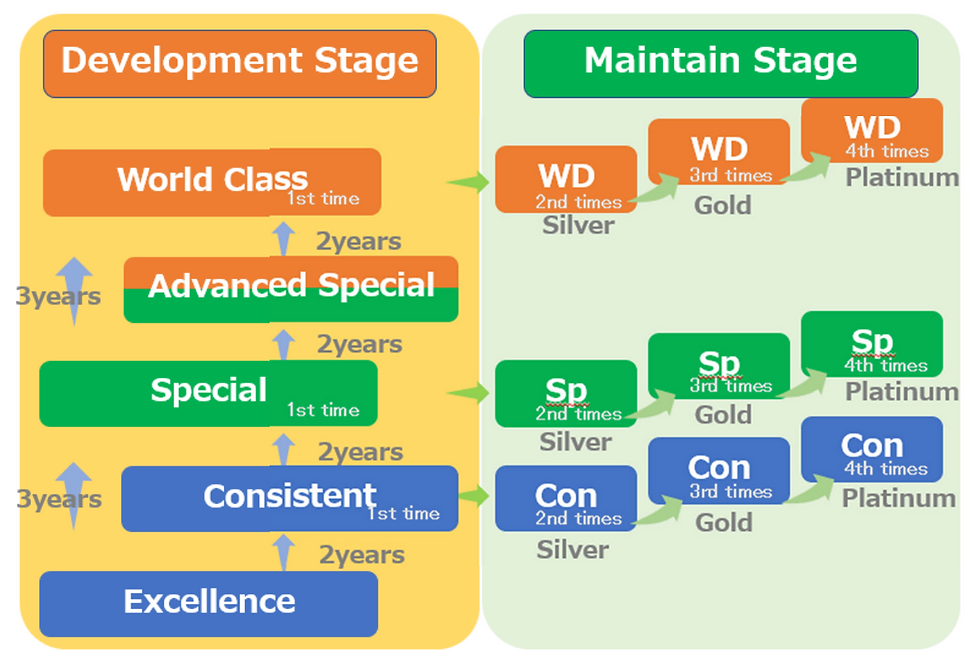
The award structure is organised into five categories, traversed sequentially in what JIPM calls the Development Stage. The entry point is the Award for TPM Excellence, which replaces the former Category A and Category B structure. Plants applying for the first time must start here, regardless of how mature their TPM activities may be. Eligibility requires at minimum two years of TPM activity since formal kick-off, deployment across six to eight pillars with full staff participation, Autonomous Maintenance progressed to the active Stage 4 (with Stage 3 completed), and a demonstrated infrastructure of both tangible and intangible achievements. There is also a self-checklist requirement, which I will return to in detail.
Having received the Award for TPM Excellence, a plant becomes eligible — after approximately two years of further activity — for the Award for Excellence in Consistent TPM Commitment. This category is explicitly about sustaining and deepening what was achieved at the Excellence level, not simply maintaining it. It assesses whether the organisation has embedded mechanisms for continuation and whether it has pushed beyond the baseline that earned the first award.
From Consistent Commitment, the path continues upward to the Special Award for TPM Achievement, which requires a distinctive character — the development of what JIPM calls "unique strengths" in TPM activities that go beyond competent pillar execution. Then comes the Advanced Special Award for TPM Achievement, which demands both significant improvement in results and a deepening of activities that is qualitatively different from what preceded it. At the summit is the Award for World-class TPM Achievement, reserved for plants whose TPM activities have achieved what JIPM describes as Global No. 1 or Only 1 status.
One important addition in the revised framework is the formal recognition of a Maintain Stage for repeated challenges within the same award category. Organisations can challenge the Consistent Commitment, Special, and World-class levels more than once, with repeated recognitions earning Silver, Gold, and Platinum designations. This formalises what was always possible but not clearly structured, and it is a significant philosophical statement: the award is not just a milestone to pass through on the way to something higher, but a level to maintain and deepen over time.
The pillars assessed are the eight pillars of TPM: Focused Improvement, Autonomous Maintenance, Planned Maintenance, Quality Maintenance, Education and Training, Safety, Health and Environment, Early Management, and Improvement of the Administrative and Indirect Departments. For the Award for TPM Excellence, Early Management and the Administrative and Indirect Departments pillar may be excluded where there are legitimate organisational reasons, making a minimum of six pillars the practical floor.
The checklist structure that underpins formal assessment is tiered across the award categories: the Self-Checklist (or Checklist C as a transitional option through 2026) for the first two levels, Checklist B for the Special Award, Checklist A for the Advanced Special, and Checklist S for World-class. Each successive checklist represents a qualitatively higher standard — not just more of the same activities, but activities that are systemically embedded, horizontally deployed, and demonstrably contributing to business results. To pass the second-stage assessment, the Award for TPM Excellence requires a minimum of 70 points on a 100-point scale; Consistent Commitment requires 80 points; and all higher awards require 80 points on their respective checklists.
How the Self-Checklist Works — and How to Use It Honestly
The revised JIPM framework introduced the Self-Checklist as the primary assessment tool for the Award for TPM Excellence and the Award for Excellence in Consistent TPM Commitment, replacing the older Checklist C as the primary instrument for these entry-level categories (though Checklist C remains available until the end of the 2026 awards cycle upon request, as a transitional accommodation).
The Self-Checklist is structured across eight to ten categories depending on which pillars the plant is declaring, with individual questions scored from 0 to 5. A score of 0 indicates that nothing exists; 5 indicates that the activity not only meets the highest standard but contributes to management goals beyond the immediate pillar. The scoring guides provide explicit descriptions of what each point level looks like in practice — not merely a numerical scale but a substantive account of what distinguishes a 2 from a 3, or a 3 from a 4.
To be eligible to challenge the Award for TPM Excellence, JIPM requires three conditions to be satisfied simultaneously at the time of application: all "Required" items must score at least 3; the average score across all items must be at least 2.5; and a completed JIPM Achievement Sheet must be submitted, verifying multi-year PQCDSME indicator trends — Productivity, Quality, Cost, Delivery, Safety, Morale, and Environment — with data that assessors can verify directly. This third condition is frequently overlooked in internal preparation, but it is not optional. A programme that clears the Self-Checklist thresholds without the Achievement Sheet data to back them up has not met the full standard for formal recognition, and the gap will be exposed in assessment. I address the Achievement Sheet in detail in the submission section below.
The required items in the Self-Checklist are precisely the ones that most plants find difficult to score honestly. Question 2-1, which asks about the number of pillars being implemented, is a Required item — as is Question 4-1, which asks how far Autonomous Maintenance activities have progressed through the seven steps. These are not soft questions that allow creative interpretation; they are factual assessments of concrete activity levels.
The categories in the Self-Checklist cover the full landscape of TPM implementation: the basic conditions for TPM (legal compliance, top-level policies, promotion system, master plan), the status of TPM promotion across pillars, Focused Improvement, Autonomous Maintenance, Planned Maintenance, Quality Maintenance, Education and Training, Safety, Health and Environment, and where applicable, Early Management and Improvement of Administrative and Indirect Departments. Reference items — covering safety accident reduction, productivity improvement, failure reduction, defect reduction, and improvement proposal frequency — provide the quantitative benchmarking context against which pillar activity scores should be read. These reference items will be evaluated comprehensively in the formal assessment.
In my work facilitating self-assessments across client plants, I use a protocol deliberately designed to counteract the social dynamics that produce inflated scores. This protocol is formalised in the OEC TPM Maturity Diagnostic as four scoring integrity rules — the Completeness Rule, the Correlation Rule, the Peer-Pillar Rule, and the Shopfloor Verification Rule — and they apply with equal force when conducting Self-Checklist assessments. The Completeness Rule requires that a level be fully achieved before it is scored. The Correlation Rule requires that scores on results-oriented criteria not increase unless the underlying operational metrics have also improved — a rising activity score alongside flat results is inflation, not progress. The Peer-Pillar Rule requires that scores across related pillars form a coherent, mutually consistent picture. The Shopfloor Verification Rule requires that any high score be confirmed by physically inspecting at least three random machines outside model areas before it is accepted. The full rationale and facilitation mechanics for each rule are covered in the OEC TPM Maturity Diagnostic practitioner guide.
The practical mechanics in a Self-Checklist session are these: pillar leaders do not score their own pillars — they score a peer pillar and have their own pillar scored by a peer who is not part of the same team. Scores are assigned individually before any group discussion, and the range of scores across evaluators becomes the starting point for calibration rather than the end point. Significant disagreements — a spread of two points or more on any item — are not resolved by averaging; they are treated as evidence that the item needs to be understood more clearly, and the team walks the shopfloor to settle the question empirically rather than argumentatively.
This matters because the most common failure mode in self-assessment is not deliberate dishonesty — it is the natural human tendency to interpret ambiguous evidence in the most favourable light. When an evaluator is asked whether "cleaning, lubrication, bolt tightening, and inspections are performed perfectly and without fail," the word "perfectly" is doing enormous work. Most plants will have evidence that these activities are performed on some machines some of the time. The question is whether the evidence supports "perfectly and without fail" as a characterisation of the programme as a whole, and that requires a standard of evidence that organisational optimism tends to relax.
What the Formal JIPM Assessment Actually Tests
Understanding the formal JIPM audit process is important not just for award applicants, but for any TPM programme director who wants to understand what genuine assessment looks like. The process is structured in two stages, and the distinction between them is substantive.
The First-stage Assessment, which takes place between April and July of the award year, involves JIPM assessors visiting the plant and evaluating three things: the status of TPM activities, tangible and intangible results, and the level of understanding demonstrated by supervisors, promotional staff, and front-line members. This last element — the understanding and engagement of the people doing the work — is one that many plants underestimate when preparing for assessment. Activity reports can be assembled by a TPM secretariat; the understanding of operators on the shopfloor cannot be manufactured at short notice.
The assessment day itself is structured around a morning of room presentations — covering each pillar in turn — followed by afternoon onsite presentations at the actual equipment and workstations where TPM activities are happening. The room presentation is an opportunity to explain what you are doing and why; the onsite presentation is the test of whether what you said in the room is actually visible and alive on the shopfloor. Assessors are looking for consistency between the two, and they are experienced enough to notice when it is absent. In my experience, assessors routinely deviate from the planned onsite route to inspect equipment that was not part of the prepared demonstration — specifically to test whether the standard described in the room presentation is systematic or confined to showcase areas. This is the same logic as the Shopfloor Verification Rule: three random machines, not the model line.
For the Award for TPM Excellence, the First-stage assessment is typically completed in a single day, with results announced on the same day. Applicants who pass proceed to the Second-stage Assessment, which takes place between late September and January. The Second-stage assesses progress since the first stage — JIPM explicitly expects that roughly six months of continued improvement activity will have occurred in the interval, and the Kaizen Improvement Report submitted for the second stage documents what has been achieved. Updated sections of the Activity Report should be clearly highlighted so assessors can identify what has changed. At least 75% of eligible facilities are expected to have completed Autonomous Maintenance Step 4 by the time of the second stage, even if only Step 3 completion was required at application.
Applicants who do not pass the first stage may reapply in subsequent years. Critically, if an applicant passes the first stage but fails the second, the first-stage result is annulled entirely — there is no partial credit. This all-or-nothing design is deliberate; it prevents organisations from treating the first stage as a lower-stakes milestone and then coasting into the second.
What assessors are looking for beyond the checklist is harder to describe but unmistakable in practice. They are looking for whether TPM has changed the culture of the plant — whether people at every level speak about their equipment with ownership rather than indifference, whether the evidence of systematic activity is woven into the daily rhythm of the workplace rather than assembled for the occasion of the assessment, and whether the losses that TPM is supposed to address are actually being addressed rather than merely documented. A plant that achieves a high score on documentation criteria but has a shopfloor that does not match the documentation will not pass. The best preparation for a JIPM assessment is not better documentation — it is better TPM.
The formal assessment also brings an external perspective that has genuine diagnostic value independent of the award outcome. Assessors typically provide feedback at the end of the assessment day, and that feedback often surfaces issues that internal self-assessment consistently missed — not because internal assessors were not looking, but because familiarity makes certain problems invisible. I have had clients who did not pass their first JIPM assessment but who later described the assessor feedback as the most useful technical input their programme had ever received, precisely because it came from outside the organisation's field of comfortable assumptions.
Preparing for a JIPM Award Submission: The Practical Pathway
The journey from deciding to pursue the Award for TPM Excellence to actually submitting an application is more complex than it might appear, and the most common mistakes are made in the preparation phase rather than in the assessment itself.
The first decision is timing. The application window for each year's awards closes in December — for the 2026 cycle, the registration deadline was 20 December 2025 — and eligibility requires at minimum two years of TPM activity since kick-off. Plants that apply before they are ready do so at real cost: not only the substantial assessment fees (denominated in Japanese yen, with on-site assessment fees for the Award for TPM Excellence at approximately JPY 1,480,000 per assessment day, plus travel costs for the assessors), but the reputational and motivational cost of a failed application. I advise clients to conduct a rigorous self-assessment against the JIPM Self-Checklist at least six months before the intended application date, with the explicit intention of finding reasons not to apply rather than reasons to proceed. If that assessment surfaces gaps, you want to know about them with time to address them.
The TPM Activity Report is the documentary centrepiece of the submission. JIPM is explicit about what it should contain and, importantly, what it should not. The report must tell the story of the plant's TPM journey — not as a collection of PowerPoint slides (JIPM specifically prohibits the mere printing and binding of presentation images as a substitute for a properly structured report), but as a coherent narrative of policy, planning, implementation, and results, pillar by pillar, supported by evidence that someone unfamiliar with the plant could understand and evaluate. The maximum length is 300 pages. Each chapter should be structured as a story that begins with the activity policy, explains what was done and why, and evaluates the results honestly — including acknowledging what has not yet been achieved and what is planned next.
One of the most common submission pitfalls is the treatment of results. Plants often present impressive-looking trend lines that start from a conveniently poor baseline, making percentage improvements look large. JIPM assessors are accustomed to this, and they probe for the absolute performance levels, the calculation methods behind the graphs, and the relationship between reported results and the business performance of the plant. OEE figures that cannot be independently verified against machine-level data, or safety records that do not account for near-misses and first-aid incidents, will not survive scrutiny. The same principle that drives the Correlation Rule in the OEC diagnostic applies here: activity documentation and results documentation are not the same thing, and assessors treat them very differently.
The Achievement Sheet — submitted at the time of application and made public if the award is received — is not an optional supplement. It is one of the three conditions a plant must satisfy to qualify for the award. The sheet requires objective data across the PQCDSME dimensions: productivity (including OEE broken into availability, performance rate, and quality products rate), number of breakdowns, MTBF, MTTR, customer complaints, in-process defect rate, cost indicators, production lead time, delivery performance, safety indicators, number of employee suggestions, and energy indicators. Gaps in this data at the time of application are revealing, and plants that cannot populate this sheet with credible baseline-to-current comparisons have usually not been measuring the right things throughout their TPM journey. Critically, the multi-year trend data the Achievement Sheet demands cannot be assembled retrospectively in the six months before an application. If you are running the OEC TPM Maturity Diagnostic now, begin building the Achievement Sheet data collection process at the same time — the two to three years of PQCDSME history that assessors require must be accumulated as you go, not reconstructed after the fact.
The JIPM also offers two optional services that I recommend strongly to first-time applicants: the Pre-assessment and the Follow-up. The Pre-assessment — available to plants challenging the award for the first time — involves a two-person JIPM team visiting the plant and identifying shortcomings before the formal application is made. At JPY 600,000 per day plus travel costs, it is not inexpensive, but it is far less expensive than a failed formal assessment, and the directional feedback it provides is calibrated specifically to the JIPM standard rather than to your own internal expectations. The Follow-up service is available to plants that have already received an award and are considering challenging a higher category, and serves a similar function of reality-checking readiness before committing to a formal application.
The Post-Award Challenge: Why the Award Is a Beginning, Not an Ending
I want to address something that is visible in almost every plant I have worked with that has achieved JIPM award recognition: the plateau effect. In the months following an award, TPM activity often experiences a distinct dip. The intense preparation effort that preceded the assessment winds down, the team that drove the process feels — legitimately — that it has earned a rest, and the organisational attention that had been mobilised around the award goal disperses. If this period is not managed actively, the plant can lose significant ground before anyone notices.
The JIPM framework anticipated this problem, which is why the Award for Excellence in Consistent TPM Commitment was designed specifically to assess whether what was built at the Excellence level has been not merely maintained but enhanced — and why it requires approximately two years of post-Excellence activity before becoming eligible. The two-year interval is not bureaucratic convenience; it is enough time for a management team to either sustain the improvement momentum or allow it to decay, and the Consistent Commitment assessment is explicitly designed to distinguish between the two.
The best TPM programmes I have observed after award recognition share a common characteristic: they treat the award as a published baseline rather than a destination. The scores and performance data from the award assessment become the floor of a new improvement cycle, not the ceiling of the current one. The JIPM assessor feedback becomes the input to the next year's master plan rather than a post-mortem on what was submitted. And — crucially — the energy that was concentrated on award preparation is redistributed into the actual pillar activities that the preparation was supposed to be documenting in the first place.
The Maintain Stage in the revised JIPM framework formalises this ongoing commitment by creating a pathway for recognised plants to continue challenging the same award category for Silver, Gold, and Platinum recognition. This is worth understanding carefully, because it changes the relationship between recognition and improvement in a useful way. A plant that has received the Award for TPM Excellence does not have to immediately pursue the Consistent Commitment level if its activities are not yet ready; it can challenge Excellence again, deepen what it has built, and earn a Silver or Gold recognition that acknowledges the continuity of commitment rather than forcing progression before the organisation is genuinely ready.
The deeper post-award risk, however, is subtler than the plateau. It is the risk that the language and structures of TPM become institutionalised while the substance fades — that pillar meetings continue to be held, activity boards continue to be updated, and self-assessment scores continue to be produced, but the restless curiosity that drives genuine improvement is replaced by the comfortable ritual of compliance. I have seen this happen in plants that won awards and then, five years later, could not explain why their OEE had drifted back to pre-TPM levels despite the fact that every pillar was nominally active. The structures were present; the culture was not.
The Self-Assessment Mindset: What Makes the Difference
The most technically sophisticated self-assessment instrument in the world will produce misleading scores in an organisation where honest self-evaluation is not safe. Safety, in this context, means cultural safety — the assurance that pointing out a problem will not be treated as an accusation, that identifying a gap in your own area will not be used against you in the next performance review, and that telling the truth about where TPM stands is more valued than presenting a picture that protects everyone's comfort.
Creating this kind of cultural safety is fundamentally a leadership responsibility, and it is worth being direct about what it requires. Leaders who respond to bad self-assessment scores with blame or defensiveness will not get honest scores the next time. Leaders who use self-assessment results to advance their own narrative about which parts of the organisation are performing and which are not will discover that people adjust their scoring accordingly. And leaders who treat the gap between self-assessment scores and JIPM assessor scores as evidence that the assessors were wrong rather than that the self-assessment was inflated will continue to be surprised by external assessments.
One pattern I observe repeatedly — and which the OEC TPM Maturity Diagnostic was specifically designed to address — is the substitution of activity governance for business results. A programme can have excellent steering committee reviews, well-maintained activity boards, and regular pillar reporting, while OEE remains flat, breakdown frequency stays high, and defect rates do not move. When the self-assessment scores reflect the quality of the governance rather than the quality of the results, the scores are telling the wrong story. JIPM Checklist C Category 10 — the results benchmarks against which Dimension 5 of the OEC diagnostic is anchored — tests exactly this: not whether the governance exists, but whether the programme is producing the outcomes that the governance is supposed to be driving. The honest self-check question worth asking at every scoring session is this: if a JIPM assessor walked onto our shopfloor unannounced today and inspected three random machines, would they see the standard described at this score level — or would they see exceptions? If the answer is uncertain, score the level below.
The converse is also true. Organisations where leadership treats honest self-assessment as genuinely useful — where a score of 2 on a difficult item is treated as valuable diagnostic information rather than a failure to be explained away — tend to produce self-assessment processes that steadily improve in accuracy over time. The scores come closer to what an external assessor would find. The gap between documented activity and shopfloor reality narrows. And when the formal JIPM assessment arrives, it confirms rather than contradicts what the organisation already knew.
In my consulting experience, one of the most useful interventions I can make in a self-assessment process is to insist on evidence calibration at every score boundary. For each item being scored above the midpoint, the evaluating team should be able to point to specific, observable, current evidence verified across at least three random machines outside model areas — not a policy document, not a historical improvement story, not a plan for what will be in place by the assessment date, but evidence that exists now and can be confirmed by walking the floor. This discipline of shopfloor verification does more to produce accurate self-assessment than any amount of training on the scoring criteria, because it forces the question that most self-assessment processes avoid: the question of whether what we think we know about our own programme is actually true.
That question, asked honestly and answered without flinching, is the beginning of genuine TPM self-assessment. It is also, not coincidentally, the beginning of the kind of improvement that makes a JIPM award worth pursuing in the first place.
What This Means in Practice
If I were advising a TPM programme director considering the self-assessment and award pathway, I would frame the journey in three stages that correspond to three different but equally important questions.
The first question is the diagnostic one: where are we, really? This requires a self-assessment conducted with full evidence calibration, involving a cross-functional team rather than just pillar leaders, with explicit attention to the gap between activity scores (which document what people are doing) and result scores (which document whether it is working). If that assessment reveals a programme that is sound in its pillars but weak in its connection between activity and results — or strong in certain areas but genuinely underdeveloped in others — that is honest, useful information, and it should drive the next improvement cycle. I recommend beginning with the OEC Maturity Diagnostic for this stage, because it provides the pillar-by-pillar structure and the Results and Business Impact dimension that makes the activity-versus-results distinction impossible to avoid.
The second question is the strategic one: is award recognition the right goal at this stage, and if so, which award and when? This is not simply a question of scores. It is a question of organisational readiness — whether the culture that produced the current scores is one that can sustain the scrutiny of an external assessment, whether the leadership commitment exists to resource and support the preparation process without distorting it, and whether the motivation for pursuing the award is genuinely developmental rather than reputational. The three conditions for application readiness — Self-Checklist thresholds met, Required items at 3 or above, and a credible Achievement Sheet — are a useful forcing function for this question, because they require the organisation to look at its results record honestly, not just its activity record.
The third question is the continuous one: after the assessment — whether or not it resulted in recognition — what did we learn, and what are we going to do about it? The formal JIPM assessment, like any rigorous external evaluation, is as valuable for what it reveals as for what it certifies. The plants that benefit most from the award process are those that treat every piece of assessor feedback, and every gap identified in preparation, as input to the next improvement cycle. The award plaque, if it arrives, marks a point of achievement in a continuous journey — and the plants that understand it as such are the ones that keep improving long after the ceremony is over.
About the Author

Allan Ung is the Founder and Principal Consultant of Operational Excellence Consulting, a Singapore-based management training and consulting firm established in 2009. With over 30 years of experience leading operational excellence and quality transformation in manufacturing-intensive environments, Allan's expertise spans Lean Thinking, Total Quality Management (TQM), TPM, TWI, ISO systems, and structured problem solving.
He is a Certified Management Consultant (CMC, Japan), Lean Six Sigma Black Belt, JIPM-certified TPM Instructor (Japan Institute of Plant Maintenance), TWI Master Trainer, ISO 9001 Lead Auditor, and former Singapore Quality Award National Assessor.
During his tenure with Singapore's National Productivity Board (now Enterprise Singapore), Allan pioneered Cost of Quality and Total Quality Process initiatives that enabled companies to reduce quality costs by up to 50 percent. In senior regional and global roles at IBM, Microsoft, and Underwriters Laboratories, he led Lean deployment, quality system strengthening, and cross-border operational transformation.
Allan has facilitated TPM, OEE and Lean programmes for organisations including Temic Automotive (Continental), Analog Devices, Amkor Technology, STATS ChipPAC, Infineon Technologies, Panasonic, Micron, Lam Research, Tokyo Electron, Dorma, and NEC. He holds a Bachelor of Engineering (Mechanical Engineering) from the National University of Singapore and completed advanced consultancy training in Japan as a Colombo Plan scholar.
His philosophy: "Manufacturing excellence is achieved through disciplined systems, capable leadership, and sustained execution on the shopfloor."
His practitioner-led toolkits have been utilized by managers and organizations across Asia, Europe, and North America to build Design Thinking and Lean capability and drive organizational improvement.
For enquiries about TPM self-assessment, the TPM Excellence Award, or operational excellence consulting, visit www.oeconsulting.com.sg or contact us directly through the OEC website.
Related Articles in the TPM Practitioner Guide Series
This article is part of a practitioner guide series on Total Productive Maintenance. Related articles include:
OEC TPM Maturity Diagnostic: A Practitioner Guide — Bridges implementation gaps with a four-level maturity model based directly on JIPM award checklists, translated into practical descriptors that make the assessment entirely actionable for practitioners.
Total Productive Maintenance (TPM): A Practitioner's Guide — The hub article covering the full TPM framework, its eight pillars, and the strategic principles that underpin effective implementation.
Autonomous Maintenance: A Practitioner's Guide — A deep practitioner account of Jishu-Hozen implementation across the seven steps, from the first cleaning inspection to genuine operator ownership.
Planned Maintenance: A Practitioner's Guide — How to design and implement a planned maintenance system that complements Autonomous Maintenance and progressively eliminates unplanned downtime.
Focused Improvement (Kobetsu Kaizen): A Practitioner's Guide — The methodology for targeting, analysing, and eliminating the specific equipment and process losses that hold OEE back.
Quality Maintenance (Hinshitsu Hozen): A Practitioner's Guide — The eight-step methodology for achieving zero defects by establishing and maintaining the precise 4M conditions required to prevent defect generation at the source.
Overall Equipment Effectiveness (OEE): A Practitioner's Guide — A deep dive into the OEE formula, the six big losses, and how to use OEE as a diagnostic tool rather than just a reporting metric.
OEE Benchmarking: A Practitioner's Guide How to measure, interpret, and act on Overall Equipment Effectiveness data — including the benchmarking traps that inflate scores without improving performance.
Build TPM Capability in Your Organisation
At Operational Excellence Consulting, I deliver customised TPM workshops and implementation programmes for manufacturing organisations across Singapore and the Asia-Pacific region — from foundational two-day workshops to multi-year TPM implementation support, facilitated by a JIPM-certified TPM Instructor.
👉 Explore our TPM training courses and practitioner-led resources:
Operational Excellence Consulting offers a full catalog of facilitation‑ready training presentations and practitioner toolkits covering Lean, Design Thinking, and Operational Excellence. These resources are developed from real workshops and transformation projects, helping leaders and teams embed proven frameworks, strengthen capability, and achieve sustainable improvement.
👉 Explore the full library at: www.oeconsulting.com.sg/training-presentations

Total Productive Maintenance 
Autonomous Maintenance 
Planned Maintenance 
Focused Improvement 
Quality Maintenance 
TPM Team Guide 
OEE 
Autonomous Maintenance Audit 
5S Workplace Organization
© Operational Excellence Consulting. All rights reserved.