


Empathy and Active Listening in the Age of AI—The Human Skills That Decide Who Gets Replaced
Updated: Apr 8
Empathy & Active Listening Are No Longer “Soft Skills”. They Are Survival Skills.
By Allan Ung, Operational Excellence Consulting

Allan Ung is the Founder and Principal Consultant of Operational Excellence Consulting, a Singapore-based firm established in 2009. A veteran practitioner with over 30 years of experience—including senior leadership roles at IBM, Microsoft, and Underwriters Laboratories—Allan specializes in bridging the gap between human-centered discovery and operational execution. As a Design Thinking coach and Certified Management Consultant (Japan), he moves beyond post-it notes to help organizations prototype and scale solutions that are both desirable for users and lean in their delivery. His unique approach, which integrates Design Thinking with the rigor of Lean Six Sigma and Systems Thinking, has been utilized by diverse organizations, including the Integrated Health Information Systems, ST Electronics (Satcom & Sensor Systems), PSA, Cisco, Vermeg, Walldorf Consulting, Hai Sia Seafood, and global leaders across 50+ countries.
The Dangerous Myth of “Soft Skills”
For years, empathy and active listening have been dismissed as nice-to-have, secondary to “real” skills like analytics, strategy, or technology.
That belief is now career-limiting — and potentially career-ending.
As AI rapidly automates analysis, reporting, coding, optimization, and even creative tasks, the skills that remain scarce are deeply human ones. The World Economic Forum (WEF) Future of Jobs Report 2025 explicitly identifies empathy and active listening as core skills required in the workforce — not optional traits.
The uncomfortable truth:
If your job relies primarily on processing information, AI is already learning to do it faster, cheaper, and better.
What it still cannot do — and may never fully do — is genuinely understand humans.
Why AI Is Replacing Jobs — But Not People with Empathy
AI excels at:
Pattern recognition
Data processing
Predictive analytics
Rule-based decision-making
AI fails at:
Understanding context, emotion, and nuance
Navigating human resistance, fear, trust, and motivation
Making sense of messy, ill-defined problems
Listening between the lines
This is why WEF places empathy and active listening alongside analytical thinking, systems thinking, leadership, resilience, and creativity. These skills compound each other — and form a protective layer around human roles.
The more your value comes from understanding people rather than managing information, the safer your role becomes.
The Jobs Most at Risk Are Not Low-Skilled — They’re Low-Empathy
Roles become vulnerable when they:
Treat people as transactions
Rely on scripts, templates, and dashboards
Optimize efficiency while ignoring human experience
Where Lack of Empathy Is Already Causing Damage
Elderly Care
When caregivers focus only on tasks, metrics, and schedules, elderly patients experience loneliness, anxiety, and neglect — even when procedures are followed “correctly”.
This is not a process problem. It is a listening problem.
Customer Service
Scripted chatbots and rigid call flows escalate frustration because they fail to understand intent, emotion, and context. Customers don’t leave because of technology — they leave because no one listened.
Corporate Leadership
Employees disengage not due to lack of strategy, but because leaders listen to data and KPIs more than people. AI can generate insights; it cannot build trust.
Why Design Thinking Starts with Empathy — Not Technology
Design Thinking is often misunderstood as a creativity toolkit. In reality, it is a discipline of structured empathy.

The first principle is not ideation.
It is deep listening.
Listening to what users say
Observing what they do
Interpreting what they struggle to articulate
Empathy enables:
Better problem definition
Fewer false assumptions
Solutions people actually adopt
Without empathy, organizations build technically brilliant solutions that fail in the real world.
Why Systems Thinking Fails Without Active Listening
Systems Thinking focuses on interconnections, feedback loops, and unintended consequences.
But systems include people — with beliefs, emotions, incentives, and fears.

When leaders fail to listen:
Policies backfire
Change initiatives stall
Resistance increases
Active listening reveals hidden feedback loops that dashboards never show:
Distrust
Fatigue
Fear of job loss
Unspoken constraints
Systems don't break because of bad models. They break because human signals were ignored.
The AI Paradox: More Technology, Less Understanding
As organizations deploy:
AI copilots
Automation
Digital workflows
Chatbots and self-service tools
They unintentionally strip away human listening moments.
The irony:
Productivity increases
Understanding decreases
Friction rises
This creates a leadership gap — not a technology gap.
The New Urgency: Learn These Skills Now — Not Later
Empathy and active listening are slow skills.
They require:
Practice
Self-awareness
Unlearning habits
Real human interaction
They cannot be “picked up” quickly when jobs are already disappearing.
Employees Who Wait Will Be Replaced.
Employees Who Listen Will Be Promoted.
Core Skills to Develop — Immediately
1. Deep Listening
Listen to understand, not to respond
Paraphrase before proposing solutions
Notice tone, hesitation, and emotion
2. Empathy Mapping
Separate what people say, do, think, and feel
Identify unmet needs beneath stated requirements
3. Contextual Judgment
Recognise when data is incomplete
Balance AI recommendations with human realities
4. Human-Centred AI Collaboration
Use AI for speed and scale
Reserve human judgment for ambiguity, conflict, and ethics
5. Reflective Leadership
Ask: Who hasn’t been heard?
Create psychological safety for honest feedback
The Hard Truth
Empathy and active listening are called “soft” only because they are hard to master — and impossible to automate fully.
In an AI-driven economy:
Technical skills keep you employed
Human skills keep you relevant
Empathy keeps you irreplaceable
Final Warning
AI will not replace humans.
Humans who lack empathy will be replaced by humans who have it — and by machines where empathy is absent.
The time to act is now, not when it’s too late.
Next Steps
Read my related thought pieces:
About the Author

Allan Ung is the Founder and Principal Consultant of Operational Excellence Consulting, a Singapore-based firm established in 2009. With over 30 years of experience, Allan specializes in the intersection of human-centered innovation and operational discipline. While his roots are in manufacturing-intensive environments, he has pioneered a "Design-to-Delivery" approach that ensures creative solutions are both desirable for users and sustainable within complex systems.
As a Design Thinking Coach and Certified Management Consultant (CMC, Japan), Allan helps organizations move beyond ideation to tangible impact. His expertise spans Lean Thinking, Total Quality Management (TQM), and Systems Thinking, providing a pragmatic framework that allows teams to prototype, test, and scale innovations rapidly.
In senior regional and global roles at IBM, Microsoft, and Underwriters Laboratories, Allan led cross-border operational transformations that balanced technical efficiency with human-centered service design. He has facilitated Design Thinking, Lean, and Quality programmes for diverse organizations, including Ministry of Social & Family Development, Integrated Health Information Systems, ST Electronics (Satcom & Sensor Systems), Ministry of Education, Health Sciences Authority, PSA, Cisco, Vermeg, Walldorf Consulting, Tokyo Electron, Panasonic, Sika Group, Toyota Tsusho, Fugro Subsea Technologies, Lam Research, and NEC.
Allan holds a Bachelor of Engineering from the National University of Singapore and completed advanced consultancy training in Japan as a Colombo Plan scholar. He is a Lean Six Sigma Black Belt, JIPM-certified TPM Instructor, and TWI Master Trainer.
His philosophy: "True innovation is found at the intersection of empathy and discipline—identifying the right human problems through Design Thinking and solving them permanently through Lean execution."
His practitioner-led toolkits are used by managers across 50+ countries to build internal capability and drive sustainable organizational improvement.
👉 Learn more at: www.oeconsulting.com.sg
Further Learning Resources
Operational Excellence Consulting offers a full catalog of facilitation‑ready training presentations and practitioner toolkits designed to support leaders in driving innovation, aligning teams, and leading organizational transformation. These resources are developed from real workshops and executive programs, helping organizations embed strategic frameworks, strengthen leadership capability, and achieve sustainable growth.
👉 Explore the full library at: www.oeconsulting.com.sg

Critical Thinking for Problem Solving 
Design Thinking 
Human-Centered Systems Thinking 
Analytical Thinking 
Lean Thinking 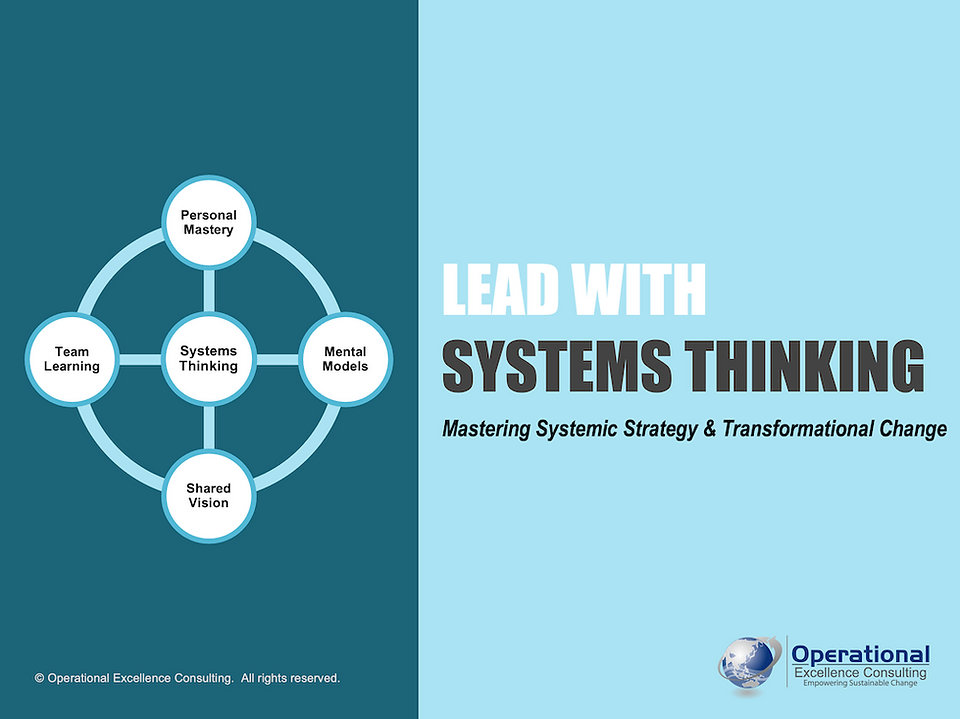
Lead with Systems Thinking 
Customer Journey Mapping 
Change Management 
Customer-Centricity