


Human-Centered Systems Thinking in Action: Reframing Singapore’s MRT for Reliability, Trust, and Human Experience
By Allan Ung, Operational Excellence Consulting

Allan Ung is the Founder and Principal Consultant of Operational Excellence Consulting, a Singapore-based firm established in 2009. A veteran practitioner with over 30 years of experience—including senior leadership roles at IBM, Microsoft, and Underwriters Laboratories—Allan specializes in bridging the gap between human-centered discovery and operational execution. As a Design Thinking coach and Certified Management Consultant (Japan), he moves beyond post-it notes to help organizations prototype and scale solutions that are both desirable for users and lean in their delivery. His unique approach, which integrates Design Thinking with the rigor of Lean Six Sigma and Systems Thinking, has been utilized by diverse organizations, including the Integrated Health Information Systems, ST Electronics (Satcom & Sensor Systems), PSA, Cisco, Vermeg, Walldorf Consulting, Hai Sia Seafood, and global leaders across 50+ countries.
Executive Summary (TL;DR)
Singapore’s MRT is a national asset and a daily lived system for millions. Recent reliability challenges show that optimizing solely for throughput and cost is insufficient. Human‑Centered Systems Thinking (HCST) combines empathy for commuters and staff with systems analysis and design practice to create resilient, trustworthy, and humane mobility. This article explains why HCST matters for the MRT, demonstrates concrete system‑level levers, and provides a practical roadmap leaders can use to move from short‑term fixes to durable transformation.
Introduction: Why the MRT Matters Now
The MRT is more than trains and tracks; it is the daily lived experience of commuters, frontline staff, regulators, and policymakers. High ridership, dense urban flows, and tight schedules make the network a complex socio‑technical system. Recent high‑profile disruptions and recurring reliability dips have exposed gaps that technical fixes alone cannot close. HCST reframes the problem: design for people first, then align structures and incentives so the system behaves reliably over time.
The Four Levels of Insight — MRT Iceberg Model

Events
Observable incidents: delays, breakdowns, overcrowding, and communication failures during disruptions.
Patterns
Recurring trends: periodic reliability dips, spikes in commuter frustration, and cycles of reactive fixes.
Structures
System drivers: maintenance regimes, procurement and funding models, contractual incentives, workforce practices, and communication protocols.
Mental Models
Underlying beliefs: an efficiency‑first mindset, assumptions that commuters tolerate short‑term pain, and the belief that technical fixes alone restore trust.
The HCST Process: Visual Framework for MRT System Redesign

The end‑to‑end HCST process is presented as Empathize → Define → Systems Analysis → Ideation → Prototype & Test. It is critical to emphasise that this is not a linear pipeline. Systems analysis underpins the design thinking process. It provides the systemic lens—feedback loops, delays, structural drivers and leverage points—that designers must use continuously as they empathize, define, ideate, prototype and test, so solutions are both human‑centred and durable.
Empathize
Map commuter journeys end‑to‑end: first mile, station experience, transfers, last mile.
Conduct ride‑alongs, staff shadowing, and targeted interviews with elderly, disabled, shift workers, and parents with young children.
Convert qualitative insights into measurable experience indicators such as perceived safety, clarity of information, and stress during disruptions.
Define
Synthesize empathy findings into clear problem statements that reflect real human needs and constraints.
Frame the problem so it is actionable and testable, avoiding vague goals like “improve reliability” without specifying whose reliability and under what conditions.
Systems Analysis
Map feedback loops, delays, and structural drivers that sustain patterns of failure or success.
Identify leverage points where modest interventions can produce outsized effects.
Use causal loop diagrams and system maps to make invisible dynamics visible to decision makers and designers.
Ideation
Co‑design solutions with commuters, frontline staff, technology partners, and regulators.
Generate options that balance technical feasibility, human experience, and systemic resilience.
Prototype & Test
Run small, rapid pilots with clear leading indicators.
Iterate based on both technical performance and human experience metrics.
Scale what demonstrably improves reliability and commuter trust.
Why Systems Analysis Matters
Systems analysis prevents narrow fixes that shift problems elsewhere. Designers who integrate systems thinking avoid solutions that improve a KPI in the short term but create new failure modes later. HCST asks teams to alternate between zooming out (system dynamics) and zooming in (human journeys and prototypes) throughout the project lifecycle.
Case Example: A Disruption and What It Reveals
On 12 August 2025 a major power fault disrupted the North East Line (NEL) and the Sengkang–Punggol LRT, affecting 11 NEL stations and causing multi‑hour service interruptions; services were progressively restored over the afternoon and evening, and operators issued apologies and incident statements. |
Event
A prolonged power fault halted multiple stations for many hours, leaving thousands stranded and sparking public frustration.
What the event revealed
Communication protocols were inconsistent across channels.
Redundancy and fault detection were insufficient to prevent cascading failures.
Frontline staff lacked clear decision rules and resources to support stranded commuters.
HCST response options
Short term: standardized, empathetic communication templates; station‑level commuter support kits; rapid shuttle coordination.
Medium term: expand predictive maintenance and sensor coverage; strengthen local redundancy.
Long term: procurement and contracting reforms that reward maintainability and reliability.
HCST Systems Tools for Visualization
To make complex systems legible, Human‑Centered Systems Thinking employs a set of systems tools that translate abstract dynamics into visible structures. These tools — including system maps, causal loop diagrams, and leverage point models — provide leaders with structured visualizations that reveal relationships, feedback loops, and intervention opportunities. By rendering the invisible architecture of systems into accessible diagrams, HCST enables decision‑makers to diagnose challenges, anticipate unintended consequences, and design more resilient strategies.
Causal Loop Diagram
A causal loop diagram is a systems thinking tool that shows how different variables influence each other over time. Arrows connect factors to reveal reinforcing loops (where changes amplify over time) and balancing loops (where changes counteract each other). In the MRT context, it helps leaders see how reliability, commuter trust, funding, and maintenance investment can either spiral upward in a virtuous cycle or downward in a vicious cycle if disruptions persist.
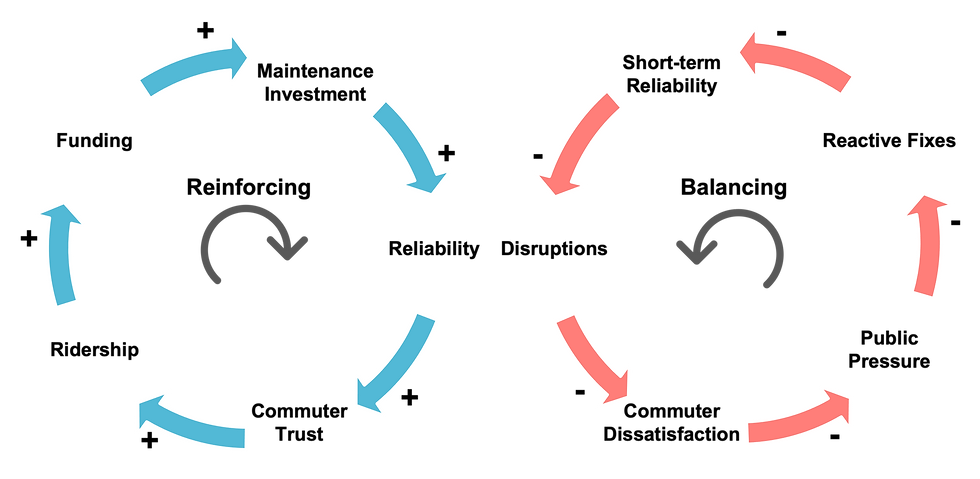
Reinforcing loop: Reliability → Commuter trust → Ridership → Funding → Maintenance investment → Reliability.
Balancing loop: Disruptions → Commuter dissatisfaction → Public pressure → Reactive fixes → Short‑term reliability → Future disruptions.
System Map
A system map is a visual representation of the key stakeholders, processes, and flows within a complex system. It shows who interacts with whom, what information or resources move between them, and where gaps or misalignments occur. By mapping commuters, staff, regulators, vendors, and policymakers, leaders can see both top‑down directives and bottom‑up feedback loops, making invisible relationships visible and actionable.

Leverage Points Diagram
A leverage points diagram highlights the specific places in a system where small, well‑targeted interventions can produce outsized effects. Instead of trying to fix everything at once, it directs attention to high‑impact levers such as communication protocols, maintenance investment, or policy incentives. In practice, this helps decision makers prioritize actions that shift system behaviour toward resilience and trust, rather than chasing symptoms.

Priority Leverage Points and Practical Actions
1. Communication Protocols (High Leverage, Fast Impact)
Standardize message templates for different disruption types and train staff to use them.
Prioritise empathy and clarity: what happened, what we’re doing, what commuters should do next.
Use multiple channels (station announcements, staff, apps, SMS) and ensure consistency.
Measure communication effectiveness with commuter feedback and response time metrics.
2. Maintenance Investment and Capability (Structural Leverage)
Reframe procurement to reward long‑term reliability and maintainability rather than lowest initial cost.
Scale predictive maintenance pilots into network‑wide programs using sensors, condition monitoring, and digital twins.
Invest in workforce capability: diagnostics training, cross‑skilling, and fatigue management.
Track leading indicators such as sensor health, spare parts availability, and staff workload.
3. Policy Incentives and Governance (Systemic Leverage)
Align regulator and operator incentives to reward reliability, accessibility, and commuter experience.
Create multi‑stakeholder governance forums that include commuter representatives and frontline staff to co‑design contingency plans.
Use planned closures strategically, with clear mitigation measures, to accelerate upgrades that reduce cumulative disruption.
A Practical 18‑Month Roadmap
0–3 months: Diagnose and Align
Launch commuter journey mapping and staff shadowing across priority lines.
Publish a simple reliability + experience dashboard (technical + trust metrics).
Standardize disruption communication templates and train frontline staff.
3–9 months: Pilot and Scale
Expand predictive maintenance pilots to priority lines; track leading indicators (sensor health, spare parts availability).
Run a planned closure pilot with full commuter support (shuttle buses, clear signage, compensation where appropriate).
Rework procurement language to include reliability and maintainability clauses; pilot performance‑based contracting.
9–18 months: Institutionalize and Sustain
Embed experience metrics into regulator/operator KPIs and public reporting.
Scale workforce capability programs (diagnostics training, cross‑skilling, fatigue management).
Establish a permanent multi‑stakeholder governance forum (commuter reps, frontline staff, tech partners) for continuous improvement and contingency planning.
Leadership Behaviours to Model
Be visible and accountable during disruptions; communicate personally and transparently.
Reward teams for preventing failures, not just for firefighting.
Invest in long‑term capability even when short‑term pressures push for quick fixes.
Measuring Success: What Good Looks Like
Technical: sustained increase in MKBF and reduction in unplanned service interruptions.
Experience: measurable improvements in commuter trust, perceived clarity of information, and reduced stress during disruptions.
Organizational: shorter mean time to repair, higher staff retention in maintenance teams, and procurement contracts that include reliability clauses.
Governance: regular multi‑stakeholder reviews and transparent public reporting of both technical and experience metrics.
Fairness and Balance: Acknowledging Progress
It is important to be fair. Operators and regulators have invested in new rolling stock, predictive maintenance pilots, and transparency measures. These steps are necessary and should be acknowledged. HCST does not replace engineering excellence; it complements it by ensuring that technical investments translate into better human outcomes and durable system behaviour.
Conclusion: HCST as Strategic Advantage
Singapore’s MRT has world‑class strengths—engineering capability, institutional capacity, and a culture of continuous improvement. HCST complements these strengths by centring human experience and systemic resilience. Leaders who adopt HCST will reduce delays and costs over time, rebuild commuter trust, strengthen staff capability, and create a transport system that is robust, humane, and future‑ready.
Next Steps
Your journey toward building resilient, human‑centered systems doesn’t end here. If you’d like to explore further, here are some resources to continue learning and applying these ideas:
Related Blogs
Human-Centered Systems Thinking in the Age of AI and Business Complexity
Systems Thinking: A Critical Leadership Capability for the Age of AI and Complexity
Revolutionizing Public Transit: The Redesign of SMRT's Chimes for a Better Commuter Experience
Design Thinking for Commuters: How SimplyGo is Shaping Better Travel
Training Programs
References
The Straits Times — MRT reliability falls to lowest level since 2020; LRT network improves https://www.straitstimes.com/singapore/transport/mrt-reliability-falls-to-lowest-level-since-2020-lrt-network-improves
LTA — Introducing Monthly Rail Reliability Reports (10 Oct 2025) https://www.lta.gov.sg/content/ltagov/en/newsroom/2025/10/news-releases/introducing_monthly_rail_reliability_reports.html
Channel NewsAsia — Rail reliability task force recommends full‑day service closures to speed up MRT, LRT upgrading (30 Dec 2025) https://www.channelnewsasia.com/singapore/rail-reliability-task-force-report-mrt-closures-lta-5764496
Business Times — More backup systems among rail task force’s recommendations (30 Dec 2025) https://www.businesstimes.com.sg/singapore/more-backup-systems-among-rail-task-forces-recommendations-submitted-acting-transport-minister
SMRT — SMRT and CRRC Sifang collaborate on C151B upgrades (6 Nov 2024) https://www.smrt.com.sg/news-publications/newsroom/media-releases/smrt-and-crrc-sifang-collaborate-to-explore-key-upgrades-on-c151b-train-for-enhanced-reliability-and/
Channel NewsAsia — SMRT to upgrade 92 trains with improved air‑conditioning, more sensors (18 Dec 2025) https://www.channelnewsasia.com/singapore/proof-concept-train-maintenance-detecting-fault-prevent-disruption-smrt-lta-5637606
The Straits Times — 92 SMRT trains to be upgraded by mid‑2030s (18 Dec 2025) https://www.straitstimes.com/singapore/transport/92-smrt-trains-to-be-upgraded-by-mid-2030s-new-systems-aim-to-reduce-breakdowns
AsiaOne — SMRT C151B proof‑of‑concept train and predictive maintenance pilot (18 Dec 2025) https://www.asiaone.com/singapore/smrt-c151b-proof-of-concept-train-maintenance-fault-detection-prevent-disruption-mrt-lta
SGTrains blog — Singapore MRT ranks 2nd‑most reliable among selected overseas metros (10 Sep 2025) https://blog.sgtrains.com/2025/09/singapore-mrt-ranks-2nd-most-reliable-among-overseas-metros-of-taipei-hong-kong-new-york-city/
Mothership — MRT & LRT rail reliability fell in Aug 2025: LTA monthly report (10 Oct 2025) https://mothership.sg/2025/10/rail-reliability-fell-august-2025-new-monthly-update/
Ministry of Transport (MOT) — Government response to MRT reliability falling to lowest level since 2020 (23 Sep 2025) https://www.mot.gov.sg/news-resources/newsroom/government-s-response-to-mrt-network-s-reliability-falling-to-lowest-level-since-2020/
The Online Citizen — Public reaction and commentary on MRT reliability and communication (23 Sep 2025) https://www.theonlinecitizen.com/2025/09/23/nobody-asked-for-zero-disruptions-netizens-push-back-on-jeffrey-siows-mrt-remarks/
About the Author

Allan Ung is the Founder and Principal Consultant of Operational Excellence Consulting, a Singapore-based firm established in 2009. With over 30 years of experience, Allan specializes in the intersection of human-centered innovation and operational discipline. While his roots are in manufacturing-intensive environments, he has pioneered a "Design-to-Delivery" approach that ensures creative solutions are both desirable for users and sustainable within complex systems.
As a Design Thinking Coach and Certified Management Consultant (CMC, Japan), Allan helps organizations move beyond ideation to tangible impact. His expertise spans Lean Thinking, Total Quality Management (TQM), and Systems Thinking, providing a pragmatic framework that allows teams to prototype, test, and scale innovations rapidly.
In senior regional and global roles at IBM, Microsoft, and Underwriters Laboratories, Allan led cross-border operational transformations that balanced technical efficiency with human-centered service design. He has facilitated Design Thinking, Lean, and Quality programmes for diverse organizations, including Ministry of Social & Family Development, Integrated Health Information Systems, ST Electronics (Satcom & Sensor Systems), Ministry of Education, Health Sciences Authority, PSA, Cisco, Vermeg, Walldorf Consulting, Tokyo Electron, Panasonic, Sika Group, Toyota Tsusho, Fugro Subsea Technologies, Lam Research, and NEC.
Allan holds a Bachelor of Engineering from the National University of Singapore and completed advanced consultancy training in Japan as a Colombo Plan scholar. He is a Lean Six Sigma Black Belt, JIPM-certified TPM Instructor, and TWI Master Trainer.
His philosophy: "True innovation is found at the intersection of empathy and discipline—identifying the right human problems through Design Thinking and solving them permanently through Lean execution."
His practitioner-led toolkits are used by managers across 50+ countries to build internal capability and drive sustainable organizational improvement.
👉 Learn more at: www.oeconsulting.com.sg
Further Learning Resources
Operational Excellence Consulting offers a full catalog of facilitation‑ready training presentations and practitioner toolkits designed to support leaders in driving innovation, aligning teams, and leading organizational transformation. These resources are developed from real workshops and executive programs, helping organizations embed strategic frameworks, strengthen leadership capability, and achieve sustainable growth.
👉 Explore the full library at: www.oeconsulting.com.sg

Critical Thinking for Problem Solving 
Design Thinking 
Human-Centered Systems Thinking 
Analytical Thinking 
Lean Thinking 
Lead with Systems Thinking 
Customer Journey Mapping 
Change Management 
Customer-Centricity