


Green Lean: The Practitioner’s Guide to Translating Waste Elimination into ESG Performance
Updated: Jun 6
By Allan Ung | Founder & Principal Consultant, Operational Excellence Consulting (OEC)
Published: 23 May 2026

Allan Ung is the Founder and Principal Consultant of Operational Excellence Consulting, a Singapore-based firm established in 2009. With over 30 years of experience leading operational excellence and quality transformation across manufacturing, technology, and global operations—including senior roles at IBM, Microsoft, and Underwriters Laboratories—Allan brings deep shopfloor expertise to every learning room he enters. A Certified Management Consultant (CMC, Japan), Lean Six Sigma Black Belt, TPM Instructor, TWI Master Trainer, and former Singapore Business Excellence Award National Assessor, he has facilitated Lean programmes and structured problem-solving for organisations including the Ministry of Social & Family Development, the Ministry of Culture, Youth & Sports, the Ministry of Education, Health Sciences Authority, Temasek Polytechnic, Tokyo Electron, Panasonic, Micron, Lam Research, Toyota Tsusho, NileDutch, Sika Group, Fugro Subsea Technologies, and NEC.
There is a conversation I have had in some form in almost every client organisation I have worked with over the past decade, and it almost always follows the same structure. The sustainability or ESG team has been tasked with reducing the company's environmental footprint and improving its social and governance disclosures. The operations or continuous improvement team has been running Lean programmes for years and has the results to show for it. Both teams are working hard. Neither team knows the other exists in any meaningful strategic sense.
When I ask the ESG team what operational mechanisms they are using to drive their environmental targets, the answer is usually a combination of capital investment in green technology, energy audits, and voluntary reduction commitments. When I ask the continuous improvement team whether their Kaizen results are being reported as ESG value, the answer is almost always no — and frequently, they have never been asked the question.
This is the structural problem that Green Lean is designed to solve. It is not a training programme about sustainability in the abstract. It is not a course that teaches Lean practitioners to care about the environment, because in my experience they already do. It is a systematic framework for making the connection between work that is already happening on the shop floor and the ESG disclosures that the boardroom is under pressure to produce.
The connection is not metaphorical. It is precise, measurable, and directly mappable to the specific disclosure numbers that global reporting frameworks require. The OEC Green Lean Matrix™ — which I will walk through in detail in this article — makes that mapping explicit, systematic, and actionable in a way that no existing framework or course has done before.
🛠️ Green Lean Implementation Resource Accelerate your deployment of the concepts discussed in this guide. Download the OEC Green Lean Master Training Presentation & Practitioner Toolkit. This fully customizable, facilitation-ready PowerPoint system includes the complete OEC Green Lean Matrix™, the Three-Currency Scorecard™, and ready-to-print workshop worksheets for your next kaizen event. |
The Boardroom-to-Shopfloor Translation Problem
The core challenge facing any organisation that is serious about ESG is not ambition. Boards and leadership teams are generally willing to commit to sustainability goals. The challenge is execution — specifically, the gap between a high-level commitment and the operational mechanism required to deliver it.
ESG metrics are, almost without exception, lagging indicators. Carbon emissions intensity reflects decisions about energy use and process design that were made months or years earlier. Total waste-to-landfill is an outcome of production and quality decisions made at the process level, shift by shift. Occupational injury rates are the result of workstation design, work method standardisation, and safety culture that were either built or neglected over time. No board committee can move these numbers from the boardroom. They can only be moved from the gemba.
What most organisations lack is not the intention to move these numbers. It is the translation mechanism — a structured way of connecting the strategic ESG commitment to the operational action that will deliver it, and then connecting that operational action back to the specific disclosures that investors, regulators, and assurance bodies are evaluating.
Lean thinking already provides the operational mechanism. The eight wastes of Lean are not merely sources of cost inefficiency; they are the operational root causes of the environmental, social, and governance failures that ESG frameworks are designed to measure and improve. Every tonne of scrap produced by a defect is a materials and emissions problem. Every idle machine drawing baseload energy while waiting for an upstream process is an energy and labour productivity problem. Every operator performing unnecessary motion due to a poorly designed workstation is an occupational health and safety problem.
The translation problem is not technical. The data exists. The improvement methodology exists. What has been missing is the explicit framework that connects the two domains with enough specificity to make the connection auditable and reportable. That is precisely what the OEC Green Lean Matrix™ provides.
ESG & Sustainability: The Strategic Context for Operations Leaders
Before describing the Green Lean framework itself, it is worth being direct about the pressures that make this integration urgent — because the urgency is real, and understanding it matters for how operations leaders position the work internally.
The corporate sustainability landscape has undergone a fundamental shift from voluntary disclosure toward mandatory, standardised reporting. Regulatory bodies in the European Union, the United States, Singapore, and across the Asia-Pacific region are progressively moving from guidelines to requirements. The International Sustainability Standards Board's IFRS S1 and S2 frameworks are being adopted as the basis for mandatory climate and sustainability reporting in a growing number of jurisdictions. The Global Reporting Initiative — the framework that anchors the OEC Green Lean Matrix™ — remains the world's most widely adopted sustainability reporting standard, used by more than 10,000 organisations across over 100 countries.
What this regulatory shift means practically is that the tolerance for unverified sustainability claims has collapsed. Institutional investors are no longer accepting narrative commitments backed by high-level financial proxies; they are requiring primary operational data that can withstand assurance scrutiny. Greenwashing allegations are no longer a reputational inconvenience; they are a litigation and regulatory risk. The organisations that are best positioned in this environment are not necessarily those with the most sophisticated sustainability strategies. They are the ones with the most credible operational data pipelines feeding directly into their disclosures.
This is where Lean organisations have an advantage they have not yet claimed. A plant running a serious continuous improvement programme is generating exactly the kind of primary operational data that modern ESG reporting requires: energy consumption per unit, material utilisation rates, scrap and waste volumes, safety incident data, training hours, workforce engagement indicators. The problem is that this data is sitting in operational performance reports and Kaizen project documentation, disconnected from the corporate sustainability disclosure process.
Green Lean closes that gap. It provides the taxonomy to classify operational improvement results as ESG value, the framework to map those results to specific GRI disclosures, and the quantification methodology to translate shopfloor metrics into the language that sustainability officers, auditors, and investors understand.
Why Lean Practitioners Are Already Doing ESG Work
One of the most consistent reactions I encounter when I present the Green Lean framework to experienced Lean practitioners is recognition. Not surprise — recognition. They have been working with the tools, driving the improvements, and generating the results for years. What they have not had is the vocabulary to describe those results in ESG terms, or the framework to connect them to the disclosure numbers that sustainability reporting requires.
This matters because it changes the nature of the implementation challenge. Green Lean is not asking organisations to start a parallel ESG programme alongside their Lean programme. It is asking them to reframe the Lean work they are already doing, measure it in an additional currency, and report it through the channel that boards and investors are monitoring.
The reframe starts with a simple observation: the eight classical Lean wastes — Defects, Overproduction, Inventory, Transportation, Motion, Waiting, Overprocessing, and underutilised Talent — are not just sources of cost. They are the operational root causes of the specific environmental, social, and governance failures that GRI Topic Standards are designed to capture.
When I teach this reframe, I use what I call the Green Lean double dividend: every unit of waste eliminated from a process yields two distinct returns simultaneously. The first is the return that Lean practitioners already know — reduced cost, improved flow, better quality, faster delivery. The second is the ESG return that has been invisible until now — lower emissions, reduced material consumption, improved worker safety and wellbeing, stronger process governance.
Lean practitioners have been delivering both returns all along. The only thing that has been missing is the accounting.
"Lean practitioners have been doing ESG work all along. It just has not been labelled, measured, or reported that way. Green Lean changes that." — Allan Ung, Founder, Operational Excellence Consulting
The strategic implication is significant. An organisation that has been running Lean for five years has been accumulating ESG value that it has never measured, claimed, or reported. Green Lean provides the framework to recover that value — and to ensure that every improvement project going forward is measured and reported in all three currencies simultaneously.
The OEC Green Lean Matrix™: Making the Invisible Connection Visible
The primary intellectual contribution of the Green Lean programme is the OEC Green Lean Matrix™. It is the first systematic mapping of all eight Lean wastes across all three ESG pillars to specific, named GRI disclosure numbers. No existing ESG reporting framework provides this mapping. No existing Lean training programme makes the connection explicit at this level of specificity. That gap is the reason the framework was worth building.

⚠️ GRI Transition Note: GRI 302 (Energy, 2016) will be replaced by GRI 103 (Energy, 2025) and GRI 305 (Emissions, 2016) will be replaced by GRI 102 (Climate Change, 2025), both effective 1 January 2027. Early adoption is encouraged. Six of the eight wastes in the matrix are affected. Organisations currently reporting under GRI 302 and GRI 305 should begin familiarising themselves with the revised standards now, and plan the transition to updated disclosure mappings before the effective date.
I want to be precise about what makes this matrix different from any prior attempt to connect operational excellence and sustainability. The existing literature on this topic tends to work at the level of general principles — "Lean reduces waste, waste elimination is good for the environment." That connection is true but useless for a sustainability officer who needs to know specifically which GRI disclosure number will improve when a Kaizen event reduces defect rates by 35%. The OEC Green Lean Matrix™ closes that gap. For every waste, the matrix specifies the ESG pillar, the GRI Topic Standards affected, the specific disclosure numbers within those standards, and the direction and nature of the metric improvement. That level of specificity is what makes the framework actionable rather than aspirational.
Walking the Eight Wastes Through the ESG Pillars
The matrix becomes meaningful in practice when practitioners walk through each waste category and understand not just the disclosure mapping, but the causal mechanism that connects the operational improvement to the ESG outcome. What follows is that walkthrough.
Defects are the waste category where the ESG connection is most immediately intuitive. Every unit of scrap represents raw materials that were consumed in production but never delivered to a customer. Those materials came from somewhere — they were extracted, processed, transported, and manufactured, all of which involved energy consumption and greenhouse gas emissions. When a quality improvement programme reduces defect rates by 40%, the ESG practitioner should be asking: how many tonnes of raw material were not consumed? How many kilowatt-hours of rework energy were not spent? What volume of solid waste did not go to landfill? These are the numbers that feed GRI 301-1, GRI 305-1, and GRI 306-3 respectively. A traditional Lean report captures the cost saving. A Green Lean report captures all three currencies simultaneously.
Overproduction — which I consider the most dangerous of the eight wastes precisely because it disguises itself as productivity — forces organisations to consume energy, materials, and floor space producing goods that have no immediate customer demand. The environmental cost of overproduction is embedded in every unit produced beyond actual need: the energy to run the machine, the material consumed, the warehouse energy required to store the excess inventory, and the emissions associated with all of the above. Eliminating overproduction does not just improve flow; it directly improves energy intensity ratios and GHG intensity per unit, which are the metrics that investors and regulators use to evaluate whether a company is genuinely decoupling production growth from environmental impact.
Inventory waste is the warehouse embodiment of overproduction's consequences. Excess inventory consumes physical space, which requires energy to heat, cool, and light. It is subject to obsolescence and degradation, which creates waste streams that frequently end up in landfill. Packaging materials accumulate and are often discarded. The GRI disclosures affected — 301-1, 301-3, 302-1, 306-3 — reflect this multi-dimensional environmental cost. A plant that achieves a sustained inventory reduction through pull system implementation has improved its environmental footprint in ways that most energy efficiency programmes never touch.
Transportation waste — the unnecessary movement of materials and products — is the most directly carbon-visible of the environmental wastes. Fuel consumption is Scope 1 emissions for own-fleet logistics and Scope 3 for third-party logistics, and both are under increasing scrutiny. Route optimisation, milk-run logistics, and plant layout redesign are classic Lean tools that reduce transportation waste; they are also emissions reduction strategies that feed directly into GRI 302-1, 302-4, 305-1, and 305-3.
Motion waste moves the analysis from the Environmental pillar to the Social pillar, and the connection is direct: unnecessary physical movement by operators — reaching for tools that are not at point of use, bending and twisting due to poor ergonomic design, walking long distances because workstations are laid out for convenience rather than flow — directly increases the physical strain placed on workers. This accumulated strain is the operational root cause of the ergonomic injury rates, lost-time incidents, and occupational ill-health cases that GRI 403 is designed to capture and improve. Workstation redesign and 5S are not just efficiency tools; they are OHS interventions with auditable, reportable impact.
Waiting waste is the one category that spans two pillars — Environmental and Social — because it has two distinct mechanisms of harm. When equipment waits for upstream processes, it frequently continues to draw baseload energy and emit greenhouse gases while producing nothing. This idle energy consumption is a direct contributor to GRI 302-1 and 305-1 disclosures. When operators wait for materials, information, or equipment, they experience the frustration and disengagement that research consistently links to voluntary turnover — which feeds directly into GRI 401-1. A balanced pull system that eliminates both forms of waiting delivers environmental and social returns in the same intervention.
Overprocessing is the waste category where the Governance pillar connection is most instructive — and most frequently overlooked. Overprocessing occurs when work is performed that adds cost but not customer value: redundant approvals, duplicate data entry, inspection steps that test what should be designed in, documentation that no one reads. This waste degrades process governance by creating non-standard workarounds, obscuring compliance trails, and introducing data quality issues into the operational metrics that feed ESG reporting. Standard Work — the Lean tool most directly targeted at overprocessing — is simultaneously the operational execution of GRI 2-24 governance commitments: it creates the documented, auditable, consistently followed procedures that ESG assurance bodies expect to find when they verify that an organisation's sustainability claims are operationally grounded.
Talent waste — the systematic underutilisation of the knowledge, creativity, and capability of the frontline workforce — is the Social pillar waste with the longest-lasting consequences. Organisations that do not engage their people in continuous improvement, do not invest in skills development, and do not provide career growth pathways lose those people — and losing them costs far more than the visible costs of recruitment and onboarding. The GRI 401, 404, and 405 disclosures affected by talent waste — employee turnover, training hours per employee, skills programme investment, workforce diversity — are precisely the metrics that institutional investors use to assess whether an organisation is building sustainable human capital or consuming it.
Green Lean in Practice: Tools as ESG Delivery Mechanisms
Understanding the waste-to-ESG mapping in the matrix is necessary but not sufficient. The practical question is how to apply Lean tools in a way that makes the ESG return measurable and reportable alongside the operational return. What follows is a practitioner's view of five core tools reframed through the Green Lean lens.
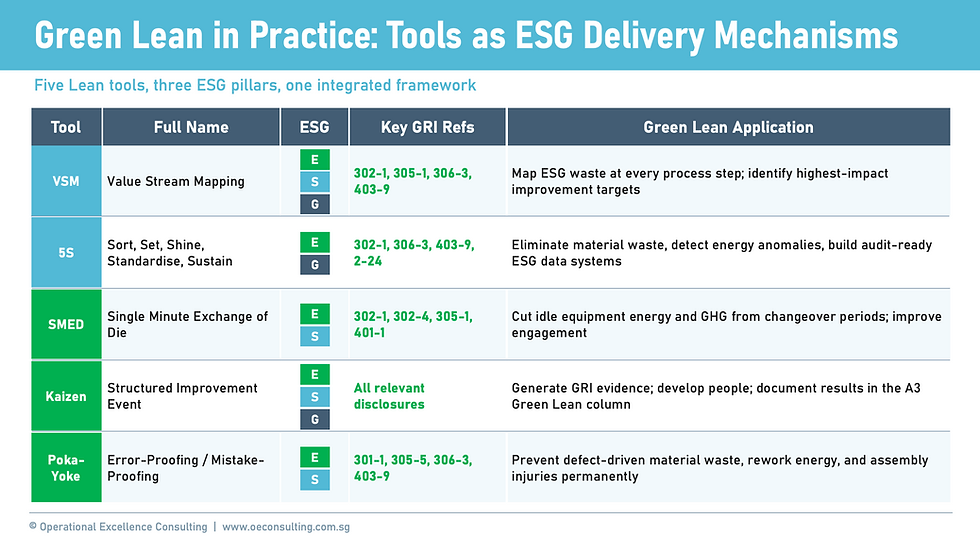
Value Stream Mapping, applied through a Green Lean lens, becomes what I call an ESG diagnostic of the enterprise process. The standard VSM exercise identifies where material flows stall, where processing time is disproportionate to value-added time, and where inventory accumulates. In a Green Lean application, the mapping team annotates each process step with sustainability data: kilowatt-hours consumed per shift, kilograms of scrap generated, litres of water used, safety incident rates at each workstation. The current state map becomes a spatial representation of the organisation's environmental and social liabilities. The future state design is not just an exercise in flow optimisation — it is a deliberate redesign of the process to reduce those liabilities while improving flow. Every future state VSM is simultaneously a GRI improvement roadmap.

5S is the bedrock of environmental safety and process compliance, and the Green Lean reframe makes this connection explicit at each step. Sort and Set in Order prevent raw material obsolescence and optimise resource allocation — these are material efficiency improvements that feed GRI 301. Shine exposes fluid leaks, contamination sources, and structural hazards that are both safety risks and environmental incidents waiting to happen. Standardise and Sustain build the process discipline and audit trail that governance disclosures require. A well-implemented 5S programme is visible evidence of operational governance to any ESG auditor who walks the floor.
Standard Work addresses the process variance that silently corrupts ESG reporting. In plants where different operators perform the same task in fundamentally different ways, the resulting variance in energy consumption, scrap rates, and safety behaviours creates ESG data that is genuinely unverifiable — it reflects which operator was working, not what the process consistently produces. Standard Work eliminates this variance, creates a reproducible baseline, and in doing so creates the auditable operational data that sustainability assurance bodies require. This is not a coincidental benefit of Standard Work; it is a direct operational execution of the governance commitments that GRI 2-24 and GRI 205-1 are designed to verify.
Total Productive Maintenance and the Overall Equipment Effectiveness metric are energy and emissions performance strategies as much as they are production performance strategies. Equipment running at 65% OEE is, from an energy perspective, consuming significantly more energy per unit produced than the same equipment running at 85% OEE — because the denominator of output is smaller while the numerator of energy consumption is largely fixed. Every machine that idles through a breakdown or runs at reduced speed due to chronic minor stops is an energy waste and an emissions source. A structured TPM programme that achieves a ten-point OEE improvement does not just unlock production capacity; it reduces energy intensity per unit and drops absolute GHG emissions, with quantifiable, reportable impact across GRI 302 and GRI 305 disclosures.
Kaizen is the compounding engine for long-term ESG improvement. What capital investment in green technology achieves through large, infrequent interventions, Kaizen achieves through small, continuous, accumulating improvements engaged by the entire workforce. A single Kaizen event that reduces setup waste by 20% may produce a modest ESG return. Fifty such events across a value stream over two years produce a transformation in the organisation's energy, materials, and safety profile — and because each event is a documented improvement with a measurable baseline and outcome, the cumulative ESG value is fully auditable. Connecting Kaizen project selection to the organisation's material ESG topics — as identified through GRI 3's materiality assessment process — is the practical mechanism for ensuring that continuous improvement effort is directed at the improvements that matter most to stakeholders.
Quantifying Green Lean: The Three-Currency Rule™
The most important shift in practice that Green Lean requires is a change in how improvement results are quantified and reported. Traditional Lean reporting measures a single currency — financial. Cost saved, waste reduced in production cost terms, labour hours recovered, capital expenditure deferred. This single-currency reporting makes operational improvements invisible to the sustainability function and to the board committees that monitor ESG performance.
The Three-Currency Rule™ — a proprietary quantification methodology developed by OEC — requires that every waste elimination project report its results across three parallel currencies simultaneously.
Financial Currency is the traditional measure: hard cost savings, cash flow improvement, capital avoidance. This is the language of the CFO and the operational P&L.
Environmental Currency is the physical, scientific measure: kilowatt-hours of electricity saved, litres of fuel not consumed, kilograms of raw material not wasted, tonnes of CO₂ equivalent not emitted. This is the language of GRI disclosures and the data that carbon accounting frameworks require.
Social Currency is the human capital measure: reduction in injury rates and ergonomic incidents, labour hours saved for employees, measurable improvement in training hours per employee, workforce engagement and retention outcomes. This is the language of the Social pillar and the data that workforce-focused investors analyse.

In practice, the Three-Currency Rule changes the nature of the pre-project business case and the post-project review. Consider a manufacturing plant that executes a Kaizen event targeting a chronic defect problem in a machining cell. The traditional project report would capture the financial saving: rejected units multiplied by standard material cost, plus rework labour recovered. A complete Green Lean report, applying the Three-Currency Rule, captures the full picture.
Financial Currency: scrap material cost avoided, rework labour recovered, rework energy saved.
Environmental Currency: tonnes of raw material not consumed, kilowatt-hours of rework energy not spent, tonnes of CO₂ equivalent not emitted from running the rework loop. These numbers feed directly into GRI 301-1, 305-1, 305-5, and 306-3 disclosures.
Social Currency: operator hours recovered from defect handling and rework, improvement in quality-related stress incidents, contribution to the team's engagement in problem-solving — which feeds into GRI 404 training and development metrics if the Kaizen event included structured problem-solving skill building.
The total value of the project, when reported in all three currencies, is consistently larger than the financial value alone. In the cases I have documented across client organisations, the environmental and social value frequently equals or exceeds the financial value over a three-year horizon. This matters not just for ESG reporting, but for project prioritisation: a project that looks modest by financial return alone may be a strategic priority when its environmental or social currency return is included.
Building the Green Lean Dashboard
The Three-Currency Rule produces results that need to be consolidated and connected to corporate reporting. The mechanism for this is the Green Lean Dashboard — a structured tool that maps operational KPIs directly to their corresponding GRI disclosures and presents the connection in a format that sustainability officers, board committees, and investor relations teams can use.
A well-designed Green Lean Dashboard does several things simultaneously. It gives operations managers real-time visibility of the ESG implications of their daily decisions — making sustainability performance as visible as safety, quality, and delivery on the daily management board. It gives sustainability officers a verified data pipeline from operations into their disclosure preparation, eliminating the end-of-year scramble to estimate environmental impacts from financial proxies. And it gives board committees the evidence they need to demonstrate that ESG commitments are being executed operationally, not just declared strategically.
The dashboard is not a separate system. It is a sustainability lens applied to the operational data that Lean organisations are already collecting. The primary investment required to build it is not technology — it is the connection work of mapping existing operational metrics to their GRI equivalents, and establishing the discipline of reporting both currencies from the same data source.
From Insight to Action: Deploying Green Lean in Your Organisation
The deployment of Green Lean follows a structured sequence that I have refined across multiple client implementations. What the sequence is designed to avoid is the common failure mode of treating Green Lean as a parallel programme — a separate sustainability initiative running alongside the existing Lean programme, competing for the same resources, and ultimately colliding with it.
Green Lean is not a parallel programme. It is a lens applied to the Lean work that is already happening, and the deployment sequence is designed to make that integration practical rather than theoretical.

The deployment begins with ESG materiality alignment — identifying which GRI disclosures are most critical to the organisation's key stakeholders and mapping those disclosures back to the waste categories in the OEC Green Lean Matrix™. This step ensures that the continuous improvement programme is directed at the exact operational problems that generate the highest strategic ESG value, rather than simply pursuing the most visible waste.
The second step is Green Lean VSM — conducting a value stream mapping exercise using the Green Lean annotation methodology to produce a current state map that reveals both operational waste and environmental and social impact simultaneously. This mapping exercise is typically the most revealing activity in the deployment, because it makes visible the ESG implications of process decisions that have been invisible for years.
The third step is the Green Lean Opportunity Map™ — a structured, single-page planning tool that converts the VSM findings into a prioritised project portfolio, with each opportunity mapped to its waste category, ESG pillar, GRI disclosure numbers, and Three-Currency value estimate.

The fourth step is governance integration — using Hoshin Kanri to cascade Green Lean objectives from the board level to individual value streams and work cells, ensuring that the improvement priorities identified through the Opportunity Map are aligned with the organisation's highest-level sustainability commitments and resourced accordingly.
The fifth step is measurement and reporting — building the Green Lean Dashboard and establishing the data pipeline from operational metrics to GRI disclosures, and ensuring that the reporting cycle for sustainability disclosures is fed by verified operational data rather than end-of-year estimates.
Throughout the deployment, there are three failure modes that I have observed consistently across client organisations, and that are worth naming explicitly.
The first is tool deployment without culture change — implementing 5S, Standard Work, and Kaizen mechanically without engaging the workforce in the sustainability narrative. Green Lean's social value is only realised if the workforce understands why the work matters beyond the immediate operational improvement. Teams that understand they are reducing their organisation's carbon footprint alongside their defect rate tend to engage more deeply and sustain results more consistently.
The second is reporting without operational grounding — attempting to publish sustainability disclosures using financial proxies and estimates without establishing verifiable operational data pipelines. This approach produces disclosures that cannot withstand assurance scrutiny, and it leaves the organisation exposed precisely when stakeholder scrutiny is highest.
The third is operational improvement without strategic framing — running excellent Lean programmes that produce genuine ESG value but never connecting those results to the sustainability reporting process. This is the failure mode I encounter most frequently, because it is the one that requires the least effort to fall into. The continuous improvement team is focused on operations. The sustainability team is focused on disclosures. No one owns the connection. Green Lean makes that connection explicit, assigns ownership for it, and provides the tools to maintain it.
A Note on the GRI Standards Transition
Practitioners implementing Green Lean programmes now need to be aware of a significant transition in the GRI Topic Standards framework that will affect six of the eight waste categories in the OEC Green Lean Matrix™.
GRI 302 (Energy, 2016) is being replaced by GRI 103 (Energy, 2025), and GRI 305 (Emissions, 2016) is being replaced by GRI 102 (Climate Change, 2025). Both replacement standards were released in June 2025 and take effect on 1 January 2027. Early adoption is encouraged.
The waste categories affected are Defects (305), Overproduction (302, 305), Inventory (302), Transportation (302, 305), Waiting (302, 305), and Overprocessing (302) — all six of the environmentally oriented waste categories. The Social and Governance categories — Motion (GRI 403) and Talent (GRI 401, 404, 405) — are not affected.
Organisations currently building Green Lean dashboards and reporting pipelines should design them to accommodate this transition. The underlying operational data — energy consumption per unit, scrap volumes, emissions calculations — does not change. What changes is the disclosure structure and reporting requirements under the new standards. I recommend verifying the final published requirements for GRI 102 and GRI 103 directly at globalreporting.org before embedding the new disclosure numbers in any client-facing material.
An updated OEC Green Lean Matrix™ reflecting the 2027-effective disclosure numbers has been developed and will be made available as part of the Green Lean programme materials when the transition approaches.
Conclusion: The Work Was Already Happening
The central claim of Green Lean is not complicated, but its implications are significant. Every organisation that has been practising Lean waste elimination has been generating ESG value. The scrap they did not produce, the energy they did not consume, the injuries they prevented, the skills they developed in their workforce — all of it has been real, measurable, and reportable. It simply has not been labelled, measured, or reported that way.
The OEC Green Lean Matrix™ provides the label. The Three-Currency Rule™ provides the measurement. And the GRI disclosure mapping provides the reporting pathway.
What changes when an organisation implements Green Lean is not the work — the Kaizen events, the 5S activities, the standard work documentation, the maintenance programmes. That work continues, and should continue, because it is what drives operational performance. What changes is the accounting. Every improvement project is now measured in all three currencies. Every improvement result is now connected to the specific sustainability disclosures it improves. Every operational decision is now visible in its environmental and social implications alongside its financial ones.
For the continuous improvement practitioner, this is an expansion of scope and significance. The work they have been doing has always mattered more than a cost saving report could capture. Green Lean gives them the framework to demonstrate that full value.
For the sustainability officer, this is the operational engine they have been looking for — not a capital investment programme or a carbon offset scheme, but a rigorous, frontline execution mechanism that produces the primary operational data that modern ESG reporting requires.
For the board, this is the credibility bridge between the sustainability commitment and the sustainability evidence. It is the answer to the question that regulators, investors, and assurance bodies are asking with increasing insistence: how do you know your ESG performance is real?
The answer is the same answer that Lean practitioners have been giving to operational performance questions for decades: because we measured it at the source, at the gemba, in the process where the work happens.
That is what Green Lean delivers.
About the Author

Allan Ung is an internationally recognized author, thought leader, and master practitioner in the field of Operational Excellence, with a career spanning more than thirty years at the absolute forefront of organizational transformation and quality management. As the Founder and Principal Consultant of Operational Excellence Consulting, a premier management training and consulting firm established in Singapore in 2009, he has dedicated his professional life to helping organizations bridge the critical gap between complex academic frameworks and practical, shopfloor execution. His unique advisory philosophy emphasizes the creation of "fit-for-purpose" management systems that democratize continuous improvement, intentionally stripping away unnecessary statistical complexity and "math anxiety" to empower frontline workers with accessible, high-impact problem-solving tools.
Prior to establishing his successful consultancy practice, Allan held senior regional leadership and advisory roles within some of the world's most prominent multinational corporations and regulatory bodies, including IBM, Microsoft, and Underwriters Laboratories. His deep expertise in managing large-scale quality transformations was further forged during his foundational tenure at Singapore's National Productivity Board, which has since evolved into Enterprise Singapore, where he actively pioneered national quality process initiatives and coached enterprises across multiple sectors on productivity enhancement. His extensive cross-border experience includes completing advanced consultancy training in Japan as a prestigious Colombo Plan scholar, an experience that allowed him to study the roots of lean thinking directly from Japanese master practitioners and adapt those methodologies for global deployment.
Allan’s comprehensive professional credentials reflect a deep commitment to mastery across multiple operational disciplines. He is a Certified Management Consultant accredited in Japan, a Lean Six Sigma Black Belt, a JIPM-certified Total Productive Maintenance Instructor, and a Training Within Industry Master Trainer. Demonstrating his deep standing within the national quality ecosystem, he has also served as a Singapore Business Excellence Award National Assessor, evaluating leading organizations against world-class business excellence frameworks. He holds a Bachelor of Engineering in Mechanical Engineering from the National University of Singapore, a world-class academic foundation that complements his highly practical, results-driven consulting approach. Through his development of proprietary methodologies like the OEC Green Lean Matrix™, OEC TPM Maturity Diagnostic, and the 4-Lens of Critical Thinking Model, Allan continues to stand out as a pioneering voice in management consulting, helping global enterprises transform their daily operational realities into sustainable competitive advantages.
His philosophy: "Manufacturing excellence is achieved through disciplined systems, capable leadership, and sustained execution on the shopfloor."
His practitioner-led toolkits have been utilized by managers and organizations across Asia, Europe, and North America to build Design Thinking and Lean capability and drive organizational improvement.
For enquiries about our facilitated Green Lean workshop, visit www.oeconsulting.com.sg or contact us directly through the OEC website.
Further Learning Resources
This article forms part of the hub of OEC's Lean Thinking content cluster. Each spoke article explores one dimension of Lean in depth:
Hub article
Related spoke articles
5S Implementation: A Practitioner's Guide to Building a Workplace that Works
Kaizen: A Practitioner's Guide to Building a Culture of Continuous Improvement
Hoshin Kanri: The Complete Practitioner Guide to Translating Strategy into Execution
Visual Management: The Practitioner's Guide to Building a Workplace where Problems Cannot Hide
Cross-linked hub articles
Ready to Equip Your Team with the Green Lean Framework?
👉 Explore our Green Lean Training Presentation and Lean Training Courses to bring the OEC Green Lean Matrix™ and Three-Currency Rule™ into your organisation.
Training Courses and Workshops:
Training Presentations:
Operational Excellence Consulting offers a full catalog of facilitation‑ready training presentations and practitioner toolkits covering Lean, Design Thinking, and Operational Excellence. These resources are developed from real workshops and transformation projects, helping leaders and teams embed proven frameworks, strengthen capability, and achieve sustainable improvement.
👉 Explore the full library at: www.oeconsulting.com.sg
The OEC Green Lean Matrix™ and the Three-Currency Rule™ are proprietary frameworks of Operational Excellence Consulting. Unauthorized reproduction, modification, or distribution without prior written consent is strictly prohibited.