


Digital Transformation: Human Factors — People, Organization & Change Management
Updated: May 16
By Allan Ung | Founder & Principal Consultant, Operational Excellence Consulting

Allan Ung is a Certified Lean Six Sigma Black Belt, Certified Management Consultant (CMC, Japan), and Singapore Business Excellence Award national examiner with over 30 years of consulting experience, including senior roles at IBM and Microsoft, and operational excellence work with Underwriters Laboratories (UL) across Asia-Pacific. He is the founder of Operational Excellence Consulting (OEC), Singapore.
This article is part of OEC's Digital Transformation blog cluster. Related reading: |
"Even if you are on the right track, you'll get run over if you just sit there." — Will Rogers
Introduction: The Human Problem That Technology Cannot Solve
In every digital transformation engagement we conduct — whether with semiconductor manufacturers like Micron, industrial groups like Sika, or logistics operators like NileDutch — the conversation follows a predictable arc. It begins with technology: which platforms to adopt, which processes to automate, which data infrastructure to build. And then, usually within the first few weeks of serious planning, it arrives at the real challenge: people.
The statistics are unambiguous. 70% of digital transformations fail, most often due to resistance from employees (Forbes). Yet the overwhelming majority of transformation investment continues to flow toward technology — platforms, systems, tools — rather than toward the people and culture that determine whether those investments ever generate value.
This article is for the leaders and change practitioners who recognize that the soft side of digital transformation is, in reality, the hard side. It covers the organizational impact of digital change, the psychological dynamics of how people respond to it, the management frameworks that help navigate it, and the practical steps you can take to build a cultural foundation strong enough to support lasting transformation.
It is a companion to OEC's hub article, Digital Transformation Step-by-Step: Your Practitioner Guide, which covers the four-phase, twelve-step strategic framework. This article goes deeper on the human dimensions that that framework depends upon.
Why 70% of Digital Transformations Fail: The People Equation
When Forbes and McKinsey report that most digital transformations fail, they are not talking about technology failures. The platforms generally work. The automation generally functions. What fails is the human system around the technology.
The eight most common human-centred failure modes, as identified by Accenture, are:
"IT" versus "Product" mindset — Technology teams and business teams speak different languages, optimize for different goals, and measure success differently
Lagging metrics — Organizations measure inputs (technology deployed) rather than outcomes (behaviour changed, value created)
Lack of customer empathy — Transformation is designed for internal efficiency rather than customer experience
Failure to understand the "Last Mile" — The final step of adoption — getting people to actually change how they work — is consistently underestimated
Lack of talent — Digital skills gaps are underestimated and under-resourced
Too many technologies — Technology proliferation without coherent strategy creates confusion and fatigue
Not decoupling legacy systems — Technical debt creates friction that slows adoption and demoralizes change agents
Slow market testing and lack of agility — Inability to experiment quickly means the organization cannot learn its way to transformation
Notice that the majority of these failure modes are cultural, behavioural, or organizational — not technical. This is the central premise of this article.
The Martec's Law Problem
Scott Brinker's Martec's Law captures the organizational dimension of digital transformation with elegant simplicity: technology changes exponentially, but organizations change logarithmically.

The practical implication is that technology management in digital transformation is fundamentally about selection — deciding which changes to adopt and in which sequence — rather than simply implementing everything that is available. Organizations that try to close the gap by accelerating technology adoption without simultaneously accelerating cultural change make the gap worse, not better.
Digital Transformation Is Not About Technology
This is the most important and most consistently underestimated truth in digital transformation:
"Most digital technologies provide possibilities for efficiency gains and customer intimacy. But if people lack the right mindset to change and the current organizational practices are flawed, Digital Transformation will fail."
Most organizations entering digital transformation have a "traditional digital transformation thinker" mindset — which sounds something like:
"We have this problem, let's get in a room and brainstorm solutions."
"We have this technology, what can we use it for?"
"Our competitors just launched X; how can we do X quickly?"
These starting points are technology-led, reactive, and inward-facing. They produce digital initiatives that are poorly aligned with customer needs, poorly adopted by employees, and quickly abandoned.
The alternative — and the approach that characterizes successful transformations — is human-centred design thinking: starting with deep empathy for the customer and the employee, defining problems rigorously before generating solutions, and iterating through rapid experimentation rather than waterfall planning.
Design Thinking as the Backbone of Digital Transformation
Digital transformation is grounded in Design Thinking principles. The most successful transformations we have supported share these characteristics:
Highly creative — solutions are not imported from competitors but developed through genuine ideation
Human-centred — the customer and the employee experience drive every design decision
Collaborative — cross-functional teams co-create rather than hand off
Iterative — learning through rapid cycles of prototype and test, not through long planning cycles
Hands-on — show, don't tell; prototypes, not presentations
The contrast with traditional organizational thinking is stark:
Traditional Thinking | Design Thinking |
Flawless planning | Enlightened trial and error |
Avoid failure | Fail fast |
Rigorous analysis | Rigorous testing |
Presentations | Lightweight experiments |
Arm's length customer research | Deep customer immersion |
Periodic | Continuous |
Thinking | Doing |
For a deeper dive into the Design Thinking methodology and how it is applied in transformation contexts, see OEC's Design Thinking Practitioner Guide.
Six Myths of Digital Transformation That Leaders Must Dispel
Before leading others through digital transformation, leaders must first challenge their own assumptions. These six myths are consistently the most damaging ones we encounter in the field:
Myth 1: Digital Transformation applies only to B2C companies
Reality: B2B manufacturers — including clients such as BRC Weldmesh and Tokyo Electron — face equally significant digital transformation imperatives in their supply chains, production systems, and customer service operations.
Myth 2: Digital Transformation is just for online businesses
Reality: Digital transformation is about using technology to change how value is created and delivered — which applies to every industry, including industrial manufacturing, logistics, and public-sector services.
Myth 3: Only Millennials are more willing to use digital services
Reality: Digital adoption is driven by convenience and value, not age. Industrial customers and government agency users adopt digital services at pace when they are well-designed and genuinely useful.
Myth 4: Digital Transformation is relevant only in developed markets
Reality: Digital transformation is reshaping industries across all markets. Singapore's public sector, in particular, has been at the global forefront of digital government and smart nation initiatives.
Myth 5: Digital Transformation is only about "Digital," not IT
Reality: IT and digital transformation are deeply intertwined. The distinction between IT-as-infrastructure and digital-as-experience is dissolving. Effective transformation requires both to work in concert.
Myth 6: Digital Transformation and Digitization are the same thing
Reality: This is perhaps the most dangerous myth. Digitization is a component of transformation — but transformation requires rethinking business models, customer experiences, and organizational culture in ways that go far beyond converting paper to pixels.
What Digital Transformation Is NOT
Aligned with the myth-busting above, here is a practical checklist of what digital transformation is not — which we share with leadership teams at the start of every engagement to anchor shared understanding:
Going paperless
Becoming agile (agility is a means, not an end)
Using advanced technology for its own sake
Switching to cloud services
Copying what competitors do
Collecting lots of data and not using it
And — critically — digital transformation is not paving the cow path. Organizations must not simply take existing flawed processes and automate them. The goal is to rethink fundamentally how new digital technologies can be used to create new sources of customer, product, and operational value.
The Organizational Impact of Digital Transformation
Digital transformation does not just change what tools people use. It changes what roles they play, how they are managed, how they are measured, and what the organizational structure looks like. Understanding this impact honestly is a prerequisite for managing it effectively.
Challenges in Delivering End-to-End Customer Experience
Most organizations are structured functionally — organized around departments — and hard-wired to deliver touchpoints. Digital transformation requires them to deliver end-to-end customer experiences that cut across those functional boundaries. The organizational consequences are significant:
Organization: Most companies are functionally organized and hard-wired to deliver touchpoints, not journeys
Performance: Performance data is often stored in silos, making it challenging to assess end-to-end performance
Involvement: Typically more than one person is responsible for the end-to-end experience
Visibility: At the frontline, there is limited visibility into customer outcomes and cross-functional handoffs
Incentives: Metrics and incentives are often touchpoint-based (first call resolution, average handle time, transactional satisfaction) rather than journey-based
Addressing these organizational misalignments is not a technology problem. It is a structural and cultural one.
What Digital Transformation Means for Employees
The honest truth about what digital transformation asks of employees is this: they are being asked to work harder, learn multiple skills, and accept constant change — in order to retain their jobs and their market value.
Employees will accept this — but only under three conditions:
1. Adequate training is provided — they are equipped for what is asked of them
2. There are clear and agreed performance measures — they know what success looks like
3. Rewards are related to these measures — their extra effort is recognized and valued
When these three conditions are not met, resistance is not irrational — it is entirely logical. Leaders who want to overcome resistance must first ask whether they have created the conditions for acceptance.
The Three-Step Workforce Response: Rethinking, Reskilling, Redeploying
To keep their people during and after digital transformation, organizations need to address the workforce question through three lenses:
1. Rethinking Looking at how current job descriptions and duties can be readjusted to accommodate new digital processes. Not every role disappears — most roles change. The question to ask of every role is: what does this person need to do differently in a digitally transformed organization?
2. Reskilling Training employees to equip them with the skills they will need to perform new roles. Reskilling goes beyond sending people to a one-day course. It requires structured learning programmes that build both technical and soft skills — digital literacy, data interpretation, digital communication, and change-readiness.
3. Redeploying Moving employees with specific skills to other parts of the organization where their skills will be more appropriate or useful. This requires genuine organizational flexibility and a culture that values internal mobility rather than treating it as a sign of failure.
Skills Areas to Develop for Digital Transformation
Five critical skills areas that organizations must develop to fully leverage digital transformation:
Big Data Analytics — The ability to glean valuable insights into consumer behaviour, making strategic and operational adjustments to improve performance and gain competitive advantage. For manufacturing clients such as Lam Research and Micron, this means leveraging equipment and process data in ways that traditional reporting never enabled.
Cloud Computing — Implementing and managing cloud services is fundamental to digital transformation. It is critical that IT personnel know how to implement, govern, and optimize cloud environments rather than simply migrate existing systems.
Machine Learning — An application of artificial intelligence that gives IT systems the ability to "learn" from data — increasingly important across production quality management, predictive maintenance, and customer behaviour analytics.
Cybersecurity — The more organizations depend on technology, the more critical it becomes to ensure the confidentiality, integrity, and availability of data — both on-premises and in the cloud. This is especially critical for semiconductor and regulated manufacturing environments.
Change Management — As social media, mobility, big data, and cloud computing reshape how organizations operate, the ability to adapt business and digital processes is itself a critical competency. Change management is not a support function in digital transformation — it is a core organizational capability.
Impact on Management and Organizational Structure
In traditional hierarchies, managers were needed to supply difficult-to-find intelligence, pass information up and down the hierarchy, and convey accumulated learning and culture. In a digitally transformed organization, these functions are substantially automated or distributed:
Managers need to be retrained as "orchestra" leaders — setting direction, removing barriers, enabling self-organizing teams — or as frontline contributors
Reward systems need to reflect the equal value of hands-on work and management
Job reductions, where they occur, are best planned well in advance
"Blockers" — those who obstruct change without constructive alternative — must be handled directly and honestly
The structural shift is toward process-driven organizations and self-steering teams organized around outcomes, value streams, and customer journeys — not tasks or departments. Matrix management will still be required, but the "silo functions" must not simply be replaced by equally isolated "skill centres" or "expertise centres."
Human Resources needs to provide more extensive guidance on career planning and development — and must itself become a strategic partner in transformation, not an administrative function.
Building a Solid Cultural Foundation
A solid cultural foundation is the essential prerequisite for effective digital transformation management — a principle grounded in McKinsey's widely researched Influence Model of Leading Change, which identifies four interlocking building blocks that organizations must develop simultaneously. Our experience across client engagements points to the same four pillars that must be addressed simultaneously:

Role Modeling — A culture where leaders consistently adopt and demonstrate the new behaviours they expect of others. There is no more powerful signal in an organization than watching the most senior leaders change their own behaviours first.
Alignment & Communications — Communications that cascade the change story to every level of the organization, in language and channels that are meaningful to each audience. Alignment is not achieved through a single all-hands presentation. It requires sustained, two-way dialogue.
Execution Focus — Formal systems and structures that ensure processes and targets reinforce the desired changes and behaviours. Governance, KPIs, performance reviews, and project charters must all reflect the transformation priorities — not the legacy priorities.
Skill Building — A structured, company-wide approach to developing the capabilities that meet the unique technical and behavioural requirements of the digitally transformed organization.
Change Management Guidelines: Working with Human Psychology
Knowing what to change is not enough. Leaders must also understand how people experience change — and work with that psychology rather than against it.
Why People Fear Change
Fear of change in digital transformation is not irrational. It is a rational response to genuine uncertainty. The two most common psychological fears we encounter are:
Insecurity: "What is happening, and what will happen to my job?" The antidote is structured, segmented communication using what practitioners call the 4 P's of change communication:
Purpose — Why is this change happening?
Process — What is the change process, and what are the timelines?
Progress — How are we doing? What have we learned?
Problems — What is not working, and how are we addressing it?
Honest communication — including about difficulties — is itself an indication that real and meaningful change is taking place.
Feeling neglected: "Nobody understands how this affects me" The antidote is genuine listening — not performance listening, but the kind where feedback actually changes decisions. Leaders must: timebox communication of complaints and successes, listen and understand before explaining, and clearly articulate each person's role in the whole.
Change in systems and processes precedes change in attitude, which precedes change in culture. The sequence matters:
Behaviour → Attitude → Culture
Start by changing work processes and systems. Attitude follows when people experience that the new way is genuinely better. Culture shifts when new attitudes become the norm.
Understanding Responses to Change: The Enrollment Curve
Not everyone responds to change at the same speed. The Enrollment Curve (adapted from The Atlanta Consulting Group) is one of the most practically useful tools for planning change communication and engagement:

The distribution is typically:
Initiators (5%) — They were already pushing for this change; enroll them immediately as co-creators
Early Enrollers (15%) — Open to the case; bring them in early as champions
Middle Enrollers (30%) — The critical mass; need to see evidence before committing
Late Enrollers (30%) — Will come when it is clear the change is happening and working
Slugs (15%) — Passive resistors; time spent will yield diminishing returns
Die Hards (5%) — Committed resistors; you will not persuade them in 100 days
The practical implication is counterintuitive for many leaders: do not spend your energy on Slugs and Die Hards. Focus your time and communication effort on the Middle and Late Enrollers — they represent 60% of the organization and determine whether you achieve critical mass. Let the Initiators and Early Enrollers help you promote the change.
The Change Curve: The Four Stages of How People Experience Change
The Change Curve, adapted from the work of Elisabeth Kübler-Ross, describes the emotional journey that individuals go through when confronted with significant organizational change:

Stage 1 — Shock and Denial (Status Quo) When a change is first introduced, people's initial reaction may be shock or denial as they react to the challenge to the status quo. At this stage, people are still anchored to how things were.
Stage 2 — Anger and Fear (Disruption) Once the reality of the change starts to hit, people tend to react negatively. They may fear the impact, feel angry, and actively resist or protest against the changes. This is the most turbulent stage and the one where most change efforts falter.
Stage 3 — Acceptance (Exploration) People stop focusing on what they have lost. They begin letting go and accepting the changes. They start testing and exploring what the changes mean — learning the reality of what is good and not so good, and how they must adapt.
Stage 4 — Commitment (Rebuilding) People not only accept the changes but start to embrace them. They rebuild their ways of working with the new tools, processes, and behaviours. Only when people reach this stage can the organization truly begin to reap the benefits of change.
Practical implications for change leaders:
Know where your key stakeholders are on the curve at any given point
Prepare and coach change leaders to guide individuals through each stage — not skip stages
Plan long-term for real cultural change: today's Change Champion might be followed by today's hidden skeptic and tomorrow's recruits
Do not mistake the end of Stage 1 (people have stopped denying it) for commitment
Key Frameworks for Cultural Development and Change Management
What follows is a curated selection of frameworks and models that OEC uses to address specific challenges in the soft side of digital transformation. These can be eclectically selected to address particular issues in your organization.
1. The McKinsey 7S Framework: Aligning the Whole System
The McKinsey 7S Framework highlights seven internal aspects of an organization that need to be aligned for digital transformation to succeed. It is one of the most powerful diagnostic tools for identifying why transformation initiatives stall.

The seven elements are:
Element | What to Examine in Digital Transformation |
Strategy | Does your digital strategy reflect a coherent competitive logic, or is it a list of technology projects? |
Structure | Is your organizational structure aligned to deliver customer journeys, or optimized for functional efficiency? |
Systems | Do your daily processes, reporting systems, and IT infrastructure support or obstruct digital ways of working? |
Shared Values | Does your culture value data-driven decision-making, experimentation, and customer empathy — or compliance and risk avoidance? |
Style | Does leadership model the digital behaviours expected of others? |
Staff | Do you have the right people, in the right roles, with the right digital capabilities? |
Skills | Are the actual competencies of your workforce aligned with the demands of the digitally transformed organization? |
The critical insight of the 7S framework is that all seven elements are interdependent. Changing Strategy without changing Structure, Systems, and Skills creates misalignment that will sabotage the transformation. Use an iterative approach: adjust and align the elements, then reanalyse how each change impacts the others.
2. Lencioni's Five Dysfunctions of a Team: Diagnosing Team Health
Digital transformation requires intensive cross-functional collaboration — which means it surfaces every pre-existing team dysfunction. Patrick Lencioni's model identifies five cascading dysfunctions that impede effective teamwork and, by extension, transformation success:

Dysfunction | What It Looks Like in Digital Transformation |
Absence of Trust | Teams do not share real problems or admit uncertainty about new technology. Surface harmony masks deep skepticism. |
Fear of Conflict | Disagreements about direction, priorities, or resources are suppressed. Decisions are made by default rather than debate. |
Lack of Commitment | Teams nod in meetings but do not follow through. Digital initiatives have sign-off but no real buy-in. |
Avoidance of Accountability | No one holds colleagues to agreed standards of behaviour or performance in the new digital environment. |
Inattention to Results | Individual agendas or departmental metrics take precedence over shared transformation goals. |
Ten common sources of team conflict that specifically impede digital transformation success include: roles, goals, procedures, resources, personalities, information, structure, values/norms, communications, and turf issues. Proactively identifying which of these is active in your transformation team is the first step toward addressing them.
3. Tuckman's Model of Team Development: Building High-Performing Teams
When digital transformation requires standing up new cross-functional teams — digital hubs, innovation labs, transformation offices — those teams go through predictable developmental stages. Understanding Tuckman's model allows leaders to accelerate the journey to high performance.

Stage 1 — Forming: Team members meet each other, learn about the task, and learn what their roles will be. Uncertainty is high; the leader plays a directive role.
Stage 2 — Storming: The inevitable friction as team members learn how to work together, surface different working styles and perspectives, and navigate competing agendas. The leader focuses the team on the shared goal.
Stage 3 — Norming: The team starts to work and act together effectively. Roles evolve to help the team succeed. Team members are more likely to express opinions constructively.
Stage 4 — Performing: Members work hard toward the goal, are flexible, and help each other. The leader's role becomes facilitative; everyone is focused on outcomes.
For digital transformation teams, the practical implication is to design deliberately for accelerated progression through Forming and Storming — through structured team-building, explicit alignment on roles and decision rights, and early shared wins that build trust and cohesion.
4. Simon Sinek's Golden Circle: Communication That Moves People
One of the most persistent communication failures in digital transformation is leaders who lead with What (new technology, new processes) and How (implementation plans, governance structures), when what actually motivates people to change is Why — the purpose, cause, or belief behind the transformation.
Simon Sinek's Golden Circle model provides a simple but powerful framework for structuring change communication from the inside out:

Applied to digital transformation communication:
Layer | Question | What to Address |
Why (Purpose) | Why are we doing this transformation? | Connect to customer impact, competitive survival, employee opportunity — not financial targets alone |
How (Process) | How are we doing this? | Describe the approach, the principles, and what makes it different from previous initiatives |
What (Result) | What will change? | Describe the specific products, systems, processes, and roles that will be different |
Real-world illustration: Apple communicates from Why ("We believe in challenging the status quo and thinking differently") to How ("Our products are beautifully designed and simple to use") to What ("We just happen to sell computers"). The same logic applies to digital transformation: Why your organization must change, How you will lead it, and What specifically will be different. Most organizations do the reverse — and then wonder why their transformation announcements fail to inspire.
5. Szpekman's Communication Framework: Enabling Manager-Led Change
Transformation fails not when senior leaders do not understand the vision, but when middle managers cannot or do not translate that vision into meaningful conversations with their teams. Andy Szpekman's Communication Framework is the most practically actionable tool we use to address this gap.

The framework makes explicit that managers are the critical node through which transformation communication flows. Their accountability includes: sharing the vision and strategy, raising questions, providing praise, assigning resources, modelling symbolic behaviour, and translating the "what" into the "what does this mean for me and my team."
Szpekman's Three-Step Process for Improving Manager Communication:
Step 1: Define Manager Communication Accountabilities — Make explicit what managers are expected to communicate, to whom, at what frequency, and through which channels. Vague expectations produce vague communication.
Step 2: Motivate Managers to Communicate — Recognize and reward managers who communicate well about transformation. Include communication quality as a component of performance management.
Step 3: Provide Training and Tools — Do not assume managers know how to communicate about change effectively. Provide frameworks, talking points, and practice scenarios.
The Change Communication Huddle is a structured tool that helps managers review work-related changes with their teams in a consistent and effective way. The process includes: telling associates what will change and why it matters to them; ensuring understanding; soliciting issues and concerns; addressing challenges; confirming commitment; and closing with expressed confidence.
6. The Conscious Competence Learning Model: Managing the Skills Journey
Building digital capabilities in a workforce is not simply a matter of training delivery. People move through four stages of competence development, and effective capability building requires understanding where individuals are in that journey — and providing the right support at each stage.
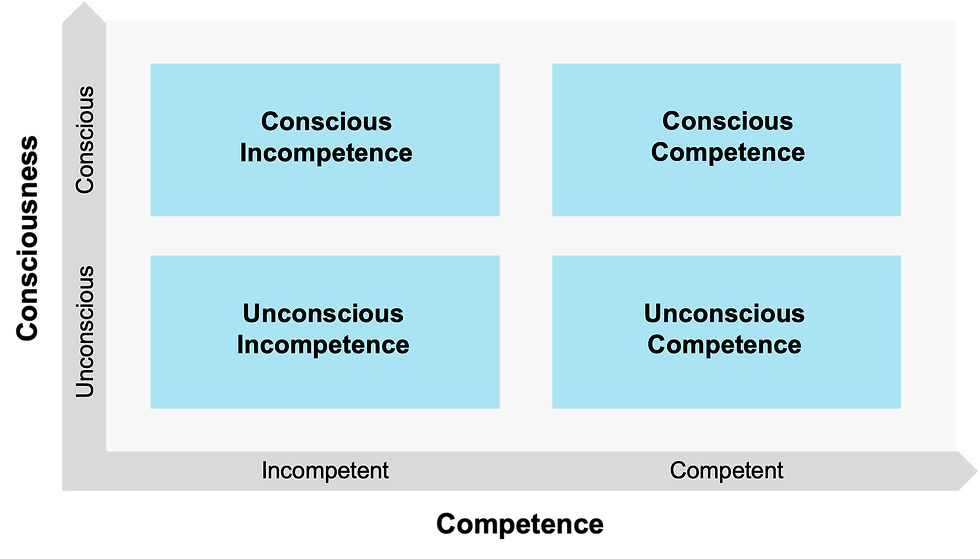
Stage 1 — Unconscious Incompetence: The individual has no knowledge of a skill and is unaware of this gap. In digital transformation contexts, this is the manager who does not realize how much data could be informing their decisions, or the customer service agent who does not know that a better digital channel exists. Confidence far exceeds ability.
Stage 2 — Conscious Incompetence: The individual discovers they need to learn new skills. This is a moment of vulnerability — people realize how much they do not know. It is also the stage most critical for change leaders to support, because this is where anxiety and resistance can crystallize.
Stage 3 — Conscious Competence: The individual has acquired the skills and knowledge needed and puts their learning into practice. Performance improves with deliberate effort.
Stage 4 — Unconscious Competence: The individual uses new skills effortlessly, without conscious effort. The new digital practice has become the natural way of working.
The practical implication for learning design: training programmes that only create Stage 2 awareness without supporting individuals through to Stage 3 and 4 do not change behaviour — they create anxiety without resolution.
Starting with Customer Empathy: The Human Tools of Transformation
If digital transformation must be human-centred, then the starting point is always empathy — a genuine, deep understanding of the human beings whose experience you are trying to improve. Two tools are indispensable for this:
The Empathy Map
An Empathy Map is a collaborative tool for synthesizing observations about a customer segment and surfacing the insights that should drive transformation decisions. It answers four questions about a customer segment:

An Empathy Map can be created based on co-creation with stakeholders or from interviews with customers. It helps define the most important question in any digital transformation initiative: What problems are we actually trying to solve?
Personas
A Persona is a representation of a customer segment — a richly described profile that captures not just demographics but goals, behaviours, fears, and decision-making patterns. Creating personas forces digital transformation teams to move from abstract categories ("our customers") to specific human beings with specific needs.

The Business Model Canvas: Innovating the Model, Not Just the Process
Digital transformation is not just about improving existing processes. In many cases — especially for clients facing competitive disruption — it requires reinventing the business model itself. The Business Model Canvas (Strategyzer) is the most widely used tool for business model design and innovation.

The four objectives of Business Model Innovation in a digital transformation context are:
To satisfy an existing but unanswered market need
To bring new technologies, products, or services to market
To improve, disrupt, or transform an existing market with a better business model
To create an entirely new market
The Business Model Canvas should be used in the Framing and Focusing phases of the digital transformation journey — helping leaders challenge their current model and design the target model that the transformation is moving toward.
Important Metrics for Tracking Digital Transformation
Transformation without measurement is aspiration without accountability. The most important metrics for tracking digital transformation span four domains:
Customer Experience Metrics - Net Promoter Score (NPS) - Customer Satisfaction Score (CSAT) - Customer Lifetime Value - Digital adoption rates by channel
Workforce Productivity Metrics - Hours saved through automation - Employee digital skills assessment scores - Team morale and engagement indices
Rate of Innovation Metrics - Number of digital experiments initiated - Time-to-test for new digital initiatives - Cloud application deployment velocity
Financial Performance Metrics - Revenue from new digital services - Operating expenses and contribution margin - Business sustainability indicators
The key is to choose metrics that are critical to your long-term transformation objectives — not the metrics that are easiest to measure. Connect initiative-level metrics to strategic scorecard metrics, and review the connection rigorously and frequently.
10 Pitfalls of Digital Transformation from the Human Factors Lens
While the hub article covers the ten general pitfalls, here they are reframed specifically through the human factors lens:
No business strategy — Without a compelling "Why," people cannot commit to the transformation. Purpose must precede process.
Not knowing what digital transformation is — When leaders do not share a clear definition, different parts of the organization pursue incompatible visions. Shared language is the foundation of shared direction.
No leadership commitment — Transformation cannot be delegated to a project team. If the senior team is not visibly, behaviourally committed, the middle and frontline will wait it out.
No stakeholder analysis — Different people have different relationships with the change. Not segmenting your stakeholders leads to one-size-fits-none communication.
No risk management — The human risks of digital transformation — resistance, skills gaps, cultural backlash, leadership fatigue — are as real as the technical risks.
No internal communication — The vacuum of official communication fills with rumour and fear. Communication must be proactive, frequent, honest, and multi-directional.
Not having the right people — This includes not just technical skills but the change leadership capabilities needed to sustain transformation across a multi-year journey.
Not investing in cultural change — Technology without culture change is the most common and most expensive mistake in digital transformation.
No collaboration with other business functions — Transformation happens in the white space between functions. Without deliberate cross-functional collaboration, the seams will tear.
No ownership of the digital transformation project — When everyone is responsible, no one is. Clear ownership — including a named senior leader with real authority and accountability — is non-negotiable.
Critical Success Factors: The Human Factors Edition
Based on OEC's practitioner experience across manufacturing, logistics, semiconductor, and public-sector transformations, the critical success digital transformation human factors are:
Figure out your business strategy first — People cannot follow a strategy that does not exist. Purpose precedes transformation.
Design customer experience from the outside in — Empathy for the customer — and for the employee — must be the starting point, not a downstream consideration.
Commit to strong, two-way communication — Commit to honesty, consistency, and listening. The 4 P's (Purpose, Process, Progress, Problems) provide the structure.
Leverage insiders and digital champions — The most credible voices for change are not consultants or executives. They are respected peers who have embraced the change and can explain its value in terms that resonate with their colleagues.
Recognize and address fear of being replaced — Do not dismiss or minimize this fear. Address it directly with specific commitments to rethinking, reskilling, and redeploying.
Develop capabilities and competencies systematically — Use the Conscious Competence model to design learning pathways that take people from Stage 1 (unaware) to Stage 4 (unconsciously competent).
Use data to make decisions — Model data-driven decision-making at the leadership level. Culture is shaped by what leaders pay attention to and reward.
Redefine roles and create new ones — Be honest about which roles will change, which will be eliminated, and which new ones will be created. Do this in advance, not in reaction.
Celebrate small successes quickly — Use quick wins to demonstrate that the transformation is real and working. Celebration is not frivolous — it is strategic momentum.
Treat digital transformation as a continuous journey — Set the expectation from the start that this is not a project with an end date. The goal is to build an organization that continuously adapts — and to help people find meaning and opportunity in that reality.
Conclusion: The Soft Side Is the Hard Side
"The role of change managers is less to push through discrete change projects, but rather to design the organization in a way that enables continuous adaptation to an ever-evolving environment."
This is the fundamental insight of human-centred digital transformation. The technology is, in many ways, the easy part. The hard part — the part that determines whether the technology ever creates value — is the human system around it: the culture, the mindset, the communication, the capability, the incentives, and the leadership.
Organizations that invest as seriously in the human architecture of transformation as they do in the technical architecture are the ones that move from Beginner to Digital Master. They are also the ones that emerge from transformation with stronger cultures, more capable people, and more resilient organizations than when they started.
Digital transformation is a human endeavour — led by people, for people, and ultimately judged by people. Lead accordingly.
Explore the Digital Transformation Cluster
This article is a spoke in OEC's Digital Transformation blog cluster:
Related articles from OEC's Design Thinking cluster:
Design Thinking Practitioner Guide — The human-centred innovation methodology that underpins digital transformation.
Customer Journey Mapping Practitioner Guide — Visualizing and redesigning the end-to-end customer experience.
About the Author

Allan Ung is the Founder and Principal Consultant of Operational Excellence Consulting, a Singapore-based firm established in 2009. With over 30 years of experience, Allan specialises in the intersection of human-centred innovation and operational discipline. While his roots are in manufacturing-intensive environments, he has pioneered a "Design-to-Delivery" approach that ensures creative solutions are both desirable for users and sustainable within complex systems.
As a Design Thinking Coach and Certified Management Consultant (CMC, Japan), Allan helps organisations move beyond ideation to tangible impact. His expertise spans Lean Thinking, Total Quality Management (TQM), and Systems Thinking, providing a pragmatic framework that allows teams to prototype, test, and scale innovations rapidly.
In senior regional and global roles at IBM, Microsoft, and Underwriters Laboratories, Allan led cross-border operational transformations that balanced technical efficiency with human-centred service design. He has facilitated Design Thinking, Lean, and Quality programmes for diverse organisations, including Ministry of Social & Family Development, Integrated Health Information Systems, ST Electronics (Satcom & Sensor Systems), Ministry of Education, Health Sciences Authority, PSA, Cisco, Micron, Vermeg, Walldorf Consulting, Tokyo Electron, Panasonic, Sika Group, Toyota Tsusho, Fugro Subsea Technologies, Lam Research, NileDutch and NEC.
Allan holds a Bachelor of Engineering from the National University of Singapore and completed advanced consultancy training in Japan as a Colombo Plan scholar. He is a Lean Six Sigma Black Belt, JIPM-certified TPM Instructor, and TWI Master Trainer.
"True innovation is found at the intersection of empathy and discipline — identifying the right human problems through Design Thinking and solving them permanently through Lean execution."
His practitioner-led toolkits are used by managers across 50+ countries to build internal capability and drive sustainable organisational improvement.
👉 Learn more at: www.oeconsulting.com.sg
Further Learning Resources
👉 Explore the full library at: www.oeconsulting.com.sg/training-presentations
© Operational Excellence Consulting. All rights reserved.