


Change Management Models and Frameworks: A Practitioner Reference Guide
Updated: May 16
By Allan Ung | Founder & Principal Consultant, Operational Excellence Consulting
Updated on 27 April 2026
Allan Ung is the Founder and Principal Consultant of Operational Excellence Consulting, a Singapore-based firm established in 2009. With over 30 years of experience leading operational excellence and quality transformation across manufacturing, technology, and global operations—including senior roles at IBM, Microsoft, and Underwriters Laboratories—Allan brings deep shopfloor expertise to every learning room he enters. A Certified Management Consultant (CMC, Japan), Lean Six Sigma Black Belt, TPM Instructor, TWI Master Trainer, and former Singapore Business Excellence National Assessor, he has facilitated Design Thinking, Lean, and Quality programmes for diverse organisations, including Ministry of Social & Family Development, Integrated Health Information Systems, ST Electronics (Satcom & Sensor Systems), Ministry of Education, Health Sciences Authority, PSA, Cisco, Micron, Vermeg, Walldorf Consulting, Tokyo Electron, Panasonic, Sika Group, Toyota Tsusho, BRC Weldmesh, Lam Research, NileDutch, and NEC.
This article is part of OEC's Change Management and Digital Transformation blog cluster. Related reading: |
"Said is not the same as heard. Heard is not the same as understood. Understood is not the same as agreed. Agreed is not the same as applied. Applied is not the same as retained." — Konrad Lorenz
Introduction: Why a Practitioner Needs More Than One Change Management Model or Framework
No single change management framework covers every situation. The discipline has evolved over seven decades — from Lewin's foundational three-stage model in the 1950s to the behavioral economics insights of Nudge Theory in the 2000s — and the accumulated body of models reflects the genuine complexity of how organizations change and how people respond when they do.
The frameworks in this reference guide are not competing alternatives. They are lenses — each illuminating a different dimension of the change challenge. A seasoned change practitioner does not ask "which framework is right?" They ask: "What does this particular change situation require, and which frameworks help me see it most clearly?"
This article is organized into five practitioner-oriented sections that follow the natural flow of change work:
Diagnosing the Situation — frameworks for understanding the organization and the nature of change before choosing a strategy
Planning the Strategy — models for designing the approach, managing forces, and making the right choices
Leading People Through Change — models for understanding human responses and mobilizing commitment
Building Team Capability — frameworks for developing the cross-functional teams that change requires
Learning, Communication, and Culture — models for communication design, capability building, and cultural intelligence
The hub article covers five foundational models in depth: the Kübler-Ross Change Curve, Bridges' Transition Model, Lewin's Three-Stage Model, Kotter's 8-Step Process, and Prosci ADKAR. This article covers the remaining fifteen-plus models from OEC's change management practice — each presented with the same three-part structure: What it is, Why we use it, When to use it.
Section 1: Diagnosing the Situation
Before choosing how to manage change, practitioners need to understand what kind of change they are dealing with and what kind of organization they are dealing with it in. These diagnostic frameworks answer those questions.
1. The Change Quadrants Model
What it is: The Change Quadrants model, based on the work of Kotter (1990), proposes that the most appropriate change strategy depends on two variables: whether the organization is warm or cold, and whether the motivation for change is warm or cold.
A cold organization is one where rules, regulations, systems, structures, and procedures drive direction and coordination. There is little intrinsic willingness to outperform — compliance is the norm.
A warm organization operates through shared norms, values, and a common understanding of direction. People are motivated by purpose, not procedure.
A cold motivation for change is an objective response to an emergency — near-bankruptcy, a drastic drop in market share, an unavoidable competitive threat. The change is externally imposed by circumstances.
A warm motivation for change is driven primarily by personal and professional ambitions — a shared desire to build something new or better, not a reaction to crisis.
The four combinations produce four change strategies:

Quadrant | Organization | Change Motivation | Strategy Description |
Intervene | Cold | Cold | Top-down design and implementation. Employees are consulted only on operational consequences of a definitive final goal. |
Transform | Warm | Cold | Efficiently using available ideas toward the final goal. Large participation, but time pressure limits co-design. |
Implement | Cold | Warm | Mobilizing the organization top-down, driven by management ambitions. Moving employees through middle managers. |
Innovate / Renew | Warm | Warm | Adopting energy and ambition to create a long-term vision together. Open to bottom-up activity. The final goal itself can evolve. |
Why we use it: Most change management programmes are designed without explicitly diagnosing the type of organization and the type of change motivation — which leads to strategy mismatches. A warm organization being managed with a cold (top-down, compliance-based) approach will generate resistance and disengagement. A cold organization being managed with a warm (co-creation, bottom-up) approach will produce confusion and inertia.
When to use it: Use the Change Quadrants as the first diagnostic step before selecting any other change framework or methodology. It is particularly valuable at the start of the Define Change Strategy step (Phase 2 of the OEC Change Management Process) when determining whether the approach should be directive, participative, or transformative. Use it in conjunction with Kotter's 8-Step Model — the quadrant diagnosis tells you which style of change to apply; Kotter tells you the sequence of steps.
Practitioner note: Many organizations believe themselves to be warmer than they really are. When in doubt, start with a colder quadrant — it is easier to open up participation once the groundwork is laid than to impose structure on a process that has been opened prematurely.
2. Lewin's Force Field Analysis
What it is: Kurt Lewin's Force Field Analysis is a diagnostic and planning tool that visualizes change as a dynamic equilibrium between two sets of forces: driving forces (positive forces that support the change) and restraining forces (resistance to the change).
The current state of the organization is maintained by the balance between these two sets of forces. To bring about change, the driving forces must be strengthened, the restraining forces must be weakened, or both.

Lewin's behavioral equation underpins the model: B = f(P, E) — behavior (B) is a function (f) of the person (P) and their environment (E). To change behaviors, you must change either the person, the environment, or both.
Why we use it: Force Field Analysis makes the invisible visible. It surfaces the specific forces that are maintaining the status quo — which are often more powerful and more numerous than leaders realize — and creates a shared picture that teams can work from. It also prevents the common mistake of simply adding more driving forces (more communication, more pressure) when the real leverage lies in removing restraining forces.
When to use it: Force Field Analysis belongs in Phase 1 (Assess Impact of Change) and Phase 2 (Define Change Strategy) of the OEC Change Management Process. It is particularly valuable as a workshop tool — having the change team and key stakeholders map forces together creates shared understanding and surfaces concerns that would not emerge from individual interviews. It is also a natural input into the stakeholder analysis and the risk management planning.
3. Leavitt's Diamond
What it is: Harold Leavitt's Diamond model proposes that organizations are complex systems in which four variables are deeply interdependent: People, Tasks, Structure, and Technology. A change to any one variable will inevitably affect all three others.

Tasks — What the organization does; the work activities and processes. Structure — How the organization is organized; authority, hierarchy, reporting lines, and communication channels. Technology — The tools, systems, and methods used to do the work. People — The individuals in the organization; their skills, motivations, attitudes, and behaviors.
Why we use it: Leavitt's Diamond prevents the single-variable thinking that causes most change failures. Technology implementations that ignore the people and process variables. Restructuring that overlooks the skills required for the new structure. Process redesigns that underestimate the system changes required to enable them. The diamond makes the interdependencies explicit and forces leaders to plan for the full impact of change before it happens.
When to use it: Use Leavitt's Diamond in Phase 1 (Assess Impact of Change) as a diagnostic frame for mapping the full scope of change impact across the organization. It is a particularly useful complement to the organizational iceberg — the iceberg shows what is visible and invisible; the diamond shows how the visible elements are connected.
4. The Burke-Litwin Model of Change
What it is: The Burke-Litwin Model (1992) is one of the most comprehensive organizational change models available. It identifies twelve interdependent factors that drive organizational performance and explains the cause-and-effect relationships between them.
The model distinguishes between transformational factors — those driven by the external environment and leadership, which produce fundamental cultural and strategic change — and transactional factors — the day-to-day management practices, systems, climate, and individual factors that produce incremental change.

The twelve drivers are:
Transformational factors (long-term levers):
1. External Environment — Key external drivers and their impact on the organization
2. Mission & Strategy — What top management sees as the purpose and direction
3. Leadership — Who provides direction, who are the role models, what style is modeled
4. Organizational Culture — The overt and covert rules, values, customs, and principles that guide behavior
Transactional factors (short-to-medium term levers):
5. Structure — Hierarchies, departments, communication channels, and decision-making relationships
6. Systems — Rules, regulations, policies, and procedures that help employees function
7. Management Practices — How managers implement strategy and relate to their teams
8. Work Unit Climate — The organizational environment; how employees feel about leadership and their work
9. Task and Individual Skills — The actions required and the expertise needed to perform them
10. Individual Needs & Values — What employees expect from their organization and what motivates them
11. Motivation — Employees' level of dedication and commitment to organizational goals
12. Individual & Organizational Performance — The output of all the above, assessed against organizational goals
Why we use it: The Burke-Litwin model is invaluable when the change initiative is complex, multi-dimensional, and involves both cultural transformation and operational change simultaneously — which describes most significant organizational change programmes. It provides a language for discussing the entire change landscape in a single framework, prevents the tendency to focus on one or two factors while ignoring the rest, and explains why change at one level is not producing results at another.
When to use it: Burke-Litwin is a strategic planning tool for change programmes of significant scope and duration. Use it in Phase 1 (Analyze Current Situation) to map the full organizational system before designing the change approach, and return to it in Phase 3 (Monitor Progress) to diagnose why the change is producing unexpected results. The twelve key diagnostic questions — "What does top management see as the organization's mission?" "What are employees' perceptions of these?" — are a structured interview framework for leadership teams embarking on a change initiative.
5. The McKinsey 7-S Framework
What it is: Developed by McKinsey consultants Tom Peters and Robert Waterman, the 7-S Framework identifies seven internal aspects of an organization that must be aligned for change to succeed. It divides the seven elements into hard elements (rational, easily identifiable) and soft elements (less tangible, culture-driven):

Element | Description | Type |
Strategy | The plan to maintain and build competitive advantage | Hard |
Structure | How the organization is structured and who reports to whom | Hard |
Systems | Daily activities and procedures staff engage in to do the work | Hard |
Shared Values | Core values evidenced in organizational culture and work ethic | Soft |
Style | The leadership style adopted | Soft |
Staff | The employees and their general capabilities | Soft |
Skills | The actual competencies of the people in the organization | Soft |
A useful companion tool is the Vectors of Contention — a profiling tool that places the organization on a spectrum for each of the seven factors (e.g., Strategy: Planned ↔ Opportunistic; Structure: Elitist ↔ Pluralist; Style: Managerial ↔ Transformational). This profiling exercise surfaces misalignments between where the organization is and where it needs to be.
The iterative approach is essential: adjust and align elements, then reanalyze how each change impacts the others. The 7-S analysis is never completed in a single pass — it is a living diagnostic.
Why we use it: The 7-S Framework is the most widely applicable diagnostic for understanding why a well-designed change initiative is not producing the expected results. In the majority of cases, the answer is misalignment between elements — typically between the hard elements (strategy, structure) and the soft elements (shared values, style, skills). Strategy changes without corresponding changes to skills and shared values are the most common source of failed transformation.
When to use it: Use the 7-S Framework in both diagnostic and planning modes. As a diagnostic: when a change programme is stalling and the reason is not obvious, map all seven elements and look for the misalignments. As a planning tool: when designing a change initiative, use the framework to ensure that all seven elements have been addressed in the change plan — not just the most visible ones.
Section 2: Planning the Change Strategy
With the situation diagnosed, these models help practitioners design the right approach and manage the forces that will determine whether the change succeeds.
6. Beer and Nohria's Theory E and Theory O
What it is: Michael Beer and Nitin Nohria identified two fundamentally different theories of organizational change that represent opposing philosophies about how change should be led:
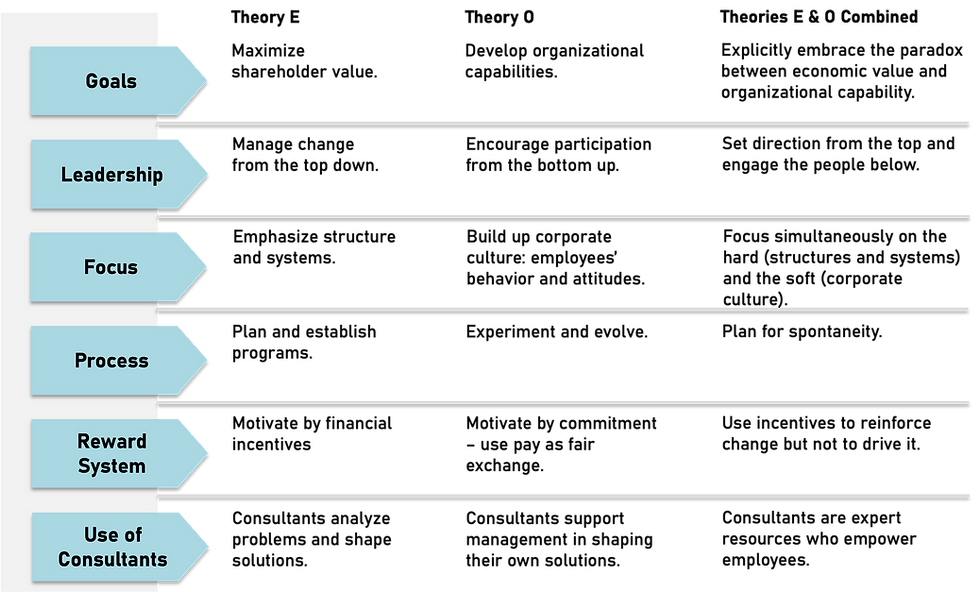
Theory E — Change driven by the goal of maximizing economic value (shareholder returns). Characterized by top-down direction, focus on structures and systems, heavy use of financial incentives, and reliance on consultants as expert solution designers. Drastic, fast, and results-oriented. The risk: destroying organizational capability and commitment in pursuit of short-term financial performance.
Theory O — Change driven by the goal of building organizational capability. Characterized by participative leadership, focus on culture and people, emergent rather than programmatic planning, and commitment as the primary motivation. Slower, richer, and more sustainable. The risk: insufficient urgency, diffused accountability, and difficulty demonstrating short-term results.
Most successful large-scale transformations combine elements of both theories — using Theory E's urgency and direction to create momentum, and Theory O's participative culture-building to sustain it.
Why we use it: Beer and Nohria's framework is essential for setting honest expectations about what a change programme is trying to achieve and how. Organizations that begin with a Theory E approach and then try to shift to Theory O mid-programme — or vice versa — consistently produce confused and demoralized workforces. The framework forces a clear choice at the design stage.
When to use it: Use at the Strategy Definition stage (Phase 2, Step 2.1) when determining the fundamental orientation of the change approach. It is particularly valuable when the change is being driven by a combination of financial pressure (E) and cultural transformation aspirations (O) — which is the most common and most challenging combination.
7. The Nudge Theory
What it is: Nudge Theory was named and popularized by Richard Thaler and Cass Sunstein in their 2008 book Nudge: Improving Decisions About Health, Wealth, and Happiness (Thaler and Sunstein won the 2017 Nobel Prize in Economics for this work). The theory proposes that the design of choices — the choice architecture — has a profound effect on the decisions people make, often more than instruction, enforcement, or incentives.
A nudge is any aspect of the choice architecture that predictably alters people's behavior in a positive way without restricting options or significantly changing their economic incentives. Nudging works by designing choices that align with how people actually think and decide — not how authorities believe they should think and decide.

The seven core aspects of effective nudges: Educational, Open-ended, Backed by evidence, Indirect, Subtle, Optional, Open to discussion.
Nudge vs. enforced change — the contrast:
Enforced Change | Nudge Techniques |
Direct, obvious | Indirect, subtle |
Legislation, rules, laws | Enablement, facilitation |
Enforcement, policing | Help, assistance |
Judgmental | Non-judgmental |
Deadlines | Open-ended |
Controlled information | Enable understanding |
Persuasion, pressure | Example, evidence, peer norms |
Simple illustration: Telling people to use the stairs (enforced). Installing attractive, well-lit stairways and slightly less convenient elevators (nudge). Both aim at the same behavior. One produces compliance; the other produces preference.
Advantages: Nudge theory gives employees real choice, strengthens the employee-organization bond, and provides an employee-centred perspective on change that most change models neglect.
Limitations: Nudge theory does not provide a complete change management methodology — it is best used as a supplement to another framework (Kotter, ADKAR, or the OEC process). It also cannot guarantee that employees will make the choices intended — changing the landscape of choice does not eliminate free will.
Why we use it: Nudge theory is particularly valuable when dealing with habitual behaviors that have been deeply embedded over a long period — changing the physical workspace layout, redesigning default digital workflows, restructuring meeting formats. Where direct instruction consistently fails to produce lasting change, nudge design often succeeds.
When to use it: Use Nudge theory in Phase 2 (Plan & Launch Program), specifically when designing the specific interventions through which new behaviors will be encouraged. It is a complement to, not a replacement for, the communication and skills development components of the change plan. It works best when the desired change direction is clear but the method of encouraging adoption needs to be indirect and low-friction.
8. The Deming Cycle: Plan-Do-Check-Act (PDCA)
What it is: The PDCA Cycle — also known as the Deming Cycle or Shewhart Cycle — is a four-step iterative method for continuous improvement and change management. It provides the structural discipline for running any improvement or change initiative in a systematic, learning-oriented way.

Plan: Identify the problem or improvement opportunity, analyze the current situation, and develop a plan for change.
Do: Implement the plan on a small scale — typically a pilot or limited trial — and collect data on results.
Check: Monitor, measure, and analyze the results against the expectations set in the planning stage. What worked? What did not? What was learned?
Act: If the pilot was successful, standardize the new approach and implement it more broadly. If not, use the learning to revise the plan and run the cycle again.
Why we use it: PDCA applies the discipline of scientific thinking to organizational change — ensuring that change decisions are based on evidence rather than assumption, and that failures become learning rather than waste. In the context of digital transformation and operational change programmes, PDCA is the mechanism through which the "fail fast, learn fast" principle is operationalized in a structured rather than chaotic way.
When to use it: PDCA is relevant throughout the OEC Change Management Process — but it is most explicitly applied in Phase 2 (Launch Pilot Projects) and Phase 3 (Monitor Progress and Measure Effectiveness). It is also the operating rhythm for Phase 4 (Evaluate Effectiveness and Iterate). For organizations that already use Lean or Six Sigma methodologies, PDCA will be a familiar framework that bridges the continuous improvement and change management disciplines naturally.
Section 3: Leading People Through Change
These models address the human dynamics of change — how people make sense of uncertainty, how leaders communicate effectively, and how momentum is built and sustained.
9. The Enrollment Curve
What it is: The Enrollment Curve (based on the Atlanta Consulting Group) describes the distribution of how people respond to change across a typical organization. Understanding this distribution is one of the most practically actionable insights available to change leaders.

Initiators (5%): Already pushing for this change before it was announced. Enroll them immediately as co-designers and champions.
Early Enrollers (15%): Open to the case with relatively little persuasion. Recruit them as the first generation of champions. Their visible commitment helps convince the Middle Enrollers.
Middle Enrollers (30%): The critical mass. They need to see credible evidence that the change is happening and working before committing. They follow when they see enough people they respect moving.
Late Enrollers (30%): Will come on board when they see that the change is real, irreversible, and manageable. They respond to demonstrated results, not arguments.
Slugs (15%): Passive resistors. They will not actively obstruct, but they will not contribute energy either. Time spent trying to convert them yields diminishing returns.
Die Hards (5%): Committed resistors. You will not persuade them in 100 days. They require management attention only when their resistance becomes active obstruction.
The counterintuitive strategic implication: Focus the majority of your communication and engagement effort on Middle and Late Enrollers — the 60% who determine whether critical mass is achieved. Let the Initiators and Early Enrollers help you promote the change; they are your most credible advocates. Do not waste energy on Slugs and Die Hards at the expense of the critical middle.
Why we use it: Most change communication is designed for the wrong audience — either preaching to the converted (Initiators and Early Enrollers who are already on board) or trying to win over the resistant (Slugs and Die Hards who are unlikely to move). The Enrollment Curve redirects effort to where leverage is highest.
When to use it: Use the Enrollment Curve in Phase 2 (Create Awareness and Get Buy-In) to segment the organization and design differentiated communication and engagement strategies for each group. Return to it in Phase 3 (Monitor Progress) to assess which segments have moved and which are stalling.
10. Sinek's Golden Circle
What it is: Simon Sinek's Golden Circle model identifies three layers of organizational communication — Why, How, and What — and proposes that the most inspiring and motivating leaders communicate from the inside out, starting with Why rather than What.

Why (Purpose): Very few organizations know why they do what they do. Why is not about making money — that is the result. Why is the purpose, cause, or belief that is the reason the organization exists.
How (Process): Some organizations know how they do what they do — their unique approach, key values, and workflow that set them apart from competitors.
What (Result): Every organization knows what they do — the products or services they sell, the outcomes they deliver.
The change management application: Most change communication leads with What (we are implementing a new ERP system) and How (here is the timeline and the training plan), neglecting Why (here is why this matters for our customers, our future, and you personally). People do not act on What. They act on Why.
Real-world examples from OEC's practice: When Toyota Tsusho's team proposed an AI literacy initiative, the breakthrough came from starting with Why — "AI will solve these specific operational pain points that are costing us time and money" — rather than leading with the training curriculum (What) or the vendor selection (How). The Golden Circle reframe secured leadership buy-in that a conventional proposal had not.
Why we use it: The Golden Circle is the single most practically accessible communication framework for change leaders. It is memorable, immediately applicable, and corrects the most common communication mistake in change management — leading with facts when people need purpose.
When to use it: Use the Golden Circle in Phase 2 (Create Awareness and Get Buy-In) as the framework for structuring the initial change communication — whether that is a CEO town hall address, a team briefing guide for managers, or the opening slide of a transformation roadshow. It is also invaluable when re-energizing a change programme that has lost momentum — returning to Why reconnects people to the purpose of the change when the operational details have become overwhelming.
Section 4: Building Team Capability
Organizational change requires effective cross-functional teams. These models help change leaders understand, diagnose, and develop the teams that transformation depends upon.
11. Tuckman's Model of Team Development
What it is: Bruce Tuckman's four-stage model of team development describes the predictable stages that all teams go through as they evolve from a group of individuals into a high-performing unit. Tuckman later added a fifth stage (Adjourning) for project-based teams, but the original four stages remain the most widely applied in organizational change contexts.

Stage 1 — Forming: Team members meet each other, learn about the task, and establish their roles. There is high dependence on the leader for guidance and direction. Relationships are polite but tentative.
Stage 2 — Storming: The inevitable friction emerges as team members learn how to work together and navigate differences in working styles, perspectives, and competing agendas. This is the most uncomfortable and most important stage — teams that suppress conflict here never achieve genuine high performance.
Stage 3 — Norming: The team begins to work together effectively. Roles evolve to help the team succeed. Team members are more likely to express opinions constructively and resolve conflicts productively.
Stage 4 — Performing: Members work hard toward shared goals, are flexible and supportive of each other, and deliver high-quality results. The leader's role becomes facilitative and delegative — the team is self-directing.
Why we use it: Change management relies heavily on cross-functional teams — change steering committees, working committees, and change agent networks — that are typically assembled specifically for the transformation programme and need to reach high performance quickly. Understanding where a team is in the Tuckman cycle allows leaders to provide the right support at the right time: directive in Forming, conflict-managing in Storming, coaching in Norming, and facilitative in Performing.
When to use it: Use Tuckman's model in Phase 2 (Set Up Change Infrastructure) when designing how the change team will be launched and developed. Plan explicitly for the Storming stage — it is inevitable and should be managed, not avoided. Teams that skip Storming through premature harmony (everyone agrees politely) never surface the real conflicts that will emerge later in the programme at a more damaging stage.
12. Lencioni's Five Dysfunctions of a Team
What it is: Patrick Lencioni's model, developed from years of observing and coaching thousands of teams, identifies five cascading dysfunctions that impede team effectiveness. The dysfunctions form a pyramid — you cannot resolve a higher-level dysfunction without first addressing the one below it.

Level 1 — Absence of Trust (Base): The foundation of all team dysfunction. Without trust — the willingness to be vulnerable with each other, to admit mistakes, and to ask for help — teams cannot have genuine debate. Trust in this model is specifically about interpersonal trust, not predictability trust.
Level 2 — Fear of Conflict: Without trust, teams fear productive ideological conflict. They engage in artificial harmony — meetings where everyone agrees politely but nothing is really decided — which leads inevitably to poor decisions and hidden resentment.
Level 3 — Lack of Commitment: Without real conflict and debate, team members cannot commit to decisions with genuine buy-in. They may sign off on plans they privately disagree with, producing the "meeting after the meeting" culture.
Level 4 — Avoidance of Accountability: Without commitment, team members are reluctant to hold each other accountable for behaviors and performance that fall short of what was agreed. Accountability requires the willingness to have uncomfortable conversations.
Level 5 — Inattention to Results (Apex): Without accountability, team members put their individual interests, departmental interests, or personal status ahead of the shared results the team exists to produce.
The change management application: The ten most common sources of team conflict that specifically impede change success — roles, goals, procedures, resources, personalities, information, structure, values/norms, communications, and turf issues — can be mapped directly onto Lencioni's pyramid. Most inter-departmental conflicts in change programmes are Level 3 or Level 4 symptoms of Level 1 or Level 2 root causes.
Why we use it: Lencioni's model is the most practically actionable team diagnostic available for change management contexts. It gives change leaders a language for naming what is actually happening in dysfunctional team dynamics — which is often far more useful than implementing another team-building exercise.
When to use it: Use Lencioni's model as both a diagnostic and a development framework for change teams. As a diagnostic: when the change steering committee or working committee is not producing the decisions and momentum needed, map the symptoms against the five dysfunctions to identify the root cause. As a development tool: use the model explicitly with the change team at the Storming stage to name the dysfunction, depersonalize it, and design a response.
13. Belbin's Team Roles Model
What it is: Dr. Meredith Belbin's research at Henley Management College identified nine team roles that together make up a high-performing team. The nine roles fall into three categories:

Action-Oriented Roles:
Shaper — Challenges the team to improve; drives, has energy and courage to overcome obstacles
Implementer — Plans practically and executes efficiently; reliable, conservative
Completer Finisher — Ensures thoroughness and quality; attention to detail, finds errors and omissions
People-Oriented Roles:
Coordinator — Focuses on team goals, delegates effectively, helps others articulate their contributions
Teamworker — Helps the team work together; diplomatic, perceptive, avoids friction
Resource Investigator — Explores outside opportunities and contacts; enthusiastic, communicative
Thought-Oriented Roles:
Plant — Presents new ideas and approaches; creative, imaginative, solves difficult problems
Monitor Evaluator — Analyses options with sober, strategic judgment; sees all angles
Specialist — Provides deep expertise in a specific area; dedicated, professional
Key insight: No individual naturally possesses all nine roles. High-performing teams need the right mix of roles — not necessarily the right mix of skills. A change team staffed entirely with Plants (creative idea generators) will produce brilliant concepts and no implementation. A team of Implementers will execute flawlessly against a flawed plan with no one to challenge it.
Why we use it: Belbin profiling surfaces team composition gaps before they become programme failures. It also provides a non-personal language for discussing team dynamics — "we need more Monitor Evaluator thinking in our planning sessions" is a more productive conversation than "Sarah is too negative."
When to use it: Use Belbin profiles when setting up the change management team (Phase 2, Step 2.2). Use the model during the Storming stage of team development to help team members understand their own natural contributions and the value of others' different approaches. Particularly valuable when building cross-functional change agent networks where the team is assembled from existing organizational roles rather than selected for change capability.
14. The Johari Window
What it is: Developed by psychologists Joseph Luft and Harrington Ingham, the Johari Window is a framework for improving self-awareness and interpersonal communication — both critical in change contexts where trust and transparency determine whether resistance is surfaced or suppressed.

Open / Arena: Information about oneself that is known both to oneself and to others. The larger this quadrant, the more open and trusted the communication climate.
Blind Spot: Information about oneself that others can see but the individual is unaware of. In change contexts, this includes leadership behaviors that are undermining the change without leaders realizing it.
Hidden / Façade: Information about oneself that is known to the individual but concealed from others. In change contexts, this includes unspoken concerns, private reservations about the change direction, and undisclosed resistance.
Unknown: Information that is not known to either the individual or others — potential, emerging skills, and behaviors not yet revealed in the current context.
The change management application: Enlarging the Open/Arena quadrant — through feedback, disclosure, and building psychological safety — is the mechanism through which trust is built in change teams and across the organization. Leaders who receive feedback about their Blind Spots and act on it visibly are among the most powerful change accelerators in any programme.
Why we use it: The Johari Window provides a model for two of the most critical change management conversations: the feedback conversation (helping people see their Blind Spots) and the disclosure conversation (creating safety for people to surface concerns from their Hidden quadrant). Both are prerequisites for the genuine alignment that the change programme requires.
When to use it: Use the Johari Window in leadership development work supporting the change programme — particularly for senior leaders whose Blind Spots are most impactful. Use it also in change team facilitation when trust-building is a prerequisite for effective decision-making, and in coaching conversations with change champions who need to build more authentic relationships across the organization.
Section 5: Learning, Communication, and Culture
Sustained change requires people to learn new things, communicate about change effectively at every level, and understand the cultural dimensions that shape how change is received.
15. The Training Needs Analysis (TNA) Framework
What it is: The Training Needs Analysis framework (Blanchard & Thacker) provides a systematic approach to identifying gaps between actual and required performance, and determining whether those gaps are best addressed through training or through other means.

The framework operates through three levels of analysis:
Organizational Analysis: What are the organization's strategic goals? Do the resources, climate, and leadership support training as a solution? Are there organizational-level factors (poor processes, misaligned incentives, inadequate tools) that are causing the performance gap that training cannot fix?
Operational Analysis: What are the tasks and behaviours required in each role for the change to be successful? What knowledge, skills, and attitudes are needed to perform these tasks? What are the performance standards?
Person Analysis: Who specifically needs training? What is their current level of performance relative to the standard? What is the cause of the gap — skills deficit, motivation deficit, or environmental barrier?
The critical output is the distinction between training needs (gaps that training can address) and non-training needs (gaps caused by process problems, unclear expectations, or misaligned incentives that training cannot fix). Sending people to training for a non-training problem is one of the most common and most expensive mistakes in organizational change.
Why we use it: TNA is the diagnostic foundation of all capability-building work in the change programme. Without it, training investment is distributed by assumption rather than evidence, and the training that is delivered addresses the symptoms rather than the causes of the performance gaps the change requires.
When to use it: Use the TNA framework in Phase 2 (Develop Skills, Step 2.5) before designing or commissioning any training. Return to it in Phase 3 (Monitor Progress) when the change programme reveals new performance gaps — some of which will require training responses and some of which will require governance, process, or incentive responses instead.
16. The ADDIE Model
What it is: ADDIE is the foundational instructional design model used to develop effective learning programmes. The five phases are:

Analyze: Define the learning needs, the target audience, the learning objectives, and the constraints (time, budget, technology).
Design: Plan the learning approach — instructional strategies, sequencing, assessment methods, and the specific objectives that each component of the programme will address.
Develop: Create the actual learning materials — facilitator guides, participant workbooks, case studies, simulations, and digital learning content.
Implement: Deliver the training. This includes logistics, facilitation quality, and the creation of a safe learning environment.
Evaluate: Assess whether the learning achieved its objectives — using Kirkpatrick's Four-Level Framework (see below).
Why we use it: ADDIE ensures that training developed for a change programme is designed to achieve specific, measurable learning outcomes rather than delivering content as an end in itself. In change contexts where training budgets are constrained and the window for learning is narrow, ADDIE's front-loaded analysis and design work produces significantly better results per hour of learning delivered.
When to use it: ADDIE applies whenever the TNA has identified a training need and the organization is commissioning new learning content — whether for digital skills, new process training, or change leadership development. It is particularly important when the scale of the change requires consistent, replicable training across multiple sites or teams.
17. Kirkpatrick's Four-Level Training Evaluation Model
What it is: Donald Kirkpatrick's model provides a framework for evaluating the effectiveness of training programmes at four progressively rigorous levels:
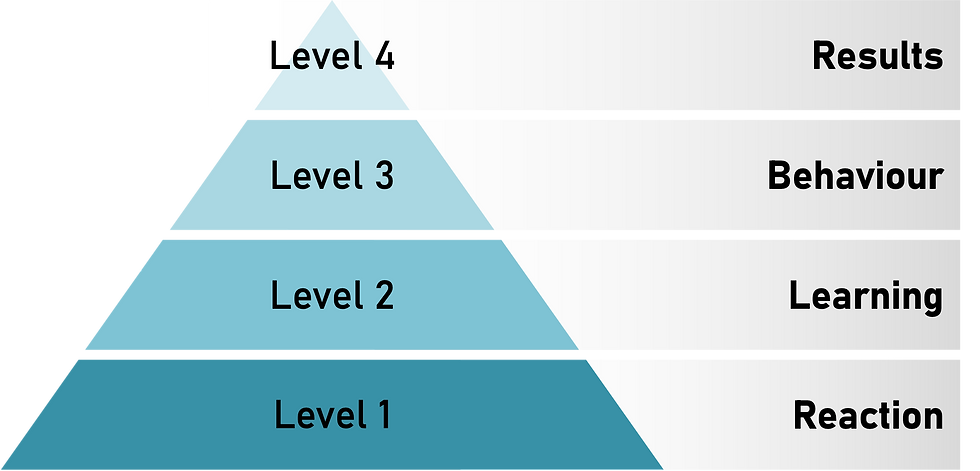
Level 1 — Reaction: Did the participants find the training valuable, relevant, and well-delivered? (Post-training surveys). This is the most commonly measured level — and the least informative about actual learning effectiveness.
Level 2 — Learning: Did participants actually acquire the intended knowledge, skills, and attitudes? (Pre/post assessments, skills demonstrations). Learning occurred if the answer is yes; reaction scores are irrelevant if Level 2 is not achieved.
Level 3 — Behaviour: Are participants applying what they learned back on the job, over time? (Manager observation, behavioral surveys 30–90 days post-training). This is where most training fails — knowledge acquired in the classroom does not automatically transfer to the workplace without practice, feedback, and reinforcement.
Level 4 — Results: Has the training produced measurable business outcomes — improved quality, reduced errors, increased adoption rates, higher customer satisfaction? This is the ultimate test, and the one most rarely measured.
Why we use it: Most organizations evaluate training only
at Level 1 (did people enjoy it?) and occasionally Level 2 (did they learn anything?). In change management contexts, the only levels that actually matter are Level 3 (are people working differently?) and Level 4 (is the change producing business results?). Kirkpatrick's model makes this hierarchy explicit and creates accountability for training that achieves behavioral change, not just satisfied participants.
When to use it: Build Kirkpatrick Level 3 and Level 4 evaluation into every training initiative from the start — not as a post-hoc assessment but as a design specification. Define what Level 3 behavior change looks like before the training is designed (so it can be designed to produce it) and what Level 4 results the training is intended to contribute to (so those metrics can be tracked over the right timeframe).
18. Osgood-Schramm's Communication Model
What it is: The Osgood-Schramm model is a cyclical communication model that describes communication as an ongoing, two-way process of encoding, sending, decoding, and interpreting messages — with both parties simultaneously acting as sender and receiver.

The key insights for change management:
Field of Experience: Each party's interpretation of a message is filtered through their accumulated knowledge, culture, experience, and perspective. The same message means different things to different recipients.
Shared Field of Experience: Communication is most effective when the sender and receiver share enough common context to interpret the message similarly. In organizational change, leaders and frontline workers often have very different fields of experience — which explains why change messages that seem clear to senior leadership are experienced as confusing or threatening by operational teams.
The feedback loop: Because the model is cyclical, the receiver's response becomes a message to the sender — providing the feedback that allows communication to be adjusted and clarified. Change programmes that use one-way communication (broadcasting) eliminate this feedback loop and lose the ability to correct misunderstandings before they become resistance.
Konrad Lorenz's insight — "Said is not the same as heard. Heard is not the same as understood. Understood is not the same as agreed. Agreed is not the same as applied. Applied is not the same as retained" — is a practical articulation of the Osgood-Schramm model's implication for change communication.
Why we use it: Osgood-Schramm grounds change communication design in the reality that communication is not a delivery problem — it is a shared-meaning problem. Messages must be designed for the receiver's field of experience, not the sender's, and feedback mechanisms must be built in from the start.
When to use it: Use the Osgood-Schramm model in Phase 2 (Develop and Communicate Plans) as a framework for designing change communication that accounts for different audience fields of experience. It is particularly valuable when designing communications that must bridge a significant organizational gap — between senior leadership and frontline workers, between head office and field operations, or between technical teams and non-technical stakeholders.
19. Hofstede's Cultural Dimensions
What it is: Geert Hofstede's research on national culture identified six dimensions along which cultures differ in ways that significantly affect organizational behavior and, critically, how people respond to organizational change:

Power Distance Index (PDI): The degree to which less powerful members of an organization expect and accept unequal distribution of power. High PDI cultures (Philippines, Malaysia, China) accept hierarchical authority naturally; low PDI cultures (Denmark, Netherlands, Australia) expect consultation and justification.
Individualism vs. Collectivism (IDV): The degree to which individuals are integrated into groups. High individualism cultures (USA, UK, Australia) prioritize personal achievement; high collectivism cultures (China, Japan, Singapore) prioritize group harmony and loyalty.
Masculinity vs. Femininity (MAS): The degree to which values are assertive/competitive (masculine) vs. modest/caring (feminine). High masculine cultures value performance and competition; high feminine cultures value quality of life and cooperation.
Uncertainty Avoidance Index (UAI): The degree to which members of a culture feel uncomfortable with uncertainty and ambiguity. High UAI cultures (Japan, Greece, Portugal) prefer structure and rules; low UAI cultures (Singapore, Jamaica, Denmark) are more comfortable with ambiguity.
Long-term vs. Short-term Orientation (LTO): Long-term oriented cultures (China, Japan, Korea) value persistence and thrift; short-term oriented cultures (USA, UK) value quick results and respect for tradition.
Indulgence vs. Restraint (IVR): The degree to which people try to control their desires and impulses. Indulgent cultures allow relatively free gratification of human drives; restrained cultures suppress them through strict social norms.
Why we use it — Singapore and Asia-Pacific context: For OEC's clients operating across Asia, Hofstede's dimensions are not abstract academic concepts — they are daily operational realities. A change programme designed for a Western headquarters that is then implemented in a Singapore, Japan, or Malaysian context without cultural adaptation will consistently produce unexpected results. Specifically:
High Power Distance in many Asian contexts means that frontline employees may agree publicly with change direction while privately holding reservations — because voicing disagreement upward is culturally uncomfortable. This makes the feedback mechanisms of Phase 3 (Monitor Progress) critically important and requires deliberate design of safe channels for upward communication.
High Collectivism means that peer influence is particularly powerful — which amplifies the value of the Initiators and Early Enrollers in the Enrollment Curve model. When respected colleagues endorse the change, adoption follows faster.
High Uncertainty Avoidance in some contexts means that the communication of change must provide more structure and more certainty than Western change models typically prescribe — ambiguity that is acceptable in a low-UAI culture can be genuinely distressing in a high-UAI one.
When to use it: Use Hofstede's dimensions in Phase 1 (Analyze Current Situation) when the change programme spans multiple national or cultural contexts, and in Phase 2 (Develop and Communicate Plans) when designing communication and engagement strategies for specific cultural audiences. It is particularly critical for multi-country programmes and for headquarters-driven changes that must be implemented across regional operations.
A Framework Selection Guide
To help practitioners select the right models for specific change situations, here is a quick-reference guide:
Situation | Most Relevant Frameworks |
Starting a major transformation — need to diagnose the organization | Change Quadrants, Burke-Litwin, McKinsey 7-S, Leavitt's Diamond |
Don't know if resistance is a skills problem or a motivation problem | ADKAR (hub article), Conscious Competence |
Need to understand the full system impact of a change | Burke-Litwin, Leavitt's Diamond, McKinsey 7-S |
Choosing between directive and participative change approach | Beer & Nohria E&O, Change Quadrants |
People understand the change but are not adopting it | Nudge Theory, Enrollment Curve, Johari Window |
Change communication is not landing effectively | Sinek's Golden Circle, Osgood-Schramm, Szpekman |
Cross-functional team is not working well | Tuckman, Lencioni, Belbin |
Running a pilot or improvement cycle within the change | PDCA |
Designing training for new capabilities | TNA, ADDIE, Kirkpatrick, Conscious Competence |
Cross-cultural change implementation | Hofstede |
Building a learning organization as part of transformation | Senge's Five Disciplines |
Sustaining and embedding change | Lewin's Refreeze (hub), Kirkpatrick Level 3/4, Enrollment Curve |
Conclusion: The Practitioner Mindset
The value of change management frameworks lies not in their theoretical elegance but in their practical utility — their ability to help practitioners see situations more clearly, make better decisions, and have more productive conversations with the people they are trying to help.
The most important thing a change practitioner can know about any framework is not how it works in theory but when to apply it, when to set it aside, and how it connects to the frameworks that complement it. No single model describes the full picture. Used together, with judgment and field experience, they provide a practitioner with the diagnostic and design toolkit that complex organizational change demands.
Explore the Change Management Cluster
Related articles from OEC's Digital Transformation cluster:
About the Author

Allan Ung is the Founder and Principal Consultant of Operational Excellence Consulting, a Singapore-based firm established in 2009. With over 30 years of experience, Allan specialises in the intersection of human-centred innovation and operational discipline. While his roots are in manufacturing-intensive environments, he has pioneered a "Design-to-Delivery" approach that ensures creative solutions are both desirable for users and sustainable within complex systems.
As a Design Thinking Coach and Certified Management Consultant (CMC, Japan), Allan helps organisations move beyond ideation to tangible impact. His expertise spans Lean Thinking, Total Quality Management (TQM), and Systems Thinking, providing a pragmatic framework that allows teams to prototype, test, and scale innovations rapidly.
In senior regional and global roles at IBM, Microsoft, and Underwriters Laboratories, Allan led cross-border operational transformations that balanced technical efficiency with human-centred service design. He has facilitated Design Thinking, Lean, and Quality programmes for diverse organisations, including Ministry of Social & Family Development, Integrated Health Information Systems, ST Electronics (Satcom & Sensor Systems), Ministry of Education, Health Sciences Authority, PSA, Cisco, Micron, Vermeg, Walldorf Consulting, Tokyo Electron, Panasonic, Sika Group, Toyota Tsusho, Fugro Subsea Technologies, Lam Research, NileDutch and NEC.
Allan holds a Bachelor of Engineering from the National University of Singapore and completed advanced consultancy training in Japan as a Colombo Plan scholar. He is a Lean Six Sigma Black Belt, JIPM-certified TPM Instructor, and TWI Master Trainer.
"True innovation is found at the intersection of empathy and discipline — identifying the right human problems through Design Thinking and solving them permanently through Lean execution."
His practitioner-led toolkits are used by managers across 50+ countries to build internal capability and drive sustainable organisational improvement.
👉 Learn more at: www.oeconsulting.com.sg
Further Learning Resources
Operational Excellence Consulting offers a full catalog of facilitation‑ready training presentations and practitioner toolkits designed to support leaders in driving innovation, aligning teams, and leading organizational transformation. These resources are developed from real workshops and executive programs, helping organizations embed strategic frameworks, strengthen leadership capability, and achieve sustainable growth.
👉 Explore the full library at: www.oeconsulting.com.sg/training-presentations
© Operational Excellence Consulting. All rights reserved.