


Training Within Industry (TWI): The Complete Practitioner Guide to Standardising Work and Developing People
By Allan Ung, Operational Excellence Consulting
Updated on 29 Mar 2026

Allan Ung is the Founder and Principal Consultant of Operational Excellence Consulting, a Singapore-based firm established in 2009. A certified TWI Master Trainer — one of a small number in Asia — he has delivered TWI programmes across manufacturing, food production, glass, optical, and education sectors in Singapore, Vietnam, the Philippines, and Cambodia. With over 30 years of experience in operational excellence including senior roles at IBM, Microsoft, and Underwriters Laboratories, he is also a Certified Management Consultant (CMC, Japan), Lean Six Sigma Black Belt, JIPM-certified TPM Instructor, and former Singapore Quality Award National Assessor. He has facilitated TWI and Lean programmes for organisations including Grundfos, Wow Education, Transitions Optical, Aprati Foods, and NSG Group Vietnam Glass Industries.
The Gap that Lean Tools Cannot Fill
I have spent more than three decades helping organisations implement Lean. In that time I have seen an enormous variety of Lean programmes — some that transformed their organisations, many that delivered initial results and then quietly plateaued, and some that produced no lasting change at all despite significant investment.
The difference between the ones that stuck and the ones that did not was rarely the quality of the Lean tools. Value Stream Mapping, 5S, Kaizen, Standard Work — these are proven methodologies with decades of demonstrated results. The difference was almost always the quality of the frontline supervision that was supposed to make those tools work every day, on every shift, with every operator.
Most organisations promote their best operators to supervisor roles and then provide them with minimal formal training on how to actually supervise. How to break down a job so it can be taught consistently. How to question a work method and improve it systematically. How to handle a people problem before it escalates into a disciplinary issue or a resignation. These are learnable skills — but only if someone teaches them.
Training Within Industry teaches them. That is precisely why it is the missing link in so many Lean programmes.
What TWI Is — And Where It Came From
Training Within Industry is a structured supervisory development programme that was developed by the United States government during World War II. When the US entered the war in 1941, it faced an urgent crisis: skilled workers were leaving manufacturing plants to join the military, and the plants had to rapidly train an entirely new workforce — many of whom had never worked in industry before — to produce the ships, aircraft, weapons, and equipment that the war effort required.
The government assembled a team of experienced industrial trainers and charged them with solving this problem. The result was TWI — a set of practical, immediately applicable training methods that could be taught quickly to supervisors and used immediately on the floor. The results were extraordinary. Plants that implemented TWI reduced training time by 25–75%, reduced scrap by 25–55%, and reduced grievances by 25–50%.
When the war ended, TWI was exported to Japan as part of the post-war industrial rebuilding effort — and it became one of the foundational inputs into what eventually became the Toyota Production System. The structured training discipline of Job Instruction, the systematic questioning of work methods in Job Methods, and the people-centred approach of Job Relations are all visible threads in how Toyota built its manufacturing culture. TWI did not just contribute to Lean — it is part of Lean's DNA.
I delivered my first TWI Job Instruction workshop in Vietnam in 2011. Fifteen years later, having facilitated TWI programmes across Singapore, Vietnam, the Philippines, Cambodia, and beyond — for manufacturers, food producers, glass makers, optical lens companies, and even an education organisation — my conviction about TWI's importance has only deepened. It is not a historical curiosity. It is as relevant and as powerful today as it was when it was first designed.
The Three Core TWI Programmes
TWI consists of three core programmes — Job Instruction, Job Methods, and Job Relations — each addressing a distinct dimension of frontline supervisory capability. A fourth programme, Job Safety, addresses workplace safety as an integral part of supervisory responsibility. Each programme uses the same elegant delivery structure: a pocket-sized reference card containing the method in four steps, designed to fit in a supervisor's shirt pocket and be used daily on the floor.

Job Instruction (JI) — How to Train
Job Instruction answers the most fundamental question in any manufacturing or service organisation: how do we ensure that every person performs every task correctly, safely, and consistently?
The answer that most organisations use — "show them once and see how they get on" — produces inconsistent results, because different people absorb and retain information differently, and because the person doing the showing rarely thinks consciously about how to break the job down in a way that makes it learnable. The result is variation: different operators doing the same job differently, quality defects that trace back to training gaps, and supervisors who are perpetually putting out fires caused by people not doing things the right way.
JI addresses this through the Job Breakdown Sheet — a structured document that separates a job into its important steps, identifies the key points within each step (the things that could injure the worker, damage the product, or affect quality), and captures the reasons behind each key point. This analysis is itself a discipline: it requires the supervisor to think carefully about what they actually know about the job and why each element matters.
The four-step JI method then provides the teaching sequence: prepare the worker, present the operation, try out the performance, and follow up. Executed properly, this method produces operators who can perform a job correctly on their first independent attempt — not after a week of trial and error.

At Vietnam Glass Industries (NSG Group) — one of the world's leading glass manufacturers — I facilitated the first TWI Job Instruction programme in 2011, training two batches of new supervisors and team leaders at the Ho Chi Minh City facility.
The results were significant enough that Plant Director Hiroyuki Nakamura subsequently reflected: "After your lecture, we appointed some of them to Leaders. They worked well and organised other workers well. And this area's performance — not only productivity but also safety — is better than I expected."
Four years later, in 2015, NSG returned for a second engagement — this time to develop its in-house trainers in TWI coaching skills, with the explicit goal of making TWI a company-wide practice rather than an externally delivered programme.
HR Executive Tu Thi Minh Chau captured the learning shift: "The course helps me recognise the good and not-so-good points in my supervision. It also gives me hints to improve."
The progression from external delivery to internal capability is the hallmark of a TWI implementation done properly.

Job Methods (JM) — How to Improve
Job Methods teaches supervisors how to question every element of a current work method systematically and develop practical improvements. The four-step JM method — break down the job, question every detail, develop the new method, apply the new method — provides a structured process for the kind of incremental improvement that Kaizen depends on.
The questioning technique at the heart of JM is deliberately provocative: why is this detail necessary? Why is it done this way? Why is it done at this place, at this time, by this person? These are not comfortable questions — they challenge the accumulated assumptions of years of practice. But they are precisely the questions that surface waste and generate improvement ideas.
JM is the TWI programme that most directly enables Kaizen. A supervisor trained in Job Methods has a structured language and method for improvement that they can apply to any work process — which is why organisations that combine TWI with a Kaizen programme consistently see faster and more sustainable improvement than those that use Kaizen tools alone.
At Transitions Optical Philippines — a global manufacturer of plastic photochromic lenses — managers and supervisors completed a two-day TWI workshop covering all three core programmes.
HR Manager John Frederic M. Ramos reflected: "This (TWI training) is very useful. I believe our company needs this to attain its goals and objectives." The practical approach enabled participants to enhance their implementation of Standard Work to improve productivity, quality, and safety.
Job Relations (JR) — How to Lead
Job Relations addresses the people dimension of frontline supervision — the dimension that is most often underdeveloped and most often responsible for the breakdown of improvement initiatives.
Every supervisor faces people problems: performance issues, conflicts between team members, resistance to change, safety violations, absenteeism. The untrained supervisor's typical response is either avoidance or confrontation — neither of which resolves the underlying issue. JR provides a four-step method for handling people problems fairly and effectively: get the facts, weigh and decide, take action, and check results.
The JR philosophy rests on four foundations that define how a supervisor should relate to their team: let each worker know how they are doing, give credit when due, tell people in advance about changes that will affect them, and make the best use of each person's ability. These are not soft principles — they are structural disciplines that, when practised consistently, build the trust and engagement that make teams perform.
Koh Jie Hui from Grundfos Singapore's EHS function captured an insight from the JR programme that connected it directly to the analytical tools covered in the other articles in this cluster: "I can apply JR during employee interviews in the event of incidents. It helps me understand how the incident happened and link it to root cause analysis."
TWI Across Industries — What Fifteen Years of Delivery Has Shown
One of the aspects of TWI that I find most consistently impressive is its cross-industry applicability. The three programmes were designed for manufacturing — and they perform brilliantly there. But the supervisory capability they build is universal. The need to train people consistently, improve work methods systematically, and handle people problems effectively exists in every organisation where people work together toward a shared goal.

At Wow Education International in 2013 — an arts education organisation serving children aged two to twelve across Asia — the Job Instruction programme was used to strengthen instructional design and delivery capability among senior management, trainers, and instructors. The application of a manufacturing training discipline to an arts education context might seem incongruous, but the underlying need is identical: ensuring that every instructor teaches with consistency and quality.
Principal Nancy Peh of WowArt Learning reflected: "Able to understand why JI is important. Know what needs to be done, why and how to do it."
Marketing Manager Pauline Soh added: "Effective actual practices and exercises are very beneficial to the team."
At Aprati Foods (Cambodia) in 2017 — a newly established confectionery manufacturer producing for local and South-East Asian markets — senior executives and key personnel were trained in all three TWI programmes as a foundation for the company's goals around safe products, a safe work environment, and consistently happy consumer experiences.
Workplace Safety Department member Muth Maraneth reflected: "I can understand TWI more clearly and know how to apply at the workplace."
The breadth of this reach — from glass manufacturing in Vietnam to arts education in Singapore to confectionery production in Cambodia — reflects something fundamental about TWI. The skills it builds are not industry-specific. They are supervisory fundamentals that apply wherever people are trained, wherever work methods can be improved, and wherever people problems need to be resolved fairly.

At Grundfos Singapore in August 2025 — one of the world's leading pump manufacturers, with a mature Lean programme already in place — I delivered a two-day TWI workshop covering all three core programmes for supervisors and line leaders. The Grundfos engagement illustrates a pattern I see frequently in mature Lean organisations: they have strong Lean tools and methodologies, but the frontline supervisory capability that should be making those tools work consistently every day has not been formally developed. TWI fills that gap directly. Participants from the Grundfos workshop captured the breadth of application across all three modules — from M. Lengkes Monogaram in Maintenance ("I learned the importance of having visual aids and verbal instructions working hand in hand. Especially in maintenance, having hands-on practice makes a big difference") to T. Nagarajan in Production ("Very useful to improve productivity") to Koh Jie Hui in EHS ("It helps me understand how the incident happened and link it to root cause analysis").
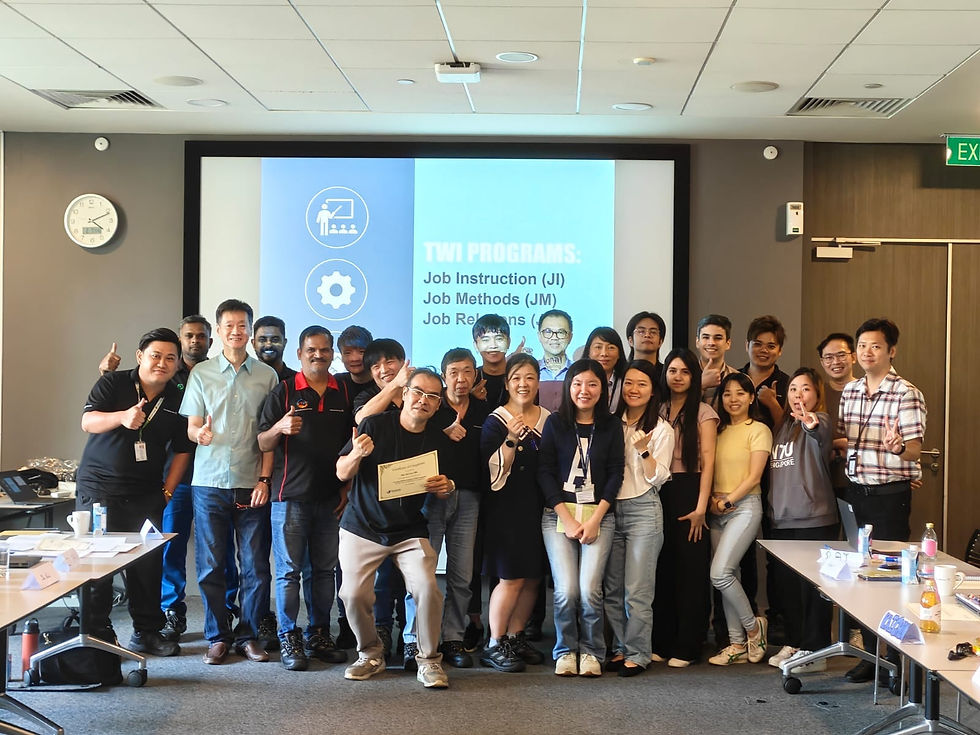
The range of functions represented in the Grundfos group — maintenance, production, EHS — reflects the programme's design intention. TWI is not a specialist programme for a particular function. It is a universal supervisory toolkit.
Why TWI is the Missing Link — Specifically
The phrase "missing link" in the article's title is deliberate. TWI is missing from most Lean programmes not because people are unaware of it but because it does not fit neatly into the usual Lean implementation sequence. It is not a process improvement tool. It is not a waste elimination technique. It does not produce a Value Stream Map or a 5S audit score.
What it produces is supervisors who can train consistently, improve work methods systematically, and handle people problems effectively. And without those capabilities, every other Lean tool underperforms. (See: The Five Needs Model for Good Supervisors: The Foundation Every TWI Programme Is Built On)
5S depends on supervisors who can train their teams on the 5S standards and sustain discipline consistently across shifts. Standard Work depends on supervisors who can break down jobs properly and teach them reliably. Kaizen depends on supervisors who can question work methods constructively and develop practical improvements. TPM's Autonomous Maintenance depends on supervisors who can train operators to inspect and maintain their equipment to a consistent standard.
TWI is the capability that makes all of these work. That is not a metaphor. It is a structural dependency.
Kelzang Dawa, a supervisor in the Community Services sector in Australia who found OEC while researching TWI online, captured it well: "I have faced a lot of pain while training and supervising staff and hence landed on your site while trying to research and learn TWI and Kaizen. I think your firm has the best material and resources integrated to propel any organisation."
Build TWI Capability in Your Organisation
At Operational Excellence Consulting, I deliver customised TWI programmes — Job Instruction, Job Methods, Job Relations, and Job Safety — for manufacturing, operations, and service organisations across Singapore and the Asia-Pacific region. As a certified TWI Master Trainer, I work with organisations to implement TWI not as a standalone training event but as an integrated component of their Lean management system.
👉 Explore our practitioner-led TWI resources:
👉 Contact us directly or visit www.oeconsulting.com.sg.
About the Author

Allan Ung is an internationally recognized author, thought leader, and master practitioner in the field of Operational Excellence, with a career spanning more than thirty years at the absolute forefront of organizational transformation and quality management. As the Founder and Principal Consultant of Operational Excellence Consulting, a premier management training and consulting firm established in Singapore in 2009, he has dedicated his professional life to helping organizations bridge the critical gap between complex academic frameworks and practical, shopfloor execution. His unique advisory philosophy emphasizes the creation of "fit-for-purpose" management systems that democratize continuous improvement, intentionally stripping away unnecessary statistical complexity and "math anxiety" to empower frontline workers with accessible, high-impact problem-solving tools.
Prior to establishing his successful consultancy practice, Allan held senior regional leadership and advisory roles within some of the world's most prominent multinational corporations and regulatory bodies, including IBM, Microsoft, and Underwriters Laboratories. His deep expertise in managing large-scale quality transformations was further forged during his foundational tenure at Singapore's National Productivity Board, which has since evolved into Enterprise Singapore, where he actively pioneered national quality process initiatives and coached enterprises across multiple sectors on productivity enhancement. His extensive cross-border experience includes completing advanced consultancy training in Japan as a prestigious Colombo Plan scholar, an experience that allowed him to study the roots of lean thinking directly from Japanese master practitioners and adapt those methodologies for global deployment.
Allan’s comprehensive professional credentials reflect a deep commitment to mastery across multiple operational disciplines. He is a Certified Management Consultant accredited in Japan, a Lean Six Sigma Black Belt, a JIPM-certified Total Productive Maintenance Instructor, and a Training Within Industry Master Trainer. Demonstrating his deep standing within the national quality ecosystem, he has also served as a Singapore Business Excellence Award National Assessor, evaluating leading organizations against world-class business excellence frameworks. He holds a Bachelor of Engineering in Mechanical Engineering from the National University of Singapore, a world-class academic foundation that complements his highly practical, results-driven consulting approach. Through his development of proprietary methodologies like the OEC Green Lean Matrix™, OEC TPM Maturity Diagnostic, and the 4-Lens of Critical Thinking Model, Allan continues to stand out as a pioneering voice in management consulting, helping global enterprises transform their daily operational realities into sustainable competitive advantages.
His philosophy: "Manufacturing excellence is achieved through disciplined systems, capable leadership, and sustained execution on the shopfloor."
His practitioner-led toolkits have been utilized by managers and organizations across Asia, Europe, and North America to build Design Thinking and Lean capability and drive organizational improvement.
👉 Learn more at: www.oeconsulting.com.sg
Further Learning Resources
This article forms part of the hub of OEC's Lean Thinking content cluster. Each spoke article explores one dimension of Lean in depth:
Hub article
Kaizen
Standard Work
Total Productive Maintenance
Five Needs Model for Good Supervisors
Operational Excellence Consulting offers a full catalog of facilitation‑ready training presentations and practitioner toolkits covering Lean, Design Thinking, and Operational Excellence. These resources are developed from real workshops and transformation projects, helping leaders and teams embed proven frameworks, strengthen capability, and achieve sustainable improvement.
👉 Explore the full library at: www.oeconsulting.com.sg

Complete TWI Framework Toolkit 
TWI Core Programs Toolkit 
TWI Job Instruction 
TWI Job Methods 
TWI Job Relations 
TWI Job Safety