


From Blank Paper to Breakthrough: How 16 Sika Leaders Learned to Think in A3
Updated: Apr 30
By Allan Ung | Founder & Principal Consultant, Operational Excellence Consulting

Allan Ung is a Certified Lean Six Sigma Black Belt, Certified Management Consultant (CMC, Japan), and Singapore Business Excellence Award national examiner with over 30 years of consulting experience, including senior roles at IBM and Microsoft, and operational excellence work with Underwriters Laboratories (UL) across Asia-Pacific. He is the founder of Operational Excellence Consulting (OEC), Singapore.
There is something quietly powerful about watching a group of managers stare at a blank A3 sheet — and then, three hours later, stand up and present a structured problem-solving story that their own organisation can act on.
That is exactly what happened on 31 March 2026 at Oasia Hotel Downtown Singapore, when 16 management trainees from Sika Asia Pacific gathered for a half-day A3 Thinking workshop I had the privilege of facilitating.

Why A3 Thinking? Why Now?
Sika is no ordinary chemicals company. Operating across construction, industrial, and infrastructure markets globally, it has built its reputation on innovation, customer focus, and protecting the built environment. But innovation does not happen by accident — it is the product of people who know how to identify a problem clearly, understand it deeply, and act on root causes rather than symptoms.
That is precisely where A3 Thinking comes in.
Developed within the Toyota Production System, the A3 report — named after the international paper size it was originally written on — is not a form to fill. It is a way of thinking: disciplined, evidence-based, and deeply rooted in the Plan-Do-Check-Act (PDCA) cycle. When embedded into a team's daily management rhythm, it becomes one of the most effective tools for building a culture of continuous improvement.
For Sika's management trainees — the next generation of leaders shaping operations across the Asia Pacific region — equipping them with this capability early is a strategic investment that compounds over time.

Inside the Workshop: What the Morning Looked Like
The session ran from 08:30 to 11:30, tight enough to feel purposeful, spacious enough to allow real thinking.
We began with the big picture: an introduction to the four A3 report types — Problem Solving, Proposal, Project Status Review, and Hoshin Planning — and how each maps to a different moment in the PDCA cycle. Many participants arrived thinking A3 was simply a template. Within the first twenty minutes, the frame had shifted: it is a thinking discipline that happens to live on one sheet of paper.
The morning's centrepiece was a structured walkthrough of the eight steps of A3 Problem Solving:
Theme — Define the issue or focus area
Background — Explain why the problem matters
Current Condition & Problem Statement — Present facts and define the gap
Goal Statement — Clarify what success looks like
Root Cause Analysis (5 Whys, fishbone) — Identify underlying causes, not symptoms
Countermeasures and Implementation Plan — Propose target solutions and action plan
Check / Confirmation of Effect — Evaluate if results met expectations
Follow-up Actions and Standardisation — Standardise, share learning, and sustain gains

These are not bureaucratic boxes. Each step is a question that demands honest, data-grounded answers. What is actually happening? How do we know? What is driving this — really?
After the introduction, teams of four began Team Activity Part 1 — working from 09:30 to 10:10 on defining their problem and mapping the current state. This is where the A3 discipline first becomes tangible: teams had to articulate what is actually happening, supported by facts and data, before any analysis or solution-seeking could begin. Getting this step right is harder than it sounds. Vague problem statements produce vague A3s, and I moved from table to table coaching teams on sharpening their problem definition before the break.
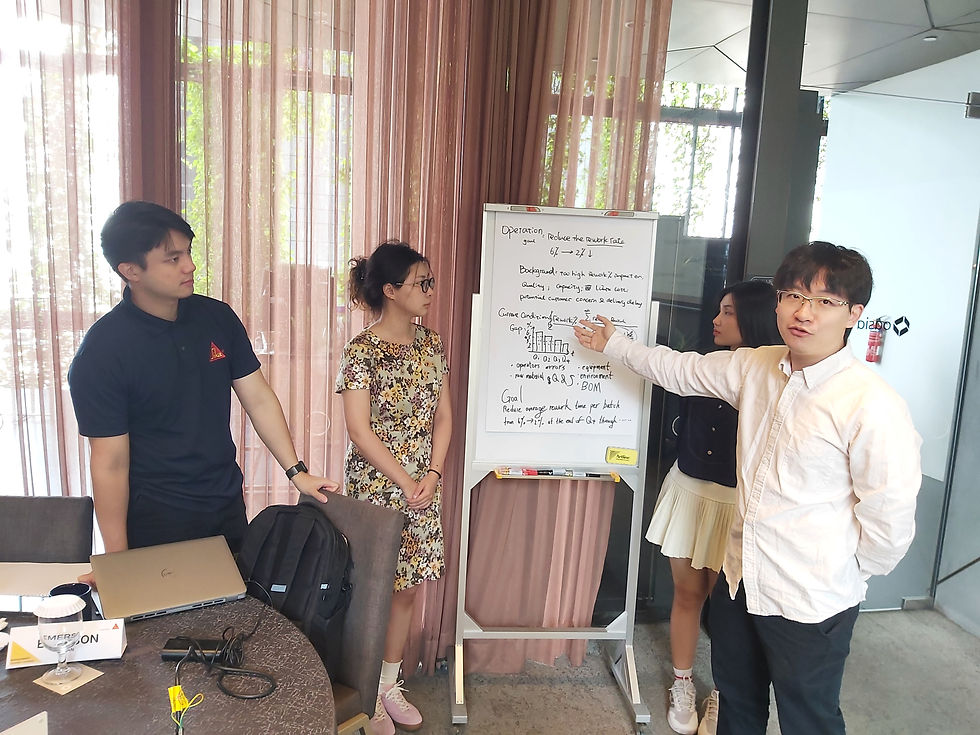
After the coffee break, Team Activity Part 2 shifted the focus from 10:25 to 11:00 to root cause analysis and countermeasure design. With their problem and current state now clearly defined, teams applied 5 Whys and cause-and-effect logic to drill past symptoms to the underlying drivers — then developed countermeasures directly traceable to those root causes. This sequencing is intentional: the break creates a natural pause between diagnosis and prescription, reinforcing the A3 principle that you must fully understand a problem before reaching for familiar solutions.

The session closed with team presentations from 11:00 to 11:20 and structured feedback, grounded in four questions: Is the problem clear? Is the evidence sound? Does the root cause logic hold? Are the countermeasures actionable?
In Their Own Words
The participant reflections from the day captured what three hours of structured A3 practice produced across a group spanning Singapore, Malaysia, Philippines, Thailand, Vietnam, China, India, and Japan.
"It helps build a thinking framework. Try to use this model to solve real problems." — Mark Meng, Key Project Management, China
"Benefitted from learning the problem identifying and solving tools. Able to try implementing fishbone and/or 5 Whys method for actual cases." — Osuke Kiyota, Business Development Engineer, India
"Very structured and well delivered. I will implement the structured thinking in my daily work." — Emerson Hsieh, Procurement, Japan
"It could help me to narrow down the actual issues and pinpoint the main issue. From there, I perhaps could come out with a solution to solve the main issue and hence, solve the overall issue." — Nana Suphapon A/P Udom, Distribution Sales, Malaysia
"I think it's a great training on a thinking method that could break down problems into smaller pieces and find the main cause. Highly recommend this." — Zhiya Zhang, R&D Data Scientist, China BFM
Three Things That Made the Difference
Reflecting on the morning, three dynamics stood out that elevated this session beyond a typical training event:
1. Real problems, not case studies. When participants bring live challenges from their own work, the A3 format stops being an exercise and starts being useful. The energy in the room shifts.
2. Coaching over lecturing. The bulk of the morning was spent in facilitated practice, not passive instruction. A3 Thinking is a craft — it must be practiced, not just explained.
3. Presentation as accountability. Requiring teams to stand and present their A3 outputs created a standard. It made the thinking visible and held it up for scrutiny — which is, after all, what A3 is designed to do.
What Sika's Leaders Are Taking Back
By the end of the workshop, each participant left with more than a completed A3 template. They left with:
A shared language for problem solving that transcends function and hierarchy
A practical framework they can apply to the next challenge they face on Monday morning
An understanding of how A3 connects to PDCA and how it can anchor daily management routines
Confidence to facilitate the thinking process, not just participate in it
A Note on Sika's Commitment to Learning
It says a great deal about an organisation when it invests in structured problem-solving capability for its management trainees — not when things have gone wrong, but as a proactive foundation for leadership.
As Eugene Vincent Ybas Aunzo, Regional Learning and Development Manager at Sika Asia Pacific, reflected: “Surely, the participants had good learning on the topic you led.” His observation underscores the value of structured A3 Thinking in leadership development and highlights how the workshop translated into meaningful learning for the trainees.
Sika's decision to embed A3 Thinking at this early stage of their leaders' careers reflects a genuine commitment to operational discipline and continuous improvement culture.
That investment will pay dividends far beyond this one morning.

The Bigger Picture: Why A3 Thinking Belongs in Every Leader's Toolkit
In over three decades of working with manufacturers, engineers, and operational teams across Asia and globally, one pattern holds true: organisations that struggle with performance rarely lack technical knowledge. What they lack is a common problem-solving language and the discipline to slow down, look clearly, and act on causes rather than symptoms.
A3 Thinking provides exactly that. It is not complicated. It does not require expensive software. It requires only rigour, humility, and the willingness to let the facts lead the way.
If you are leading a team, running a department, or building the next generation of managers in your organisation — this is a capability worth building.
👉 A3 Thinking is far more than a reporting format. If you would like a deeper understanding of the four A3 report types and how each connects to the PDCA cycle, read The power of A3 frameworks: a structured approach to thinking, problem solving, and strategic alignment. |
About the Author

Allan Ung is the Founder and Principal Consultant of Operational Excellence Consulting, a Singapore-based management training and consulting firm established in 2009. With over 30 years of experience leading operational excellence and quality transformation in manufacturing-intensive environments, Allan's expertise spans Lean Thinking, Total Quality Management (TQM), TPM, TWI, ISO systems, and structured problem solving.
He is a Certified Management Consultant (CMC, Japan), Lean Six Sigma Black Belt, TPM Instructor (Japan Institute of Plant Maintenance), TWI Master Trainer, ISO 9001 Lead Auditor, and former Singapore Quality Award National Assessor.
During his tenure with Singapore's National Productivity Board (now Enterprise Singapore), Allan pioneered Cost of Quality and Total Quality Process initiatives that enabled companies in the electrical and fabricated metals industries to reduce quality costs by up to 50 percent. In senior regional and global roles at IBM, Microsoft, and Underwriters Laboratories, he led Lean deployment, quality system strengthening, and cross-border operational transformation.
Allan has facilitated programmes for organisations including Ministry of Education, Tokyo Electron, Panasonic, Micron, Lam Research, NileDutch, Toyota Tsusho, and NEC. He holds a Bachelor of Engineering (Mechanical Engineering) from the National University of Singapore and completed advanced consultancy training in Japan as a Colombo Plan scholar.
His philosophy: "Manufacturing excellence is achieved through disciplined systems, capable leadership, and sustained execution on the shopfloor."
His practitioner-led toolkits are used by managers and organisations across Asia, Europe, and North America to build quality capability and drive sustained operational improvement.
👉 Learn more at: www.oeconsulting.com.sg
Further Learning Resources
If you’d like to find out more about A3 Thinking, explore our A3 Thinking Training Courses and our full catalog of facilitation-ready training presentations and practitioner toolkits at Operational Excellence Consulting. These practitioner‑led resources are designed to help leaders and teams apply A3 concepts in real workshops, strengthen problem‑solving capability, and deliver sustainable customer value.
Training Courses:
Related Practitioner Guides in This Series:
Training Presentations and Toolkits:
👉 Explore the full library at: www.oeconsulting.com.sg