


A3 Hoshin Planning: The Strategy Tool That Bridges Execution Gaps
- Dec 29, 2023
- 4 min read
Updated: 7 days ago
By Allan Ung, Operational Excellence Consulting

Allan Ung is the Founder and Principal Consultant of Operational Excellence Consulting, a Singapore-based firm established in 2009. With over 30 years of experience leading operational excellence and quality transformation across manufacturing, technology, and global operations—including senior roles at IBM, Microsoft, and Underwriters Laboratories—Allan brings deep shopfloor expertise to every learning room he enters. A Certified Management Consultant (CMC, Japan), Lean Six Sigma Black Belt, TPM Instructor, TWI Master Trainer, and former Singapore Quality Award National Assessor, he has facilitated structured problem-solving, Quality and Lean programmes for organisations including the Ministry of Education, Tokyo Electron, Panasonic, Micron, Lam Research, Infineon Technologies, Toyota Tsusho, NileDutch, Sika Group, and NEC.
Introduction
In the ever-evolving landscape of strategic management, organizations are continually seeking effective tools to translate their visions into tangible results. A3 Hoshin Planning emerges as a dynamic approach, blending simplicity, clarity, and strategic alignment to propel organizations toward excellence.
What is A3 Hoshin Planning?
A3 Hoshin Planning is a strategic deployment framework that empowers organizations to navigate from their Current State to a Desired State. Unlike traditional planning approaches, A3 Hoshin focuses on prioritizing crucial aspects, allowing leaders to concentrate on what truly matters without being overwhelmed by unnecessary details. This transformative process serves as a clear path for organizations to streamline efforts, foster continuous improvement, and achieve strategic objectives.
What Makes A3 Hoshin Planning Unique?
A3 Hoshin Planning stands out for its simplicity, making strategic planning accessible to all organizational levels. It ensures crystal-clear alignment with the organization's "True North," fostering unity in purpose and emphasizing execution over theoretical concepts.
Why A3 Hoshin Planning?
The methodology serves as a blueprint for organizational success, offering a structured approach to address critical business needs, develop people, and consistently achieve pivotal results. Its adaptability and focus on execution distinguish it as a preferred choice for strategy deployment.
Objectives of A3 Hoshin Planning
1. Define clear organizational goals and objectives.
2. Foster collaboration and unity across all levels.
3. Bridge the gap between planning and tangible results.
4. Provide a structured approach for continuous improvement.
Principles of A3 Hoshin Planning
A3 Hoshin Planning is guided by key principles:
1. True North: Establish a clear organizational direction.
2. PDCA Cycle: Embrace continuous improvement.
3. Catchball: Foster dynamic collaboration.
4. Focus on Critical Few: Concentrate on crucial goals.
5. Alignment: Ensure all activities align with True North.
6. Execution Emphasis: Bridge planning and results.
7. Integrated PDCA Cycles: Foster continuous learning.
8. A3 Thinking: Frame problems and plans visually for clarity and effective decision-making.
True North and A3

A3 Hoshin Planning finds its roots in the concept of True North—an organization's guiding principles. The A3 tool acts as a practical canvas to translate True North into actionable plans, ensuring a shared understanding of strategic objectives.
A3 Hoshin Planning and the PDCA Cycle
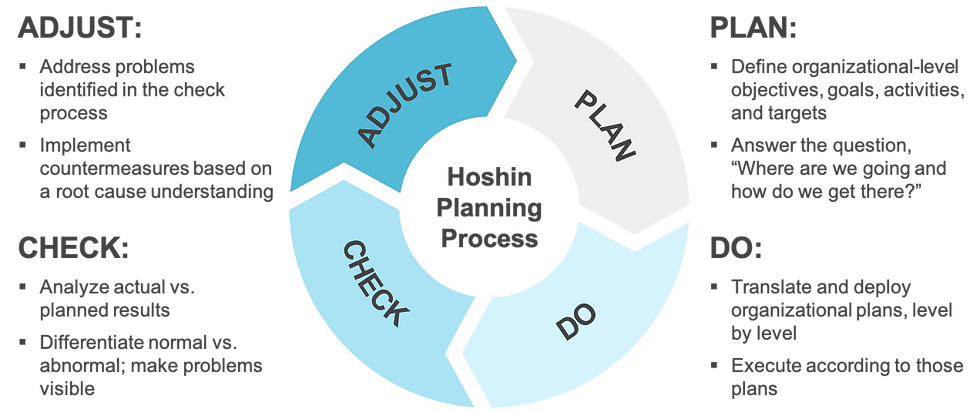
The methodology seamlessly integrates with the Plan, Do, Check, and Adjust (PDCA) cycle. It provides a systematic and iterative approach, allowing organizations to plan strategically, execute efficiently, monitor progress, and adjust strategies based on real-time feedback.
A3 Hoshin Formulation and Deployment

A3 Hoshin Planning involves the formulation of key elements like organizational objectives, critical goals, and action plans. Deployment ensures that these strategies cascade through all levels, fostering a collaborative approach to achieve organizational goals.
The 8 Steps to Creating an A3 for Hoshin Deployment
To effectively deploy your strategy using A3 Hoshin Planning, follow these 8 steps:
1. Clearly define the main objective for the year.
2. Identify Key Performance Indicators (KPIs) illustrating the objective.
3. Reflect on the successes and failures of the previous year.
4. Establish critical few goals for the current year.
5. Provide a rationale supporting the critical few goals.
6. Develop an action plan outlining specific steps to achieve the objective.
7. Keep concerns in sight and monitor their impact on the plan.
8. Implement a monitoring system to track the progress of the plan.

Key Factors for A3 Hoshin Planning Success
1. Clear and concise communication.
2. Collaborative decision-making through "Catchball."
3. Continuous improvement through PDCA cycles.
4. True North alignment for shared purpose.
5. Emphasis on execution over theoretical concepts.
Conclusion
A3 Hoshin Planning emerges not just as a strategic tool but as a cultural shift towards organizational excellence. By embracing its principles and following the 8-step process, organizations can chart a course towards their True North, fostering unity, clarity, and execution excellence.
About the Author

Allan Ung is the Founder and Principal Consultant of Operational Excellence Consulting, a Singapore-based management training and consulting firm established in 2009. With over 30 years of experience leading operational excellence and quality transformation in manufacturing-intensive environments, Allan's expertise spans Lean Thinking, Total Quality Management (TQM), TPM, TWI, ISO systems, and structured problem solving.
He is a Certified Management Consultant (CMC, Japan), Lean Six Sigma Black Belt, TPM Instructor (Japan Institute of Plant Maintenance), TWI Master Trainer, ISO 9001 Lead Auditor, and former Singapore Quality Award National Assessor.
During his tenure with Singapore's National Productivity Board (now Enterprise Singapore),
Allan pioneered Cost of Quality and Total Quality Process initiatives that enabled companies in the electrical and fabricated metals industries to reduce quality costs by up to 50 percent. In senior regional and global roles at IBM, Microsoft, and Underwriters Laboratories, he led Lean deployment, quality system strengthening, and cross-border operational transformation.
Allan has facilitated A3, Lean and Quality programmes for organisations including Tokyo Electron, Panasonic, Micron, Lam Research, Sika, Toyota Tsusho, NileDutch, and NEC. He holds a Bachelor of Engineering (Mechanical Engineering) from the National University of Singapore and completed advanced consultancy training in Japan as a Colombo Plan scholar.
His philosophy: "Manufacturing excellence is achieved through disciplined systems, capable leadership, and sustained execution on the shopfloor."
His practitioner-led toolkits have been utilized by managers and organizations across Asia, Europe, and North America to build Design Thinking and Lean capability and drive organizational improvement.
👉 Learn more at: www.oeconsulting.com.sg
Further Learning Resources
Operational Excellence Consulting offers a full catalog of facilitation‑ready training presentations and practitioner toolkits designed to support leaders in driving innovation, aligning teams, and leading organizational transformation. These resources are developed from real workshops and executive programs, helping organizations embed strategic frameworks, strengthen leadership capability, and achieve sustainable growth.
👉 Explore the full library at: www.oeconsulting.com.sg


